Quick support from trusted insurance professionals Call +1 713-777-2886 today! |
Call +1 713-777-2886
Call +1 713-777-2886
Quick support from insurance professionals Call +1 713-777-2886 today! |


Table of Content
Title

Let AZ Insurance Help You
Find Affordable Coverage
Connect with our experienced team today & get reliable, affordable insurance designed around your needs.
Contact Us!

Let A-Z Auto Insurance Help You Find Affordable Coverage
Connect with our experienced team today & get reliable, affordable insurance designed around your needs.
Contact Us!
What Can Actually Cancel or Void Your General Liability Policy in Texas
What Can Actually Cancel or Void Your General Liability Policy in Texas
What Can Actually Cancel or Void Your General Liability Policy in Texas
What Can Actually Cancel or Void Your General Liability Policy in Texas
What Can Actually Cancel or Void Your General Liability Policy in Texas

Reviewed by AZ Insurance Agency, licensed in Texas, serving Houston since 2003.
A drywall contractor in Pasadena calls on a Tuesday. A general contractor has just pulled him off a job because the certificate came back showing no active policy. He is certain there has been a mistake. He has been insured for six years, he has never had a claim, and nobody from the insurance company has spoken to him.
Nobody had to. The notice went out eighteen days earlier to the address on the application, which is the address of the office he moved out of in March.
Short answer: In Texas a general liability policy is far harder to cancel than most business owners think, but only after the first 60 days. Inside those first 60 days a brand new policy can be cancelled for any reason at all. After that, or on any renewal, the Texas Department of Insurance lists only five permitted reasons. The catch is that if your policy sits with a surplus lines carrier, those protections do not apply to you at all, and a great many Houston contractors are on surplus lines without knowing it.
Key Takeaways
The first 60 days are open season. On a brand new policy inside its first period, an insurer can cancel for any reason.
At day 61, or on any renewal, the list closes to five reasons, and three of the five have nothing to do with you.
Nonpayment buys you 10 days of notice, not 30. That clock usually runs from the mailing date, not the day it lands in your hands.
Nonrenewal is a different animal from cancellation and carries a 60 day notice instead.
Surplus lines carriers are exempt. The Texas Department of Insurance states plainly that Texas cancellation and nonrenewal notice laws do not apply to them.
"Voided" and "denied" are not the same event. Most business owners who say their policy was voided actually had a claim denied by an exclusion, and the fix for each is completely different.
Since January 1 2026 your insurer has to tell you why, automatically, without you asking.
Cancelled, nonrenewed, voided or denied. Four different problems
Almost every panicked phone call we take on this subject uses the word "voided," and in most of them the policy was never voided. Getting the vocabulary right matters, because each of these four has a different cause, a different timeline and a different route back.
Cancellation ends a policy in the middle of its term. The policy was valid, it was in force, and now it stops on a future date.
Nonrenewal lets the policy run to its natural end and declines to write the next one. Nothing is taken away from you. You simply do not get offered another year.
Rescission, which is what people usually mean by "voided," unwinds the policy as though it never existed and returns your premium. This is rare, and Texas makes it deliberately hard.
Claim denial leaves your policy fully intact and refuses one specific claim, normally because an exclusion applies. Your coverage is fine. This particular loss simply was not the kind of loss the policy covers. If you want the clearest example of that distinction, read what we wrote on whether general liability covers your own faulty workmanship, where the repair is excluded and the resulting damage usually is not.
Three quarters of the calls are the fourth one. If yours is, nothing in the cancellation rules below will help you, and the answer lives in your exclusions and endorsements instead.
What happened | Policy still in force | What it turns on | Usual notice |
|---|---|---|---|
Cancellation | No, ends on a future date | One of five permitted reasons | 10 days |
Nonrenewal | Yes, until the term ends | Carrier appetite, loss history, class | 60 days |
Rescission | No, treated as never issued | Intent to deceive on the application | None, premium returned |
Claim denial | Yes, fully | A policy exclusion | Not applicable |
The first 60 days, when they can walk away for any reason
The Texas Department of Insurance is direct about this. If your policy has been active for 60 days or less, your insurance company can cancel your policy for any reason.
That window exists because underwriting is not finished when the policy is issued. The carrier writes the policy on what you told them, then sends an inspector, pulls loss runs, checks the class code against what you actually do, and occasionally discovers that the janitorial account is doing exterior window work at four storeys. In that window they can simply leave.
This is the single most common cancellation we see, and it almost always lands on a business that was placed in a class it does not really belong in. If your operations changed between the quote and the policy, say so in the first week rather than the eighth. Our guidance on what general liability costs in Houston walks through how class codes drive the number in the first place, and the same mechanism is visible in what we wrote for cleaning companies in Houston, where adding one service line moves the whole account.
After day 61, the list closes
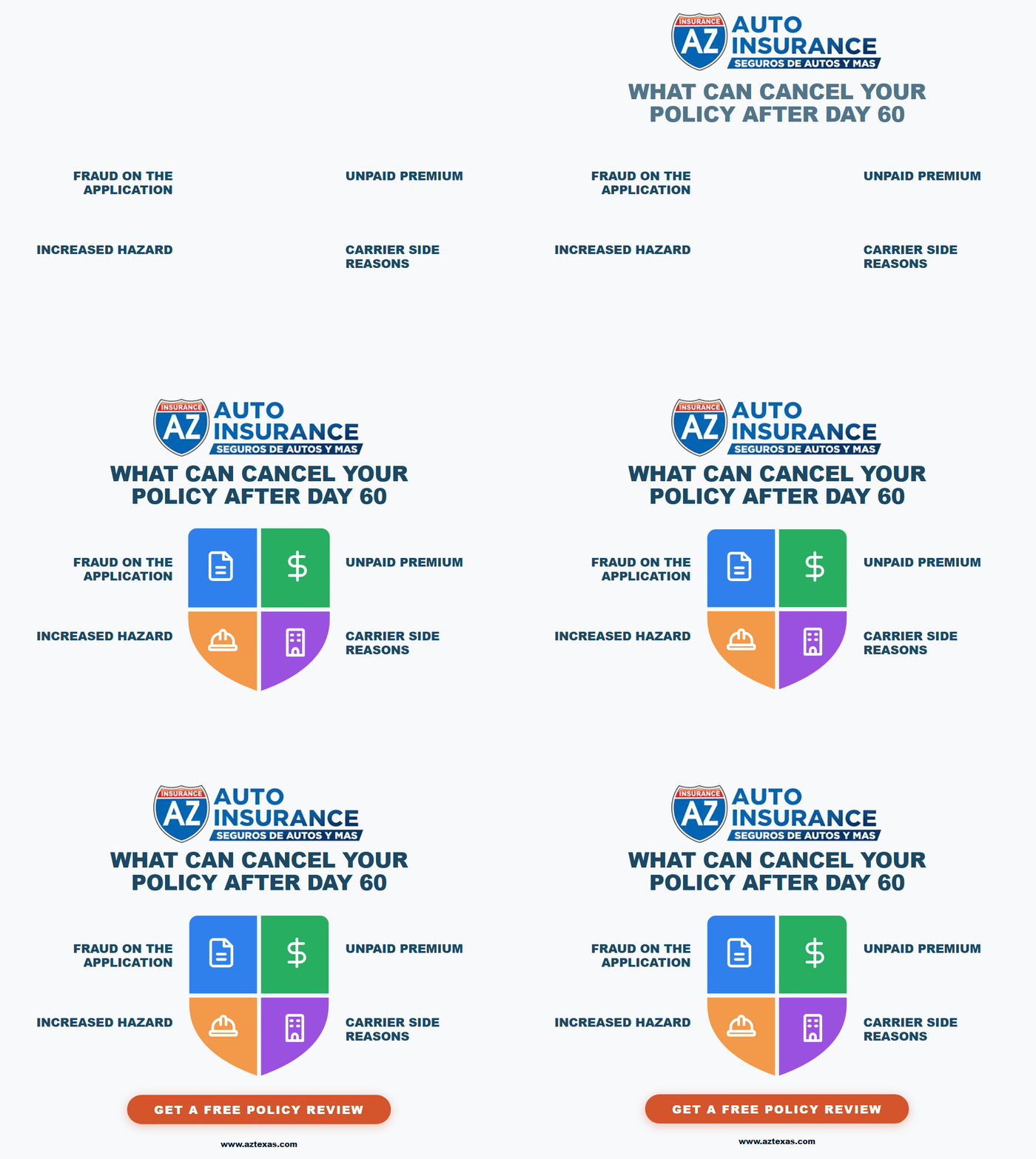
Once a liability policy has been renewed or continued, or once it is 61 days from when the policy started in its first policy period, the Texas Department of Insurance says the insurer can no longer cancel at will. Five reasons remain:
You purposefully gave them wrong information to get coverage. Note the word purposefully. An honest mistake on an application is a different thing, and Texas courts have treated it that way for decades.
You did not pay your premiums on time.
A hazard within your control increases their risk and would raise your premium. Buying a boom lift, adding roofing to a remodelling operation, or taking on work at height all sit here.
The insurer lost its reinsurance.
The insurer is in financial trouble and has been placed in supervision, conservatorship or receivership.
Read that list again and notice what it means. Reasons four and five have nothing to do with your business at all. Reason three is about what you did, not about whether you had a claim. And a claim is not on the list. A single large loss, or even several, is not a permitted reason to cancel a Texas general liability policy mid term. It is an extremely common reason to be nonrenewed, which is the next section, and that difference is exactly why the vocabulary matters.
The notice periods, and the clock you do not control
Action | Notice required | Runs from |
|---|---|---|
Cancellation | At least 10 days before the cancellation date | The date it was sent |
Nonrenewal | At least 60 days before the policy ends | The date it was sent |
Nonrenewal, condominium association | 30 days, to the association and each unit owner | The date it was sent |
Ten days is short, and it is shorter than it sounds because the clock generally starts when the notice is mailed rather than when you read it. A notice sent to a stale mailing address is still a notice. The drywall contractor at the top of this article lost a job over exactly that.
There is one piece of good news buried in the nonrenewal rule. If the company misses its 60 day deadline, the policy stays active for 61 days after the notice is finally sent. You still owe premium for those days, but the coverage does not simply stop because the carrier was slow.
The single cheapest thing you can do about all of this is confirm the mailing address, the email address and the agent of record on your policy today, before anything goes wrong. It takes one phone call and it is the reason a meaningful share of these cases never had to happen.
Get a free general liability review or call (281) 833-6755. Hablamos Español.
The surplus lines exception, and why it probably applies to you
Here is the part almost nobody is told at binding.
Everything above comes from Texas statute and applies to admitted carriers, the companies licensed by the state. On its own commercial general liability page the Texas Department of Insurance states that Texas laws regarding notice of cancellation and nonrenewal do not apply to surplus lines insurers. It adds a second warning in the same breath: if a surplus lines insurer becomes insolvent, policyholders do not have the protection of the Texas guaranty association either.
Surplus lines is not a fringe market and it is not a downgrade. It is where Texas businesses go when the admitted market will not write them, and for Houston that covers an enormous amount of ordinary work: roofing, demolition, tree service, scaffolding, anything at height, anything involving hot work, staffing, certain habitational property, and most contractors carrying a heavy loss history. A landscaping outfit that added tree removal can find itself there without a conversation, which is one of the gaps we mapped in landscaping insurance in Houston.
One nuance worth knowing if you carry a packaged policy: a business owners policy bundles liability and property into one contract, so a cancellation does not take away one coverage and leave the other standing. It takes both at once, along with any business interruption sitting inside it.
On a surplus lines policy the cancellation terms are whatever the policy itself says. Some carriers give 30 days. Some give 10. It is also common for a surplus lines insurer to keep a significant share of the premium if you cancel mid term, because the policy carries a minimum earned premium provision, often 25 percent and sometimes more.
How to tell which one you are on: look at the declarations page for the words "surplus lines," for a Texas surplus lines stamping fee or surplus lines tax as a separate line item, or for a notice in capital letters stating that the insurer is not licensed in Texas and is not protected by the guaranty association. If you cannot find your declarations page, your agent can tell you in under a minute. A certificate of insurance will not tell you, and neither will the certificate holder or additional insured wording a general contractor asks you for.
What it actually takes to void a policy in Texas
Rescission is the nuclear option, and Texas sets the bar high. The long standing Texas common law rule, from Mayes v. Massachusetts Mutual Life Insurance Company, requires an insurer to plead and prove that the insured intended to deceive the insurer, not merely that an application answer turned out to be wrong.
The Texas Supreme Court reaffirmed that rule in American National Insurance Company v. Arce in 2023, holding that Texas Insurance Code section 705.051 did not displace the common law intent requirement. One honest caveat, because it matters: Arce was a life insurance case, and the holding is written for life, accident and health applications. Commentators expect it to influence how courts read misrepresentation elsewhere in the Insurance Code, but it is not a general liability holding and nobody should treat it as settled for a CGL policy.
What that means in practice for a Houston business is still useful. An insurer that discovers your payroll was understated, or that you do 40 percent new construction rather than the 10 percent on the application, has real options. It can cancel prospectively under reason one. It can audit and bill you. What it cannot casually do is erase the policy retroactively over an honest error. If you are facing a rescission letter, that is a conversation with a Texas coverage attorney, not with a blog.
Since January 1 2026, they have to tell you why
This one is new enough that most business owners have not noticed it yet.
House Bill 2067, passed by the 89th Texas Legislature in 2025 and effective January 1 2026, amends Chapter 551 of the Insurance Code. Before it, an insurer had to give you the reason for a declination, cancellation or nonrenewal only if you asked. Now the written explanation has to be sent automatically. It applies to applications made and policies delivered, issued or renewed on or after January 1 2026, and workers compensation policies are excepted.
It also requires insurers to report those reasons to the Texas Department of Insurance on a quarterly basis, with the department publishing the data aggregated by ZIP code. The department has said it expects insurers to write out real descriptions in the consumer notice rather than lean on internal reason codes.
If you received a cancellation or nonrenewal notice this year with no reason on it, that is worth a phone call.
The four things that actually end coverage for Houston businesses
Statute aside, here is what we genuinely see end policies across our Houston and Dallas offices, in order.
Nonpayment, by a distance. Usually a card on file that expired, a change of bookkeeper, or a notice sent to an old address. It is the most preventable item on this list and the most common.
A premium audit that goes unanswered. The carrier estimates payroll or receipts at the worst end of the range, bills the difference, the bill does not get paid, and the file exits as a nonpayment. Answer the audit. The same audit usually touches your workers compensation figures, so one unanswered request can put two policies at risk rather than one.
Operations that drifted away from the class code. The remodeller who started doing roofs. The cleaner who started doing post construction cleanup. The sole proprietor who hired a first crew and never mentioned it.
Nonrenewal after losses, which is not cancellation, arrives with 60 days of warning, and is the one where an independent agency earns its keep because the answer is a different carrier rather than an argument.
Three of those four are administrative. None of them is about being a bad risk.
What to do if a notice arrives
Find the date it was sent, not the date you opened it. That is what the clock runs on.
Read which of the four it is: cancellation, nonrenewal, rescission or a claim denial. The letter will use one of those words.
If it is nonpayment, call the same day. Reinstatement is frequently possible inside the notice window and becomes much harder after the cancellation date passes.
Do not let it lapse while you shop. A lapse in coverage is its own problem: it raises your next premium, it can breach your contracts, and any claim arising during the gap belongs to you. If a general contractor is waiting on paper, we cover the mechanics of getting one fast in our piece on same day certificates of insurance.
Check whether your contracts require notice of cancellation to a third party. Many construction contracts do, and the obligation is usually yours, not the carrier's.
Bring the declarations page to an independent agent, not just the notice. The notice tells you what is happening. The declarations page tells you what you had.
Why this sits differently for a business than for a household
A homeowner whose policy cancels has a bad month. A contractor whose policy cancels can lose a job the same week, because the general contractor's compliance software flags the certificate before anyone reads the mail. That is the real cost, and it is why whether general liability is required in Texas is the wrong question. The state does not require it. Your contracts do, and they enforce it far faster than any regulator would.
The same logic applies to the coverages that sit alongside it: a commercial umbrella that lapses breaches the same clause, and if you are a non subscriber for workers compensation the exposure of a gap is larger still. Your commercial auto sits under the same contractual notice clauses and cancels on its own schedule, so confirming one policy tells you nothing about the other. If you use 1099 contractors, their lapse becomes your problem too, because their work usually ends up inside your policy's payroll audit.
And none of this touches the separate question of what the policy pays while it is perfectly in force. A policy that is active can still decline a loss, which is the distinction we drew at the top and worked through in detail in does general liability cover customer property damage.
Frequently asked questions
Q: Can my insurance company cancel my general liability policy because I filed a claim?
Not mid term. Once the policy is past 61 days in its first period or has been renewed, the Texas Department of Insurance lists only five permitted reasons for cancellation and a claim is not one of them. A claim is a very common reason to be nonrenewed at the end of the term, which requires 60 days of written notice. This protection does not apply to surplus lines policies.
Q: How much notice do I get before a cancellation for nonpayment?
At least 10 days before the cancellation date. The clock generally runs from when the notice was sent rather than when you received it, which is why the mailing address on your policy matters more than most owners realise.
Q: What is the difference between cancellation and nonrenewal?
Cancellation ends the policy in the middle of its term and requires one of five specific reasons after day 60. Nonrenewal lets the policy finish its term and declines the next one, requires 60 days of notice, and can be based on much broader grounds including loss history or a carrier leaving a class of business.
Q: How do I know if I have a surplus lines policy?
Check your declarations page for a surplus lines tax or stamping fee as a separate line, or for a notice stating the insurer is not licensed in Texas and is not covered by the guaranty association. It matters, because Texas notice of cancellation and nonrenewal laws do not apply to surplus lines insurers and because a minimum earned premium provision may mean you cannot recover much premium if you cancel early. Call us at (281) 833-6755 and we will read it for you.
Q: Can an insurer void my policy because I made a mistake on the application?
Not easily. Texas common law requires an insurer to plead and prove that the insured intended to deceive, not merely that an answer was inaccurate. An insurer may still have the right to cancel going forward or to audit and bill the correct premium. A rescission letter is a reason to speak with a Texas coverage attorney.
Q: My policy was cancelled and I never received the letter. Does that help me?
Sometimes, but less than you would hope. Notice requirements are generally satisfied by sending to the address in the policy. That is why updating your mailing address, your email and your agent of record is the cheapest protection available to you.
Q: Does a cancellation on my record make it harder to get insured again?
Yes, particularly a cancellation for nonpayment or for misrepresentation, both of which are asked about on most applications. It usually narrows your market rather than closing it, and it is one of the situations where an independent agency comparing multiple insurance companies is worth considerably more than a single carrier's quote.
Q: What happens to my certificates of insurance if the policy cancels?
They become inaccurate immediately. A certificate reflects the policy as of its issue date and confers no rights. Most construction contracts also obligate you to notify the certificate holder, and that duty typically sits with you rather than with the carrier.
Related Articles
Why AZ Insurance Stands Apart
Most agencies hand a contractor a certificate and file the policy away until renewal. We read the declarations page, because that is where the surplus lines notice lives, that is where the minimum earned premium sits, and that is where the mailing address that decides whether you ever see a cancellation notice is printed. Since 2003 we have been independent in Houston, which means when a carrier nonrenews you we go shopping rather than go quiet.
If a notice has arrived, or if you simply do not know which market your policy sits in, bring us the declarations page. Request a free general liability review or call our business line at (281) 833-6755, and we will tell you exactly what protections you have and which ones you do not.
Reviewed by AZ Insurance Agency, licensed in Texas, serving Houston since 2003.
A drywall contractor in Pasadena calls on a Tuesday. A general contractor has just pulled him off a job because the certificate came back showing no active policy. He is certain there has been a mistake. He has been insured for six years, he has never had a claim, and nobody from the insurance company has spoken to him.
Nobody had to. The notice went out eighteen days earlier to the address on the application, which is the address of the office he moved out of in March.
Short answer: In Texas a general liability policy is far harder to cancel than most business owners think, but only after the first 60 days. Inside those first 60 days a brand new policy can be cancelled for any reason at all. After that, or on any renewal, the Texas Department of Insurance lists only five permitted reasons. The catch is that if your policy sits with a surplus lines carrier, those protections do not apply to you at all, and a great many Houston contractors are on surplus lines without knowing it.
Key Takeaways
The first 60 days are open season. On a brand new policy inside its first period, an insurer can cancel for any reason.
At day 61, or on any renewal, the list closes to five reasons, and three of the five have nothing to do with you.
Nonpayment buys you 10 days of notice, not 30. That clock usually runs from the mailing date, not the day it lands in your hands.
Nonrenewal is a different animal from cancellation and carries a 60 day notice instead.
Surplus lines carriers are exempt. The Texas Department of Insurance states plainly that Texas cancellation and nonrenewal notice laws do not apply to them.
"Voided" and "denied" are not the same event. Most business owners who say their policy was voided actually had a claim denied by an exclusion, and the fix for each is completely different.
Since January 1 2026 your insurer has to tell you why, automatically, without you asking.
Cancelled, nonrenewed, voided or denied. Four different problems
Almost every panicked phone call we take on this subject uses the word "voided," and in most of them the policy was never voided. Getting the vocabulary right matters, because each of these four has a different cause, a different timeline and a different route back.
Cancellation ends a policy in the middle of its term. The policy was valid, it was in force, and now it stops on a future date.
Nonrenewal lets the policy run to its natural end and declines to write the next one. Nothing is taken away from you. You simply do not get offered another year.
Rescission, which is what people usually mean by "voided," unwinds the policy as though it never existed and returns your premium. This is rare, and Texas makes it deliberately hard.
Claim denial leaves your policy fully intact and refuses one specific claim, normally because an exclusion applies. Your coverage is fine. This particular loss simply was not the kind of loss the policy covers. If you want the clearest example of that distinction, read what we wrote on whether general liability covers your own faulty workmanship, where the repair is excluded and the resulting damage usually is not.
Three quarters of the calls are the fourth one. If yours is, nothing in the cancellation rules below will help you, and the answer lives in your exclusions and endorsements instead.
What happened | Policy still in force | What it turns on | Usual notice |
|---|---|---|---|
Cancellation | No, ends on a future date | One of five permitted reasons | 10 days |
Nonrenewal | Yes, until the term ends | Carrier appetite, loss history, class | 60 days |
Rescission | No, treated as never issued | Intent to deceive on the application | None, premium returned |
Claim denial | Yes, fully | A policy exclusion | Not applicable |
The first 60 days, when they can walk away for any reason
The Texas Department of Insurance is direct about this. If your policy has been active for 60 days or less, your insurance company can cancel your policy for any reason.
That window exists because underwriting is not finished when the policy is issued. The carrier writes the policy on what you told them, then sends an inspector, pulls loss runs, checks the class code against what you actually do, and occasionally discovers that the janitorial account is doing exterior window work at four storeys. In that window they can simply leave.
This is the single most common cancellation we see, and it almost always lands on a business that was placed in a class it does not really belong in. If your operations changed between the quote and the policy, say so in the first week rather than the eighth. Our guidance on what general liability costs in Houston walks through how class codes drive the number in the first place, and the same mechanism is visible in what we wrote for cleaning companies in Houston, where adding one service line moves the whole account.
After day 61, the list closes
Once a liability policy has been renewed or continued, or once it is 61 days from when the policy started in its first policy period, the Texas Department of Insurance says the insurer can no longer cancel at will. Five reasons remain:
You purposefully gave them wrong information to get coverage. Note the word purposefully. An honest mistake on an application is a different thing, and Texas courts have treated it that way for decades.
You did not pay your premiums on time.
A hazard within your control increases their risk and would raise your premium. Buying a boom lift, adding roofing to a remodelling operation, or taking on work at height all sit here.
The insurer lost its reinsurance.
The insurer is in financial trouble and has been placed in supervision, conservatorship or receivership.
Read that list again and notice what it means. Reasons four and five have nothing to do with your business at all. Reason three is about what you did, not about whether you had a claim. And a claim is not on the list. A single large loss, or even several, is not a permitted reason to cancel a Texas general liability policy mid term. It is an extremely common reason to be nonrenewed, which is the next section, and that difference is exactly why the vocabulary matters.
The notice periods, and the clock you do not control
Action | Notice required | Runs from |
|---|---|---|
Cancellation | At least 10 days before the cancellation date | The date it was sent |
Nonrenewal | At least 60 days before the policy ends | The date it was sent |
Nonrenewal, condominium association | 30 days, to the association and each unit owner | The date it was sent |
Ten days is short, and it is shorter than it sounds because the clock generally starts when the notice is mailed rather than when you read it. A notice sent to a stale mailing address is still a notice. The drywall contractor at the top of this article lost a job over exactly that.
There is one piece of good news buried in the nonrenewal rule. If the company misses its 60 day deadline, the policy stays active for 61 days after the notice is finally sent. You still owe premium for those days, but the coverage does not simply stop because the carrier was slow.
The single cheapest thing you can do about all of this is confirm the mailing address, the email address and the agent of record on your policy today, before anything goes wrong. It takes one phone call and it is the reason a meaningful share of these cases never had to happen.
Get a free general liability review or call (281) 833-6755. Hablamos Español.
The surplus lines exception, and why it probably applies to you
Here is the part almost nobody is told at binding.
Everything above comes from Texas statute and applies to admitted carriers, the companies licensed by the state. On its own commercial general liability page the Texas Department of Insurance states that Texas laws regarding notice of cancellation and nonrenewal do not apply to surplus lines insurers. It adds a second warning in the same breath: if a surplus lines insurer becomes insolvent, policyholders do not have the protection of the Texas guaranty association either.
Surplus lines is not a fringe market and it is not a downgrade. It is where Texas businesses go when the admitted market will not write them, and for Houston that covers an enormous amount of ordinary work: roofing, demolition, tree service, scaffolding, anything at height, anything involving hot work, staffing, certain habitational property, and most contractors carrying a heavy loss history. A landscaping outfit that added tree removal can find itself there without a conversation, which is one of the gaps we mapped in landscaping insurance in Houston.
One nuance worth knowing if you carry a packaged policy: a business owners policy bundles liability and property into one contract, so a cancellation does not take away one coverage and leave the other standing. It takes both at once, along with any business interruption sitting inside it.
On a surplus lines policy the cancellation terms are whatever the policy itself says. Some carriers give 30 days. Some give 10. It is also common for a surplus lines insurer to keep a significant share of the premium if you cancel mid term, because the policy carries a minimum earned premium provision, often 25 percent and sometimes more.
How to tell which one you are on: look at the declarations page for the words "surplus lines," for a Texas surplus lines stamping fee or surplus lines tax as a separate line item, or for a notice in capital letters stating that the insurer is not licensed in Texas and is not protected by the guaranty association. If you cannot find your declarations page, your agent can tell you in under a minute. A certificate of insurance will not tell you, and neither will the certificate holder or additional insured wording a general contractor asks you for.
What it actually takes to void a policy in Texas
Rescission is the nuclear option, and Texas sets the bar high. The long standing Texas common law rule, from Mayes v. Massachusetts Mutual Life Insurance Company, requires an insurer to plead and prove that the insured intended to deceive the insurer, not merely that an application answer turned out to be wrong.
The Texas Supreme Court reaffirmed that rule in American National Insurance Company v. Arce in 2023, holding that Texas Insurance Code section 705.051 did not displace the common law intent requirement. One honest caveat, because it matters: Arce was a life insurance case, and the holding is written for life, accident and health applications. Commentators expect it to influence how courts read misrepresentation elsewhere in the Insurance Code, but it is not a general liability holding and nobody should treat it as settled for a CGL policy.
What that means in practice for a Houston business is still useful. An insurer that discovers your payroll was understated, or that you do 40 percent new construction rather than the 10 percent on the application, has real options. It can cancel prospectively under reason one. It can audit and bill you. What it cannot casually do is erase the policy retroactively over an honest error. If you are facing a rescission letter, that is a conversation with a Texas coverage attorney, not with a blog.
Since January 1 2026, they have to tell you why
This one is new enough that most business owners have not noticed it yet.
House Bill 2067, passed by the 89th Texas Legislature in 2025 and effective January 1 2026, amends Chapter 551 of the Insurance Code. Before it, an insurer had to give you the reason for a declination, cancellation or nonrenewal only if you asked. Now the written explanation has to be sent automatically. It applies to applications made and policies delivered, issued or renewed on or after January 1 2026, and workers compensation policies are excepted.
It also requires insurers to report those reasons to the Texas Department of Insurance on a quarterly basis, with the department publishing the data aggregated by ZIP code. The department has said it expects insurers to write out real descriptions in the consumer notice rather than lean on internal reason codes.
If you received a cancellation or nonrenewal notice this year with no reason on it, that is worth a phone call.
The four things that actually end coverage for Houston businesses
Statute aside, here is what we genuinely see end policies across our Houston and Dallas offices, in order.
Nonpayment, by a distance. Usually a card on file that expired, a change of bookkeeper, or a notice sent to an old address. It is the most preventable item on this list and the most common.
A premium audit that goes unanswered. The carrier estimates payroll or receipts at the worst end of the range, bills the difference, the bill does not get paid, and the file exits as a nonpayment. Answer the audit. The same audit usually touches your workers compensation figures, so one unanswered request can put two policies at risk rather than one.
Operations that drifted away from the class code. The remodeller who started doing roofs. The cleaner who started doing post construction cleanup. The sole proprietor who hired a first crew and never mentioned it.
Nonrenewal after losses, which is not cancellation, arrives with 60 days of warning, and is the one where an independent agency earns its keep because the answer is a different carrier rather than an argument.
Three of those four are administrative. None of them is about being a bad risk.
What to do if a notice arrives
Find the date it was sent, not the date you opened it. That is what the clock runs on.
Read which of the four it is: cancellation, nonrenewal, rescission or a claim denial. The letter will use one of those words.
If it is nonpayment, call the same day. Reinstatement is frequently possible inside the notice window and becomes much harder after the cancellation date passes.
Do not let it lapse while you shop. A lapse in coverage is its own problem: it raises your next premium, it can breach your contracts, and any claim arising during the gap belongs to you. If a general contractor is waiting on paper, we cover the mechanics of getting one fast in our piece on same day certificates of insurance.
Check whether your contracts require notice of cancellation to a third party. Many construction contracts do, and the obligation is usually yours, not the carrier's.
Bring the declarations page to an independent agent, not just the notice. The notice tells you what is happening. The declarations page tells you what you had.
Why this sits differently for a business than for a household
A homeowner whose policy cancels has a bad month. A contractor whose policy cancels can lose a job the same week, because the general contractor's compliance software flags the certificate before anyone reads the mail. That is the real cost, and it is why whether general liability is required in Texas is the wrong question. The state does not require it. Your contracts do, and they enforce it far faster than any regulator would.
The same logic applies to the coverages that sit alongside it: a commercial umbrella that lapses breaches the same clause, and if you are a non subscriber for workers compensation the exposure of a gap is larger still. Your commercial auto sits under the same contractual notice clauses and cancels on its own schedule, so confirming one policy tells you nothing about the other. If you use 1099 contractors, their lapse becomes your problem too, because their work usually ends up inside your policy's payroll audit.
And none of this touches the separate question of what the policy pays while it is perfectly in force. A policy that is active can still decline a loss, which is the distinction we drew at the top and worked through in detail in does general liability cover customer property damage.
Frequently asked questions
Q: Can my insurance company cancel my general liability policy because I filed a claim?
Not mid term. Once the policy is past 61 days in its first period or has been renewed, the Texas Department of Insurance lists only five permitted reasons for cancellation and a claim is not one of them. A claim is a very common reason to be nonrenewed at the end of the term, which requires 60 days of written notice. This protection does not apply to surplus lines policies.
Q: How much notice do I get before a cancellation for nonpayment?
At least 10 days before the cancellation date. The clock generally runs from when the notice was sent rather than when you received it, which is why the mailing address on your policy matters more than most owners realise.
Q: What is the difference between cancellation and nonrenewal?
Cancellation ends the policy in the middle of its term and requires one of five specific reasons after day 60. Nonrenewal lets the policy finish its term and declines the next one, requires 60 days of notice, and can be based on much broader grounds including loss history or a carrier leaving a class of business.
Q: How do I know if I have a surplus lines policy?
Check your declarations page for a surplus lines tax or stamping fee as a separate line, or for a notice stating the insurer is not licensed in Texas and is not covered by the guaranty association. It matters, because Texas notice of cancellation and nonrenewal laws do not apply to surplus lines insurers and because a minimum earned premium provision may mean you cannot recover much premium if you cancel early. Call us at (281) 833-6755 and we will read it for you.
Q: Can an insurer void my policy because I made a mistake on the application?
Not easily. Texas common law requires an insurer to plead and prove that the insured intended to deceive, not merely that an answer was inaccurate. An insurer may still have the right to cancel going forward or to audit and bill the correct premium. A rescission letter is a reason to speak with a Texas coverage attorney.
Q: My policy was cancelled and I never received the letter. Does that help me?
Sometimes, but less than you would hope. Notice requirements are generally satisfied by sending to the address in the policy. That is why updating your mailing address, your email and your agent of record is the cheapest protection available to you.
Q: Does a cancellation on my record make it harder to get insured again?
Yes, particularly a cancellation for nonpayment or for misrepresentation, both of which are asked about on most applications. It usually narrows your market rather than closing it, and it is one of the situations where an independent agency comparing multiple insurance companies is worth considerably more than a single carrier's quote.
Q: What happens to my certificates of insurance if the policy cancels?
They become inaccurate immediately. A certificate reflects the policy as of its issue date and confers no rights. Most construction contracts also obligate you to notify the certificate holder, and that duty typically sits with you rather than with the carrier.
Related Articles
Why AZ Insurance Stands Apart
Most agencies hand a contractor a certificate and file the policy away until renewal. We read the declarations page, because that is where the surplus lines notice lives, that is where the minimum earned premium sits, and that is where the mailing address that decides whether you ever see a cancellation notice is printed. Since 2003 we have been independent in Houston, which means when a carrier nonrenews you we go shopping rather than go quiet.
If a notice has arrived, or if you simply do not know which market your policy sits in, bring us the declarations page. Request a free general liability review or call our business line at (281) 833-6755, and we will tell you exactly what protections you have and which ones you do not.
Latest Blogs

Hazard Insurance vs. Homeowners Insurance: What's the Difference?

Average Hazard Insurance Cost: What Homeowners Can Expect

What Is Home Hazard Insurance and What Does It Cover?

Certificate Holder or Additional Insured? The Difference That Decides Who Pays Your Defense

Does General Liability Cover Your Own Faulty Workmanship? What Texas Contractors Get Wrong

Buying a Car in Houston? What Insurance You Need Before You Drive Off the Lot
Let A-Z Auto Insurance Help You Find Affordable Coverage
Connect with our experienced team today & get reliable, affordable insurance designed around your needs.
Contact Us!
Let A-Z Auto Insurance Help
You Find Affordable Coverage
Connect with our experienced team today & get reliable, affordable insurance designed around your needs.
Contact Us!
Let A-Z Auto
Insurance Help You
Find Affordable Coverage
Connect with our experienced team today & get reliable, affordable insurance designed around your needs.
Contact Us!
Let A-Z Auto Insurance Help
You Find Affordable Coverage
Connect with our experienced team today & get reliable, affordable insurance designed around your needs.
Contact Us!
Latest New & Blogs
Latest New & Blogs
Related Blog Posts
Related Blog Posts
What Is Home Hazard Insurance and What Does It Cover?
Learn what home hazard insurance is, what it covers in TX, & what's left out. See how AZ Insurance Agency helps Houston homeowners close the gaps.
What Is Home Hazard Insurance and What Does It Cover?
Learn what home hazard insurance is, what it covers in TX, & what's left out. See how AZ Insurance Agency helps Houston homeowners close the gaps.
What Is Home Hazard Insurance and What Does It Cover?
Learn what home hazard insurance is, what it covers in TX, & what's left out. See how AZ Insurance Agency helps Houston homeowners close the gaps.
Certificate Holder or Additional Insured? The Difference That Decides Who Pays Your Defense
One is a name on a form. The other is coverage under someone else's policy. Here is how Texas contractors tell them apart before a claim decides it for them.
Certificate Holder or Additional Insured? The Difference That Decides Who Pays Your Defense
One is a name on a form. The other is coverage under someone else's policy. Here is how Texas contractors tell them apart before a claim decides it for them.
Certificate Holder or Additional Insured? The Difference That Decides Who Pays Your Defense
One is a name on a form. The other is coverage under someone else's policy. Here is how Texas contractors tell them apart before a claim decides it for them.
Does General Liability Cover Your Own Faulty Workmanship? What Texas Contractors Get Wrong
Your policy will not pay to redo the work you got wrong. In Texas it may still pay for the damage that work caused. Here is exactly where the line sits.
Does General Liability Cover Your Own Faulty Workmanship? What Texas Contractors Get Wrong
Your policy will not pay to redo the work you got wrong. In Texas it may still pay for the damage that work caused. Here is exactly where the line sits.
Does General Liability Cover Your Own Faulty Workmanship? What Texas Contractors Get Wrong
Your policy will not pay to redo the work you got wrong. In Texas it may still pay for the damage that work caused. Here is exactly where the line sits.
What Is Home Hazard Insurance and What Does It Cover?
Learn what home hazard insurance is, what it covers in TX, & what's left out. See how AZ Insurance Agency helps Houston homeowners close the gaps.
Certificate Holder or Additional Insured? The Difference That Decides Who Pays Your Defense
One is a name on a form. The other is coverage under someone else's policy. Here is how Texas contractors tell them apart before a claim decides it for them.