Quick support from trusted insurance professionals Call +1 713-777-2886 today!
Quick professional support Call +1 713-777-2886 today!
Quick professional support Call +1 713-777-2886 today!


Table of Content
Title

Let AZ Insurance Help You
Find Affordable Coverage
Connect with our experienced team today & get reliable, affordable insurance designed around your needs.
Contact Us!

Let A-Z Auto Insurance Help You Find Affordable Coverage
Connect with our experienced team today & get reliable, affordable insurance designed around your needs.
Contact Us!
Does General Liability Cover Your Own Faulty Workmanship? What Texas Contractors Get Wrong
Does General Liability Cover Your Own Faulty Workmanship? What Texas Contractors Get Wrong
Does General Liability Cover Your Own Faulty Workmanship? What Texas Contractors Get Wrong
Does General Liability Cover Your Own Faulty Workmanship? What Texas Contractors Get Wrong
Does General Liability Cover Your Own Faulty Workmanship? What Texas Contractors Get Wrong
Reviewed by AZ Insurance Agency, licensed in Texas, serving Houston since 2003.
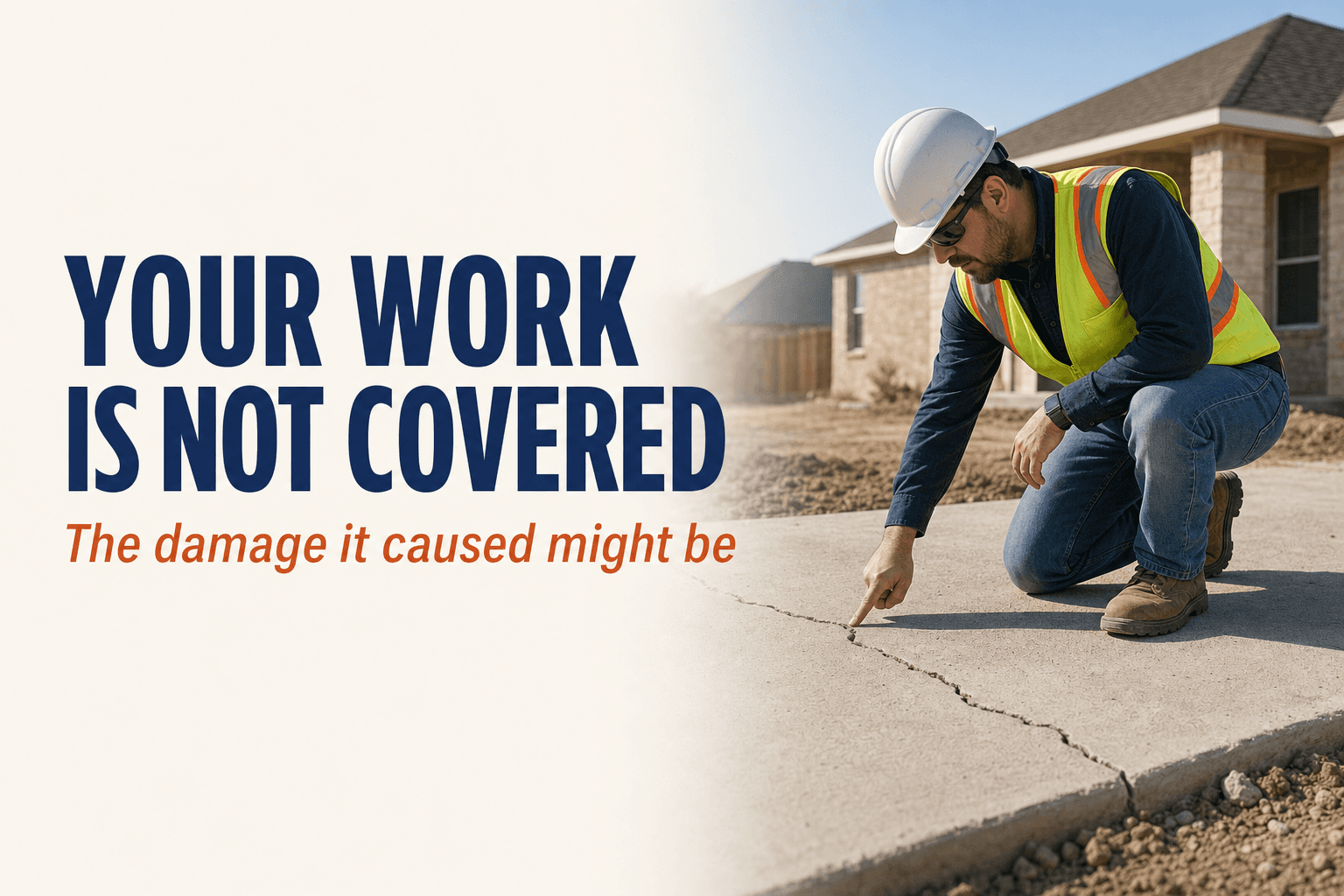
A framer in Spring installs a second story deck. Eight months later the ledger board pulls away from the house, the deck drops four inches, and the homeowner's sunroom ceiling below it splits open. The homeowner sues. The framer calls his agent, certain he is covered, because he has carried general liability for eleven years and has never missed a payment.
He is about half right, and the half he has wrong is the half that costs him money. Since 2003 we have watched Texas contractors discover this distinction in the worst possible way, which is after the demand letter arrives. If you want the short version before the detail, our business insurance team can read your actual policy forms rather than guess from a certificate.
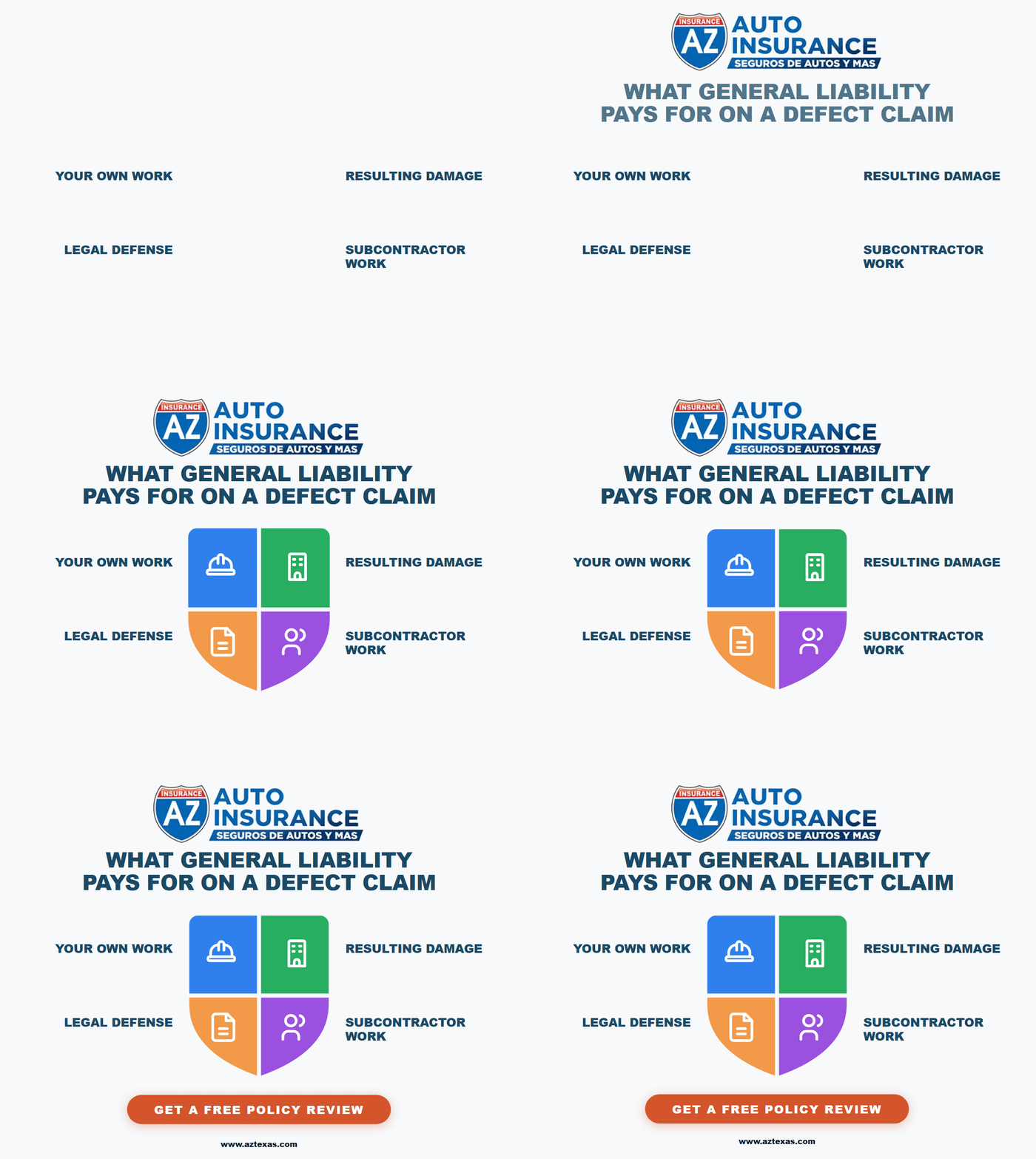
Short answer: No. A standard general liability policy does not pay to tear out and redo the work you performed incorrectly. That cost is yours. But in Texas it often does pay for the damage your defective work caused to other property, and it usually pays for your legal defense while that gets sorted out. The repair is excluded. The consequences frequently are not.
Key Takeaways
General liability excludes your own work. The Texas Department of Insurance states plainly that CGL policies exclude coverage for property damage to your work, with limited exceptions for damage caused by a subcontractor.
Resulting damage is a separate question from the defect itself. The cracked ceiling below the failed deck is not the same claim as the failed deck.
Texas is more favorable than most states on the threshold question. In Lamar Homes v. Mid Continent Casualty, decided in 2007, the Texas Supreme Court held that unintended construction defects may qualify as an accident and therefore an occurrence.
The duty to defend is broader than the duty to pay. Your insurer can owe you a lawyer even on a claim it may ultimately never indemnify.
Work performed by a subcontractor sits in a different position than work performed by your own crew, and that single fact decides a great many Texas claims.
None of this is settled by your certificate of insurance. The answer lives in the exclusions and endorsements, which a certificate never shows.
What the "your work" exclusion actually says
The exclusion removes the cost of repairing or replacing your own completed work from the policy. It does not remove the entire claim. It removes one specific piece of it, and it removes that piece whether or not you were negligent.
The Texas Department of Insurance describes this directly on its commercial general liability page, stating that CGL policies exclude coverage for property damage to your work, with limited exceptions for subcontractor caused damage. The regulator's own language is the clearest summary available, and it is worth reading before you accept any carrier's coverage position.
The logic behind it is not arbitrary. Insurance covers fortuitous events, not the quality of your workmanship. If a policy paid to redo bad work, it would function as a performance bond or a warranty, and it would be priced like one. That is the reasoning, and understanding it makes the rest of the policy read more sensibly.
What the exclusion typically removes:
The labor to demolish and rebuild the portion you installed incorrectly
The materials to replace that portion
Costs to correct work that simply does not meet the contract specification
The value of work you were paid for and did not deliver properly
Recall or withdrawal costs for faulty products or impaired property
What it typically does not remove:
Damage your defective work caused to other parts of the structure
Damage to property belonging to the owner that your work was not performed on
Bodily injury to anyone hurt because the work failed
Loss of use of property that was not itself your work
Your legal defense costs while the allegation is being tested
That split is the whole subject. Contractors who understand it price and argue their claims very differently from those who do not. If your policy is more than a couple of years old, a free policy review is the fastest way to see which endorsements you actually hold.
Why Texas treats this better than most states
In most of the country, insurers argue that defective workmanship is not an accident at all, so there is no occurrence, so the policy never engages in the first place. That argument ends many claims before any exclusion is even reached.
Texas rejected that reasoning. In Lamar Homes v. Mid Continent Casualty, the Texas Supreme Court answered certified questions from the Fifth Circuit and held that allegations of unintended construction defects may constitute an accident and therefore an occurrence, and that damage to the home itself may constitute property damage sufficient to trigger the duty to defend. The court applied this whether the defect came from the prime contractor or from a subcontractor.
For a Texas contractor this matters enormously:
The occurrence threshold is not an automatic wall the way it is in several other states
The carrier generally cannot deny simply by asserting that bad work is never accidental
The analysis moves to the exclusions, which are narrower and more specific
The duty to defend can attach even where the duty to indemnify is doubtful
National advice you read online is frequently written for states that decided this the other way
This is the single most common reason a Texas contractor is told something wrong by a generic internet source. Much of the content on this subject is accurate for its home state and misleading here. Our Houston and DFW offices deal with the Texas version.
The subcontractor exception, and why it decides claims
The "your work" exclusion contains an exception that gives back coverage when the damaged work, or the work that caused the damage, was performed by a subcontractor on your behalf. This exception is the reason two contractors with identical policies can receive opposite answers on nearly identical facts.
Consider the difference:
Your own crew installs the flashing wrong, water enters, drywall is ruined. The flashing is excluded. The drywall is a separate analysis.
Your subcontractor installs the flashing wrong, water enters, drywall is ruined. The exception may return coverage to a broader portion of the claim than in the first case.
Practical consequences worth acting on before you ever have a claim:
Confirm your policy has not been endorsed to delete the subcontractor exception, because some carriers remove it
Watch for endorsements requiring written subcontractor agreements as a condition of coverage
Watch for endorsements requiring you to collect certificates from every sub, with specific limits
Keep signed subcontractor agreements, because an oral arrangement can fail a policy condition
Understand that classifying a helper as a subcontractor for tax purposes does not settle the insurance question
If you use 1099 labor, the interaction between your liability policy and your workforce classification deserves its own review. We cover the wider version of that problem in our guide to 1099 contractors and general liability in Texas, and the workers compensation side in the Texas non subscriber rules.
Defense costs: the benefit most contractors overlook
Even when the indemnity outcome is uncertain, the duty to defend is a real and valuable benefit. It is triggered by what the lawsuit alleges, not by what is eventually proven, and in Texas the standard is generous to the policyholder.
That distinction pays for itself:
Defense costs generally sit outside your limits as supplementary payments, so they do not erode what remains for damages
A construction defect defense can run into six figures before any determination of fault
The insurer selects and pays experienced coverage counsel
A defense obligation can exist for a suit that is ultimately meritless
An early defense often produces a far better settlement than a contractor negotiating alone
This is why reporting a claim promptly matters more than most contractors believe. Late notice can prejudice the carrier and jeopardize the defense you paid for. The same principle applies across your commercial lines, including commercial property and commercial umbrella coverage.
What actually fills the gap
If the repair of your own work is excluded, and that is your largest realistic exposure, the honest answer is that general liability was never the product designed to solve it. Several other tools exist, and they are not interchangeable.
Exposure | General liability | What actually responds |
|---|---|---|
Redoing your own defective work | Excluded | Contractors faulty workmanship endorsement, or self funded |
Damage your defect caused to other property | Often covered | General liability |
Bodily injury from the failure | Covered | General liability |
Design or specification error | Usually excluded | Professional liability, errors and omissions |
Damage to a customer's property in your care | Depends | Care custody and control endorsement |
Employee injury on the job | Excluded | Workers compensation or a non subscriber plan |
Your tools and equipment | Excluded | Inland marine, or a business owners policy |
A claim exceeding your limits | Capped | Commercial umbrella |
Some carriers now offer a faulty workmanship endorsement with its own separate limit, and a smaller number of specialty markets write it as a standalone product. Availability varies by trade, by claims history and by revenue, so this is a conversation rather than a checkbox. A business owners policy is often the right container for the property and equipment pieces sitting alongside it.
Get a free general liability review or call (281) 833-6755. Hablamos Español.
Six situations Texas contractors ask us about
These come up repeatedly across our offices, and the pattern in the answers is consistent.
A roofer's nails miss the decking, the roof leaks, and the owner's hardwood floor buckles. The roof is the roofer's work. The floor is not.
A plumber's joint fails inside a wall and ruins the cabinetry. The joint and the pipe section are the plumber's work. The cabinetry is a separate item.
A concrete sub pours a slab out of level and the general contractor is sued. The subcontractor exception is the first thing to examine.
An electrician's panel work causes a fire that destroys the garage. Bodily injury and fire damage sit on the covered side of the line, even though the panel does not.
A landscaper's irrigation line is cut and floods a neighbor's yard. Third party property, not the landscaper's own work. We cover the trade specific version in our landscaping coverage gaps guide.
A cleaning company damages a client's flooring with the wrong chemical. This is care custody and control territory rather than faulty workmanship, and we address it in the cleaning company general liability guide.
The general principle behind every one of them is covered in our breakdown of what general liability covers and in what happens when you damage a customer's property.
What to do before you have a claim
Coverage questions are cheap to answer in September and expensive to answer after a demand letter.
Request the full policy, including every endorsement, not the declarations page alone
Search the endorsement list for any deletion of the subcontractor exception
Confirm whether products and completed operations coverage is included and what the limit is
Check whether your completed operations coverage continues after a job is finished
Confirm your policy period matches the dates of the work in question
Collect and store certificates from every subcontractor for the full statutory period
Put subcontractor agreements in writing, every time, including for the small jobs
Ask whether a faulty workmanship endorsement is available for your trade
Verify your limits against what your largest current contract requires
Report anything that could become a claim immediately, even if you expect to resolve it yourself
Whether general liability is legally required for your operation is a separate question, answered in is general liability insurance required in Texas. Pricing is covered in our 2026 Houston general liability cost guide, and if you operate alone, the sole proprietor risk guide is the right starting point.
Frequently Asked Questions
Q: Does general liability cover faulty workmanship in Texas?
It does not cover the cost of repairing or replacing your own defective work. It frequently does cover damage that defective work caused to other property, and bodily injury arising from it. The Texas Department of Insurance states that CGL policies exclude property damage to your work, with limited exceptions for subcontractor caused damage.
Q: Is defective construction an occurrence under Texas law?
Yes, it can be. The Texas Supreme Court held in Lamar Homes v. Mid Continent Casualty that allegations of unintended construction defects may constitute an accident and therefore an occurrence, and that damage to the structure itself may be property damage sufficient to trigger the duty to defend. Texas is more favorable on this point than many other states.
Q: What is the subcontractor exception?
It is language inside the "your work" exclusion that gives coverage back when the damaged work, or the work that caused the damage, was performed by a subcontractor on your behalf. Some carriers delete it by endorsement, so it should be verified in your own policy rather than assumed.
Q: Will my insurer defend me even if the claim is excluded?
Often yes. The duty to defend is triggered by the allegations in the lawsuit rather than the eventual outcome, and it is broader than the duty to indemnify. Defense costs are generally paid as supplementary payments outside your limits.
Q: Can I buy coverage for my own faulty work?
Sometimes. Some carriers offer a contractors faulty workmanship endorsement with a separate limit, and specialty markets write standalone products. Availability depends on trade, revenue and claims history. Call our business line at (281) 833-6755 and we will check what your trade can actually obtain.
Q: Does my certificate of insurance tell me whether I have this coverage?
No. A certificate confirms that a policy exists on a given date. It does not list exclusions, it does not list endorsements, and it does not show whether the subcontractor exception survives in your form. See our guide to the Texas certificate of insurance for what a certificate can and cannot establish.
Q: My general contractor says I need higher limits. Does that change any of this?
Higher limits raise the ceiling on covered claims. They do not convert an excluded claim into a covered one. If your contract demands limits above your policy, a commercial umbrella is usually the efficient route.
Related Articles
Why AZ Insurance Stands Apart
Most agencies sell a contractor a general liability policy and never open the endorsement pages again. We read them, because the endorsement pages are where a defect claim is won or lost, and because the difference between a deleted subcontractor exception and an intact one is the difference between a defended claim and a personal check. We have been doing this from Houston since 2003, we are independent, and we compare multiple insurance companies rather than defending one carrier's form.
If you build, install, repair or finish anything in Texas, bring us your policy before the next contract requires a certificate. Request a free general liability review or call our business line at (281) 833-6755, and we will tell you exactly which side of the line your biggest exposure sits on.
Reviewed by AZ Insurance Agency, licensed in Texas, serving Houston since 2003.
A framer in Spring installs a second story deck. Eight months later the ledger board pulls away from the house, the deck drops four inches, and the homeowner's sunroom ceiling below it splits open. The homeowner sues. The framer calls his agent, certain he is covered, because he has carried general liability for eleven years and has never missed a payment.
He is about half right, and the half he has wrong is the half that costs him money. Since 2003 we have watched Texas contractors discover this distinction in the worst possible way, which is after the demand letter arrives. If you want the short version before the detail, our business insurance team can read your actual policy forms rather than guess from a certificate.
Short answer: No. A standard general liability policy does not pay to tear out and redo the work you performed incorrectly. That cost is yours. But in Texas it often does pay for the damage your defective work caused to other property, and it usually pays for your legal defense while that gets sorted out. The repair is excluded. The consequences frequently are not.
Key Takeaways
General liability excludes your own work. The Texas Department of Insurance states plainly that CGL policies exclude coverage for property damage to your work, with limited exceptions for damage caused by a subcontractor.
Resulting damage is a separate question from the defect itself. The cracked ceiling below the failed deck is not the same claim as the failed deck.
Texas is more favorable than most states on the threshold question. In Lamar Homes v. Mid Continent Casualty, decided in 2007, the Texas Supreme Court held that unintended construction defects may qualify as an accident and therefore an occurrence.
The duty to defend is broader than the duty to pay. Your insurer can owe you a lawyer even on a claim it may ultimately never indemnify.
Work performed by a subcontractor sits in a different position than work performed by your own crew, and that single fact decides a great many Texas claims.
None of this is settled by your certificate of insurance. The answer lives in the exclusions and endorsements, which a certificate never shows.
What the "your work" exclusion actually says
The exclusion removes the cost of repairing or replacing your own completed work from the policy. It does not remove the entire claim. It removes one specific piece of it, and it removes that piece whether or not you were negligent.
The Texas Department of Insurance describes this directly on its commercial general liability page, stating that CGL policies exclude coverage for property damage to your work, with limited exceptions for subcontractor caused damage. The regulator's own language is the clearest summary available, and it is worth reading before you accept any carrier's coverage position.
The logic behind it is not arbitrary. Insurance covers fortuitous events, not the quality of your workmanship. If a policy paid to redo bad work, it would function as a performance bond or a warranty, and it would be priced like one. That is the reasoning, and understanding it makes the rest of the policy read more sensibly.
What the exclusion typically removes:
The labor to demolish and rebuild the portion you installed incorrectly
The materials to replace that portion
Costs to correct work that simply does not meet the contract specification
The value of work you were paid for and did not deliver properly
Recall or withdrawal costs for faulty products or impaired property
What it typically does not remove:
Damage your defective work caused to other parts of the structure
Damage to property belonging to the owner that your work was not performed on
Bodily injury to anyone hurt because the work failed
Loss of use of property that was not itself your work
Your legal defense costs while the allegation is being tested
That split is the whole subject. Contractors who understand it price and argue their claims very differently from those who do not. If your policy is more than a couple of years old, a free policy review is the fastest way to see which endorsements you actually hold.
Why Texas treats this better than most states
In most of the country, insurers argue that defective workmanship is not an accident at all, so there is no occurrence, so the policy never engages in the first place. That argument ends many claims before any exclusion is even reached.
Texas rejected that reasoning. In Lamar Homes v. Mid Continent Casualty, the Texas Supreme Court answered certified questions from the Fifth Circuit and held that allegations of unintended construction defects may constitute an accident and therefore an occurrence, and that damage to the home itself may constitute property damage sufficient to trigger the duty to defend. The court applied this whether the defect came from the prime contractor or from a subcontractor.
For a Texas contractor this matters enormously:
The occurrence threshold is not an automatic wall the way it is in several other states
The carrier generally cannot deny simply by asserting that bad work is never accidental
The analysis moves to the exclusions, which are narrower and more specific
The duty to defend can attach even where the duty to indemnify is doubtful
National advice you read online is frequently written for states that decided this the other way
This is the single most common reason a Texas contractor is told something wrong by a generic internet source. Much of the content on this subject is accurate for its home state and misleading here. Our Houston and DFW offices deal with the Texas version.
The subcontractor exception, and why it decides claims
The "your work" exclusion contains an exception that gives back coverage when the damaged work, or the work that caused the damage, was performed by a subcontractor on your behalf. This exception is the reason two contractors with identical policies can receive opposite answers on nearly identical facts.
Consider the difference:
Your own crew installs the flashing wrong, water enters, drywall is ruined. The flashing is excluded. The drywall is a separate analysis.
Your subcontractor installs the flashing wrong, water enters, drywall is ruined. The exception may return coverage to a broader portion of the claim than in the first case.
Practical consequences worth acting on before you ever have a claim:
Confirm your policy has not been endorsed to delete the subcontractor exception, because some carriers remove it
Watch for endorsements requiring written subcontractor agreements as a condition of coverage
Watch for endorsements requiring you to collect certificates from every sub, with specific limits
Keep signed subcontractor agreements, because an oral arrangement can fail a policy condition
Understand that classifying a helper as a subcontractor for tax purposes does not settle the insurance question
If you use 1099 labor, the interaction between your liability policy and your workforce classification deserves its own review. We cover the wider version of that problem in our guide to 1099 contractors and general liability in Texas, and the workers compensation side in the Texas non subscriber rules.
Defense costs: the benefit most contractors overlook
Even when the indemnity outcome is uncertain, the duty to defend is a real and valuable benefit. It is triggered by what the lawsuit alleges, not by what is eventually proven, and in Texas the standard is generous to the policyholder.
That distinction pays for itself:
Defense costs generally sit outside your limits as supplementary payments, so they do not erode what remains for damages
A construction defect defense can run into six figures before any determination of fault
The insurer selects and pays experienced coverage counsel
A defense obligation can exist for a suit that is ultimately meritless
An early defense often produces a far better settlement than a contractor negotiating alone
This is why reporting a claim promptly matters more than most contractors believe. Late notice can prejudice the carrier and jeopardize the defense you paid for. The same principle applies across your commercial lines, including commercial property and commercial umbrella coverage.
What actually fills the gap
If the repair of your own work is excluded, and that is your largest realistic exposure, the honest answer is that general liability was never the product designed to solve it. Several other tools exist, and they are not interchangeable.
Exposure | General liability | What actually responds |
|---|---|---|
Redoing your own defective work | Excluded | Contractors faulty workmanship endorsement, or self funded |
Damage your defect caused to other property | Often covered | General liability |
Bodily injury from the failure | Covered | General liability |
Design or specification error | Usually excluded | Professional liability, errors and omissions |
Damage to a customer's property in your care | Depends | Care custody and control endorsement |
Employee injury on the job | Excluded | Workers compensation or a non subscriber plan |
Your tools and equipment | Excluded | Inland marine, or a business owners policy |
A claim exceeding your limits | Capped | Commercial umbrella |
Some carriers now offer a faulty workmanship endorsement with its own separate limit, and a smaller number of specialty markets write it as a standalone product. Availability varies by trade, by claims history and by revenue, so this is a conversation rather than a checkbox. A business owners policy is often the right container for the property and equipment pieces sitting alongside it.
Get a free general liability review or call (281) 833-6755. Hablamos Español.
Six situations Texas contractors ask us about
These come up repeatedly across our offices, and the pattern in the answers is consistent.
A roofer's nails miss the decking, the roof leaks, and the owner's hardwood floor buckles. The roof is the roofer's work. The floor is not.
A plumber's joint fails inside a wall and ruins the cabinetry. The joint and the pipe section are the plumber's work. The cabinetry is a separate item.
A concrete sub pours a slab out of level and the general contractor is sued. The subcontractor exception is the first thing to examine.
An electrician's panel work causes a fire that destroys the garage. Bodily injury and fire damage sit on the covered side of the line, even though the panel does not.
A landscaper's irrigation line is cut and floods a neighbor's yard. Third party property, not the landscaper's own work. We cover the trade specific version in our landscaping coverage gaps guide.
A cleaning company damages a client's flooring with the wrong chemical. This is care custody and control territory rather than faulty workmanship, and we address it in the cleaning company general liability guide.
The general principle behind every one of them is covered in our breakdown of what general liability covers and in what happens when you damage a customer's property.
What to do before you have a claim
Coverage questions are cheap to answer in September and expensive to answer after a demand letter.
Request the full policy, including every endorsement, not the declarations page alone
Search the endorsement list for any deletion of the subcontractor exception
Confirm whether products and completed operations coverage is included and what the limit is
Check whether your completed operations coverage continues after a job is finished
Confirm your policy period matches the dates of the work in question
Collect and store certificates from every subcontractor for the full statutory period
Put subcontractor agreements in writing, every time, including for the small jobs
Ask whether a faulty workmanship endorsement is available for your trade
Verify your limits against what your largest current contract requires
Report anything that could become a claim immediately, even if you expect to resolve it yourself
Whether general liability is legally required for your operation is a separate question, answered in is general liability insurance required in Texas. Pricing is covered in our 2026 Houston general liability cost guide, and if you operate alone, the sole proprietor risk guide is the right starting point.
Frequently Asked Questions
Q: Does general liability cover faulty workmanship in Texas?
It does not cover the cost of repairing or replacing your own defective work. It frequently does cover damage that defective work caused to other property, and bodily injury arising from it. The Texas Department of Insurance states that CGL policies exclude property damage to your work, with limited exceptions for subcontractor caused damage.
Q: Is defective construction an occurrence under Texas law?
Yes, it can be. The Texas Supreme Court held in Lamar Homes v. Mid Continent Casualty that allegations of unintended construction defects may constitute an accident and therefore an occurrence, and that damage to the structure itself may be property damage sufficient to trigger the duty to defend. Texas is more favorable on this point than many other states.
Q: What is the subcontractor exception?
It is language inside the "your work" exclusion that gives coverage back when the damaged work, or the work that caused the damage, was performed by a subcontractor on your behalf. Some carriers delete it by endorsement, so it should be verified in your own policy rather than assumed.
Q: Will my insurer defend me even if the claim is excluded?
Often yes. The duty to defend is triggered by the allegations in the lawsuit rather than the eventual outcome, and it is broader than the duty to indemnify. Defense costs are generally paid as supplementary payments outside your limits.
Q: Can I buy coverage for my own faulty work?
Sometimes. Some carriers offer a contractors faulty workmanship endorsement with a separate limit, and specialty markets write standalone products. Availability depends on trade, revenue and claims history. Call our business line at (281) 833-6755 and we will check what your trade can actually obtain.
Q: Does my certificate of insurance tell me whether I have this coverage?
No. A certificate confirms that a policy exists on a given date. It does not list exclusions, it does not list endorsements, and it does not show whether the subcontractor exception survives in your form. See our guide to the Texas certificate of insurance for what a certificate can and cannot establish.
Q: My general contractor says I need higher limits. Does that change any of this?
Higher limits raise the ceiling on covered claims. They do not convert an excluded claim into a covered one. If your contract demands limits above your policy, a commercial umbrella is usually the efficient route.
Related Articles
Why AZ Insurance Stands Apart
Most agencies sell a contractor a general liability policy and never open the endorsement pages again. We read them, because the endorsement pages are where a defect claim is won or lost, and because the difference between a deleted subcontractor exception and an intact one is the difference between a defended claim and a personal check. We have been doing this from Houston since 2003, we are independent, and we compare multiple insurance companies rather than defending one carrier's form.
If you build, install, repair or finish anything in Texas, bring us your policy before the next contract requires a certificate. Request a free general liability review or call our business line at (281) 833-6755, and we will tell you exactly which side of the line your biggest exposure sits on.
Latest Blogs

Buying a Car in Houston? What Insurance You Need Before You Drive Off the Lot

Landscaping Insurance in Houston: The Three Gaps Your Personal Policy Leaves Open

A Storm Hits Before Your Renewal: The Texas Claim Timeline, and the New Right You Have in 2026

A Storm Claim Cannot Raise Your Texas Home Insurance Rate. A Broken Pipe Can.

Your Roof Before the Storm: The Four Things to Check on Your Policy While You Still Can

Commercial Property Insurance Coverage Explained: What's Protected and What's Not
Let A-Z Auto Insurance Help You Find Affordable Coverage
Connect with our experienced team today & get reliable, affordable insurance designed around your needs.
Contact Us!
Let A-Z Auto Insurance Help
You Find Affordable Coverage
Connect with our experienced team today & get reliable, affordable insurance designed around your needs.
Contact Us!
Let A-Z Auto
Insurance Help You
Find Affordable Coverage
Connect with our experienced team today & get reliable, affordable insurance designed around your needs.
Contact Us!
Let A-Z Auto Insurance Help
You Find Affordable Coverage
Connect with our experienced team today & get reliable, affordable insurance designed around your needs.
Contact Us!
Latest New & Blogs
Latest New & Blogs
Related Blog Posts
Related Blog Posts
A Storm Hits Before Your Renewal: The Texas Claim Timeline, and the New Right You Have in 2026
The deadlines your Texas insurer must meet on a storm claim, the appraisal right added for 2026, and what a claim does to your renewal in Fort Bend.
A Storm Hits Before Your Renewal: The Texas Claim Timeline, and the New Right You Have in 2026
The deadlines your Texas insurer must meet on a storm claim, the appraisal right added for 2026, and what a claim does to your renewal in Fort Bend.
A Storm Hits Before Your Renewal: The Texas Claim Timeline, and the New Right You Have in 2026
The deadlines your Texas insurer must meet on a storm claim, the appraisal right added for 2026, and what a claim does to your renewal in Fort Bend.
A Storm Claim Cannot Raise Your Texas Home Insurance Rate. A Broken Pipe Can.
Texas law protects weather claims from rate increases and nonrenewal. The claims that count against you are the everyday ones. Here is the exact line.
A Storm Claim Cannot Raise Your Texas Home Insurance Rate. A Broken Pipe Can.
Texas law protects weather claims from rate increases and nonrenewal. The claims that count against you are the everyday ones. Here is the exact line.
A Storm Claim Cannot Raise Your Texas Home Insurance Rate. A Broken Pipe Can.
Texas law protects weather claims from rate increases and nonrenewal. The claims that count against you are the everyday ones. Here is the exact line.
Your Roof Before the Storm: The Four Things to Check on Your Policy While You Still Can
Four things to check on your Texas homeowners policy before a storm: settlement basis, deductible percentage, roof age schedule, and cosmetic damage.
Your Roof Before the Storm: The Four Things to Check on Your Policy While You Still Can
Four things to check on your Texas homeowners policy before a storm: settlement basis, deductible percentage, roof age schedule, and cosmetic damage.
Your Roof Before the Storm: The Four Things to Check on Your Policy While You Still Can
Four things to check on your Texas homeowners policy before a storm: settlement basis, deductible percentage, roof age schedule, and cosmetic damage.
A Storm Hits Before Your Renewal: The Texas Claim Timeline, and the New Right You Have in 2026
The deadlines your Texas insurer must meet on a storm claim, the appraisal right added for 2026, and what a claim does to your renewal in Fort Bend.
A Storm Claim Cannot Raise Your Texas Home Insurance Rate. A Broken Pipe Can.
Texas law protects weather claims from rate increases and nonrenewal. The claims that count against you are the everyday ones. Here is the exact line.