Quick support from trusted insurance professionals Call +1 713-777-2886 today! |
Call +1 713-777-2886
Call +1 713-777-2886
Quick support from insurance professionals Call +1 713-777-2886 today! |


Table of Content
Title

Let AZ Insurance Help You
Find Affordable Coverage
Connect with our experienced team today & get reliable, affordable insurance designed around your needs.
Contact Us!

Let A-Z Auto Insurance Help You Find Affordable Coverage
Connect with our experienced team today & get reliable, affordable insurance designed around your needs.
Contact Us!
Texas Storm Deductible Explained: Why 2 Percent Does Not Mean $200
Texas Storm Deductible Explained: Why 2 Percent Does Not Mean $200
Texas Storm Deductible Explained: Why 2 Percent Does Not Mean $200
Texas Storm Deductible Explained: Why 2 Percent Does Not Mean $200
Texas Storm Deductible Explained: Why 2 Percent Does Not Mean $200

Reviewed by AZ Insurance Agency, licensed in Texas, serving Houston since 2003.
The storm came through on a Tuesday afternoon. By Thursday morning the adjuster was in the driveway photographing the roof, the fence, and the side of the house where the siding had peeled back. By the following Monday there was a claims summary in the inbox: covered damage totaling $9,400. And then a number nobody had prepared for. The deductible was $7,800. Not the $1,000 the homeowner remembered from signing the policy. $7,800, because the home was insured for $390,000 and the wind and hail deductible was 2 percent of the insured dwelling value. Since 2003, AZ Insurance Agency has watched this exact conversation play out with Houston families every storm season, and it is almost always discovered at the worst possible moment.
Quick Answer: Most Texas homeowners policies carry two deductibles, not one. The flat amount you remember, often $1,000, is the All Other Perils deductible and it applies to fire, theft and water claims. Wind and hail get a separate deductible expressed as a percentage of your dwelling coverage. A 2 percent wind and hail deductible on a $300,000 home is $6,000 out of pocket, not $200. The number is printed on your declarations page, and checking it takes about two minutes.
Key Takeaways
Texas homeowners policies routinely carry two separate deductibles. The flat one you remember does not apply to wind or hail damage.
The wind and hail deductible is usually a percentage of Coverage A, your dwelling amount, not a flat dollar figure. On a $400,000 home, 2 percent is $8,000.
Carriers moved to percentage deductibles because Texas storm exposure made flat deductibles unsustainable. It is a structural feature of the Texas market, not one carrier being difficult.
Your exact figure is on your declarations page under a label like Wind and Hail Deductible, Named Storm Deductible or Windstorm Deductible.
If your damage estimate lands below the deductible, the carrier pays nothing. Many smaller hail claims fall entirely below a 2 percent deductible.
Some carriers offer a flat dollar wind deductible or a buy down endorsement for extra premium. Whether it is worth it is a math question that depends on your home value.
Raising your Coverage A raises your deductible in real dollars at the same time, so the two numbers move together.
In This Guide
What most Texas homeowners believe about their deductible
Why Texas policies work this way
Where to find your wind and hail deductible right now
The moment most homeowners find out, and why it is too late
Can you get a flat dollar wind deductible in Texas
What the Texas Department of Insurance does and does not control
Frequently asked questions
What Most Texas Homeowners Believe About Their Deductible
Ask a homeowner in the Houston suburbs what their deductible is and most will give you a flat number. $1,000. $2,500. Maybe $500 if they bought the policy when rates were lower. That number is what they remember from the application and from a kitchen table conversation three or four years ago.
That flat number is real. It appears on the policy. It applies to most claims.
But it does not apply to wind or hail.
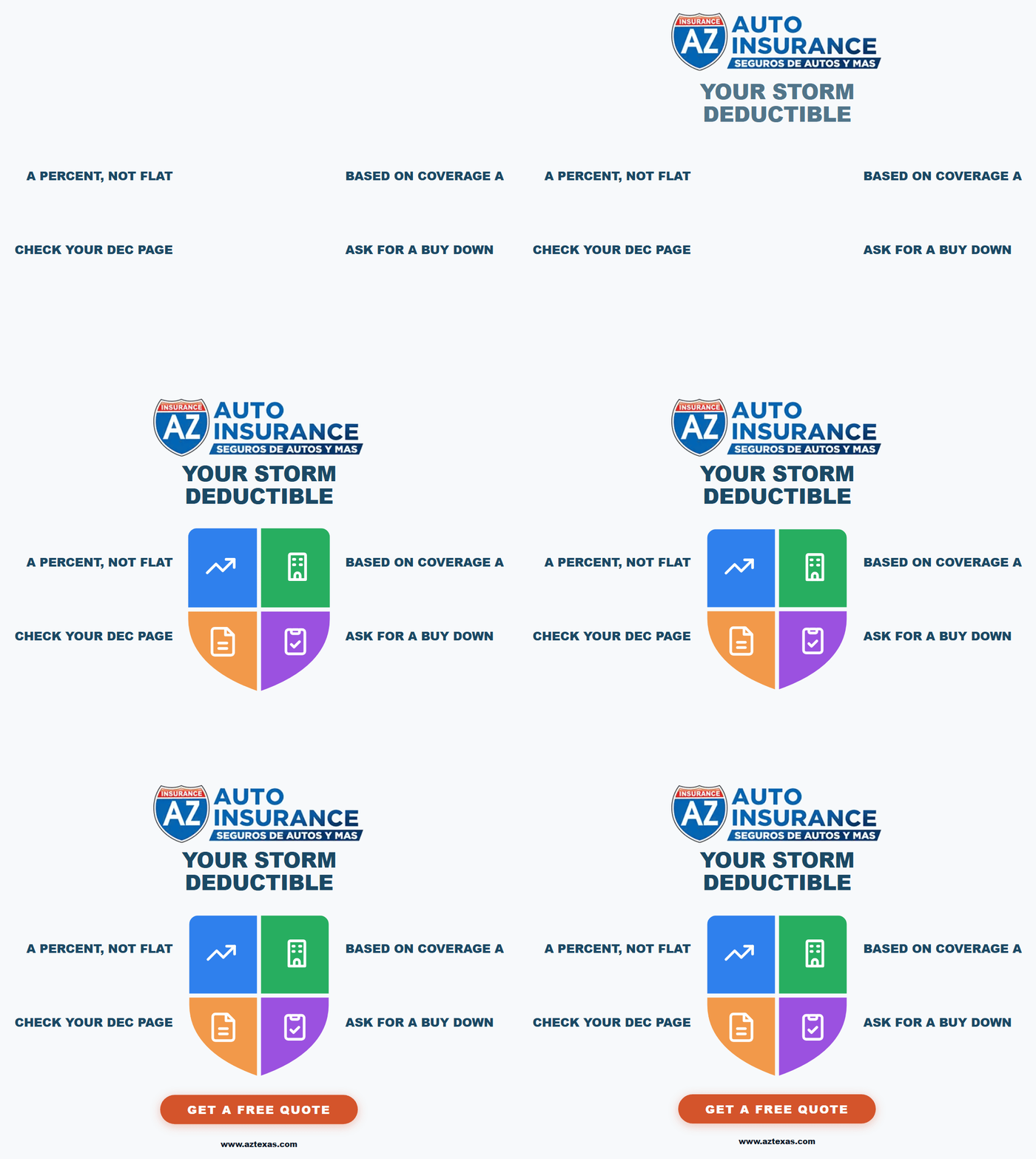
In Texas, homeowners policies routinely carry a second deductible, separate and higher, that applies specifically when the damage is caused by wind, hail or a named storm. This second deductible is expressed as a percentage of the home's insured value rather than a flat dollar amount.
Deductible type | Also called | Applies to | How it is expressed |
|---|---|---|---|
Flat deductible | All Other Perils, AOP | Fire, theft, water damage from plumbing, most other claims | A flat dollar amount |
Storm deductible | Wind and Hail, Named Storm, Windstorm, Hurricane | Wind, hail, and on some policies only officially named storms | Usually a percentage of Coverage A |
Both appear in the same policy. One document, two deductible structures, and most people only ever notice the first one.
Here is what the second one looks like in real dollars.
Insured dwelling value (Coverage A) | 1 percent | 2 percent | 3 percent | 5 percent |
|---|---|---|---|---|
$250,000 | $2,500 | $5,000 | $7,500 | $12,500 |
$300,000 | $3,000 | $6,000 | $9,000 | $15,000 |
$350,000 | $3,500 | $7,000 | $10,500 | $17,500 |
$400,000 | $4,000 | $8,000 | $12,000 | $20,000 |
$450,000 | $4,500 | $9,000 | $13,500 | $22,500 |
$500,000 | $5,000 | $10,000 | $15,000 | $25,000 |
Estimates only, shown to illustrate how percentage deductibles scale. Your actual figure is on your declarations page.
Suburban Houston, Sugar Land and Katy are densely concentrated with homes in exactly this range. A 2 percent deductible at these values is not a minor cost sharing mechanism. It is a five figure gap between what the policy covers and what actually lands in the homeowner's hands. And in Texas, storm season is not an abstract risk. It is a recurring annual event.
Why Texas Policies Work This Way
Texas sits in one of the most active storm corridors in the country. The state absorbs more hurricane activity than any other continental state, and the interior corridor, including the entire greater Houston metro, sees severe thunderstorm and hail events that routinely cost insurers hundreds of millions of dollars in a single season.
Carriers responded years ago by restructuring deductibles. Instead of absorbing the first $1,000 of every wind and hail claim, they shifted more of the initial loss to homeowners through percentage deductibles. That is what allowed many of them to keep writing in Texas at all. Some carriers have pulled back from the state anyway.
The Texas Insurance Code requires carriers to disclose percentage deductibles clearly in the policy documents, and the declarations page has to show the deductible and how it is calculated. The law is on the homeowner's side here. The problem is not disclosure. The problem is that most homeowners do not read their declarations page until they have a reason to, and by then there has usually been a loss.
The flat deductible that applies to fire, theft and water claims works very differently from the storm structure. Our overview of what homeowners insurance covers and does not cover walks through how the rest of the policy fits together.
Where to Find Your Wind and Hail Deductible Right Now
You do not need to wait for a storm to find out what your exposure is. The information is already in your policy.
Pull out your homeowners declarations page, the one to two page summary at the front of your policy document. It is usually available through your carrier's online portal too. Then look for any of these labels.
Label on your declarations page | What it means |
|---|---|
Wind and Hail Deductible | Applies to any wind or hail loss |
Named Storm Deductible | May apply only when a storm is officially named |
Hurricane Deductible | Applies to hurricane losses, sometimes separately from hail |
Windstorm Deductible | General wind coverage deductible |
Wind Percentage Deductible | Explicitly a percentage of Coverage A |
The value next to that label will be either a percentage or, if your carrier offers it, a flat dollar amount. If it is a percentage, multiply it by your Coverage A figure on the same page. That is your out of pocket exposure for any wind or hail claim.
Four things worth checking while you have the page open:
Is your Coverage A amount current? If you bought years ago and never updated your dwelling coverage, your insured value may be below what it would cost to rebuild today. That affects both your deductible math and your claim payout.
Is the deductible 1 percent, 2 percent, or higher? Some Texas policies carry 3 percent or even 5 percent, particularly closer to the coast.
Is there a separate hurricane deductible? Some policies split wind and hail from hurricane into two different percentages.
What actually triggers it? Some named storm deductibles only activate when a storm is officially named by the National Hurricane Center, which is an important distinction for inland hail events.
If anything on that page is unclear, that is exactly what an independent agent is for. At AZ Insurance a coverage review costs nothing and takes about twenty minutes.
The Moment Most Homeowners Find Out, and Why It Is Too Late
Here is the pattern we see repeatedly.
A storm moves through the Houston area in spring or early summer. Hail hits the northwest suburbs. Damage is widespread. The homeowner files a claim. The adjuster documents the roof, the gutters, maybe the siding, and produces an estimate of $9,000.
The homeowner is relieved. Nine thousand covers a new roof. They start calling roofers.
Then the explanation of benefits arrives. The carrier applied the wind and hail deductible. The home is insured for $450,000. The deductible is 2 percent. That is $9,000. The claim payout is zero, or close to it, because the carrier owes nothing until the damage exceeds the deductible and in this case the two are equal.
The homeowner now owes the full cost of the roof out of pocket, with no reimbursement, on a policy they have paid premiums on for years.
This is not fraud and it is not bad faith. It is a contractual structure the homeowner agreed to and, in most cases, never fully understood. The disclosure happened. The signature happened. The reading did not.
The remedy is not outrage after the claim. The remedy is reading the policy before the storm.
Wind and hail are also only half the Houston storm picture. Standard homeowners insurance excludes flood entirely, a separate gap that blindsides families the same way. Our guide to whether homeowners insurance covers flood in Texas explains the other coverage every Houston homeowner should review before hurricane season.
Can You Get a Flat Dollar Wind Deductible in Texas?
Yes, but it costs something, and availability depends heavily on your carrier and where your home sits.
Some Texas homeowners insurers offer flat dollar wind and hail options. Instead of 2 percent of insured value, the policy might offer a $5,000 or $10,000 flat deductible. In some cases you can buy it down further with an endorsement.
The tradeoff is premium. Flat dollar wind deductibles move more of the initial loss back to the carrier, and carriers price that into the annual premium. Depending on your home value, risk profile and carrier, expect roughly $200 to $600 per year in additional premium.
Whether that trade makes sense is arithmetic.
Scenario | Exposure at 2 percent | Flat option | Risk bought down | Extra premium | Years to break even |
|---|---|---|---|---|---|
$400,000 home | $8,000 | $5,000 flat | $3,000 | About $300 a year | 1 storm claim in 10 years |
$250,000 home | $5,000 | $2,500 flat | $2,500 | About $400 a year | 1 storm claim in 6 years |
Estimates only. Actual pricing varies by carrier, location and risk profile.
On the $400,000 home you are buying down $3,000 of risk for about $300 a year, roughly a 10 to 1 leverage ratio. Most financial planners would call that a reasonable trade. On the $250,000 home the math is tighter and depends on your neighborhood's storm history and how much liquidity you have if a major claim lands.
This is exactly the kind of comparison that shopping across multiple carriers makes possible. The flat dollar option your current carrier does not offer may be available through a different one at a premium you can absorb.
What the Texas Department of Insurance Does and Does Not Control
The Texas Department of Insurance regulates homeowners insurance in the state and publishes consumer guidance on wind and hail deductibles. Carriers have to disclose these deductibles in the policy documents, and the declarations page has to show both the amount and the method used to calculate it, which for most policies is a percentage of Coverage A.
The TDI Consumer Guide to Homeowners Insurance and the windstorm insurance page are both worth reading before you review your policy or dispute a claim decision.
There are three things TDI cannot do for you.
What people expect | What is actually true |
|---|---|
TDI can make my carrier lower my deductible | The deductible is a contractual term. Different terms require a different policy or a different carrier. |
TDI can reverse the claim decision | If the damage falls below your deductible, the carrier owes nothing. That is the policy working as written, not a handling error. |
TDI can shop the market for me | That is what an independent agent does. |
Knowing your rights under the Texas Insurance Code is useful. It does not close the gap between what your current policy says and what better options look like on the open market.
Frequently Asked Questions
Q: My policy says my deductible is $1,000. Does that apply to hail damage?
Usually not. Most Texas homeowners policies carry two deductibles: a flat amount for standard claims like fire, water and theft, and a separate percentage deductible for wind and hail. The $1,000 is almost certainly the All Other Perils deductible. Your declarations page lists the wind and hail or named storm deductible separately. Find it before assuming the flat amount applies to storm damage.
Q: Is a 2 percent wind deductible really $6,000 on a $300,000 home?
Yes. The percentage applies to your Coverage A dwelling amount, so 2 percent of $300,000 is $6,000. That is what you pay before the carrier pays anything on a wind or hail claim. The percentage looks small and the dollar figure does not, which is the entire reason this catches people.
Q: Can my carrier add a wind and hail deductible without telling me?
The Texas Insurance Code requires carriers to disclose wind and hail deductibles in the policy documents, and the declarations page has to show the amount and how it is calculated. If you believe a percentage deductible was never disclosed, you can file a complaint with the Texas Department of Insurance. That said, if the deductible is printed on your declarations page it was disclosed, whether or not the page was read at signing.
Q: Can I negotiate my wind and hail deductible with my current carrier?
Some carriers offer endorsements that cap or modify the storm deductible for additional premium, but not all do, and availability varies by location and risk profile. The more practical route is shopping the market. An independent agent working with multiple carriers can find a policy with a deductible structure your current carrier does not offer.
Q: My home is insured for $350,000 but I paid $280,000 for it. Is my deductible still $7,000?
Yes. The deductible is calculated against your insured replacement value, the Coverage A figure on your declarations page, not the purchase price or market value. Rebuilding a home after a total loss, including materials, labor and permits, often costs meaningfully more than a buyer paid, especially at current Houston construction costs. Your Coverage A should reflect the rebuild cost.
Q: What happens if storm damage comes in below my deductible?
The carrier pays nothing and the loss is yours. Smaller hail events, roof granule loss, minor gutter damage, cosmetic siding impact, often produce claims in the $3,000 to $6,000 range that fall entirely below a 2 percent deductible on a home insured for $300,000 or more. This is one reason many Texas homeowners now save their deductible exposure for major events instead of filing small wind claims.
Q: If I raise my Coverage A, does my deductible go up too?
If your deductible is a percentage, yes. The two move together. Raising your dwelling coverage to keep pace with rebuild costs is usually the right call, but it does raise your storm deductible in real dollars at the same time, so it is worth seeing both numbers before you decide.
Q: Can AZ Insurance help if I already have a policy and just want to understand it?
Yes. A free coverage review is available whether or not you are an AZ Insurance customer. Bring your declarations page and we will walk through the deductible structure, whether your Coverage A is adequate, what endorsements exist, and what the open market looks like for your home. There is no obligation to switch. Call 713-777-2886. Hablamos Español.
Why AZ Insurance Stands Apart
AZ Insurance has protected Texas families since 2003. Real agents in 15 local offices across Houston and Dallas, not call centers reading scripts. Bilingual support so language never gets in the way of understanding your own policy. Over 100,000 customers trust us with their family's protection.
The storm deductible conversation is one we have dozens of times a month. Not because it is a clever sales point, but because it is the single most consistent gap between what homeowners expect their insurance to do and what it actually does when a storm claim comes in. Here is what that looks like with us: we pull your current declarations page with you and calculate the dollar exposure in plain numbers, we compare 8 carriers on deductible structure and replacement cost provisions rather than premium alone, we show you the buy down math in writing so you decide, and we re shop it at every renewal because carrier pricing shifts every year.
Five questions worth asking any agent before you commit to a homeowners policy: what is my wind and hail deductible in dollars at my current Coverage A, does this carrier offer a flat dollar option and what does it cost, is my Coverage A enough to rebuild at today's construction costs, are hurricane and hail one deductible or two, and what endorsements would lower my storm exposure. If your current agent cannot answer all five in about five minutes, that is information worth acting on.
Get a free homeowners quote and we will compare eight carriers across all of these variables at once. Houston storms are not a matter of if. They are a matter of when, and this is a thirty minute conversation that is worth having before the clouds build.
Related Articles
Reviewed by AZ Insurance Agency, licensed in Texas, serving Houston since 2003.
The storm came through on a Tuesday afternoon. By Thursday morning the adjuster was in the driveway photographing the roof, the fence, and the side of the house where the siding had peeled back. By the following Monday there was a claims summary in the inbox: covered damage totaling $9,400. And then a number nobody had prepared for. The deductible was $7,800. Not the $1,000 the homeowner remembered from signing the policy. $7,800, because the home was insured for $390,000 and the wind and hail deductible was 2 percent of the insured dwelling value. Since 2003, AZ Insurance Agency has watched this exact conversation play out with Houston families every storm season, and it is almost always discovered at the worst possible moment.
Quick Answer: Most Texas homeowners policies carry two deductibles, not one. The flat amount you remember, often $1,000, is the All Other Perils deductible and it applies to fire, theft and water claims. Wind and hail get a separate deductible expressed as a percentage of your dwelling coverage. A 2 percent wind and hail deductible on a $300,000 home is $6,000 out of pocket, not $200. The number is printed on your declarations page, and checking it takes about two minutes.
Key Takeaways
Texas homeowners policies routinely carry two separate deductibles. The flat one you remember does not apply to wind or hail damage.
The wind and hail deductible is usually a percentage of Coverage A, your dwelling amount, not a flat dollar figure. On a $400,000 home, 2 percent is $8,000.
Carriers moved to percentage deductibles because Texas storm exposure made flat deductibles unsustainable. It is a structural feature of the Texas market, not one carrier being difficult.
Your exact figure is on your declarations page under a label like Wind and Hail Deductible, Named Storm Deductible or Windstorm Deductible.
If your damage estimate lands below the deductible, the carrier pays nothing. Many smaller hail claims fall entirely below a 2 percent deductible.
Some carriers offer a flat dollar wind deductible or a buy down endorsement for extra premium. Whether it is worth it is a math question that depends on your home value.
Raising your Coverage A raises your deductible in real dollars at the same time, so the two numbers move together.
In This Guide
What most Texas homeowners believe about their deductible
Why Texas policies work this way
Where to find your wind and hail deductible right now
The moment most homeowners find out, and why it is too late
Can you get a flat dollar wind deductible in Texas
What the Texas Department of Insurance does and does not control
Frequently asked questions
What Most Texas Homeowners Believe About Their Deductible
Ask a homeowner in the Houston suburbs what their deductible is and most will give you a flat number. $1,000. $2,500. Maybe $500 if they bought the policy when rates were lower. That number is what they remember from the application and from a kitchen table conversation three or four years ago.
That flat number is real. It appears on the policy. It applies to most claims.
But it does not apply to wind or hail.
In Texas, homeowners policies routinely carry a second deductible, separate and higher, that applies specifically when the damage is caused by wind, hail or a named storm. This second deductible is expressed as a percentage of the home's insured value rather than a flat dollar amount.
Deductible type | Also called | Applies to | How it is expressed |
|---|---|---|---|
Flat deductible | All Other Perils, AOP | Fire, theft, water damage from plumbing, most other claims | A flat dollar amount |
Storm deductible | Wind and Hail, Named Storm, Windstorm, Hurricane | Wind, hail, and on some policies only officially named storms | Usually a percentage of Coverage A |
Both appear in the same policy. One document, two deductible structures, and most people only ever notice the first one.
Here is what the second one looks like in real dollars.
Insured dwelling value (Coverage A) | 1 percent | 2 percent | 3 percent | 5 percent |
|---|---|---|---|---|
$250,000 | $2,500 | $5,000 | $7,500 | $12,500 |
$300,000 | $3,000 | $6,000 | $9,000 | $15,000 |
$350,000 | $3,500 | $7,000 | $10,500 | $17,500 |
$400,000 | $4,000 | $8,000 | $12,000 | $20,000 |
$450,000 | $4,500 | $9,000 | $13,500 | $22,500 |
$500,000 | $5,000 | $10,000 | $15,000 | $25,000 |
Estimates only, shown to illustrate how percentage deductibles scale. Your actual figure is on your declarations page.
Suburban Houston, Sugar Land and Katy are densely concentrated with homes in exactly this range. A 2 percent deductible at these values is not a minor cost sharing mechanism. It is a five figure gap between what the policy covers and what actually lands in the homeowner's hands. And in Texas, storm season is not an abstract risk. It is a recurring annual event.
Why Texas Policies Work This Way
Texas sits in one of the most active storm corridors in the country. The state absorbs more hurricane activity than any other continental state, and the interior corridor, including the entire greater Houston metro, sees severe thunderstorm and hail events that routinely cost insurers hundreds of millions of dollars in a single season.
Carriers responded years ago by restructuring deductibles. Instead of absorbing the first $1,000 of every wind and hail claim, they shifted more of the initial loss to homeowners through percentage deductibles. That is what allowed many of them to keep writing in Texas at all. Some carriers have pulled back from the state anyway.
The Texas Insurance Code requires carriers to disclose percentage deductibles clearly in the policy documents, and the declarations page has to show the deductible and how it is calculated. The law is on the homeowner's side here. The problem is not disclosure. The problem is that most homeowners do not read their declarations page until they have a reason to, and by then there has usually been a loss.
The flat deductible that applies to fire, theft and water claims works very differently from the storm structure. Our overview of what homeowners insurance covers and does not cover walks through how the rest of the policy fits together.
Where to Find Your Wind and Hail Deductible Right Now
You do not need to wait for a storm to find out what your exposure is. The information is already in your policy.
Pull out your homeowners declarations page, the one to two page summary at the front of your policy document. It is usually available through your carrier's online portal too. Then look for any of these labels.
Label on your declarations page | What it means |
|---|---|
Wind and Hail Deductible | Applies to any wind or hail loss |
Named Storm Deductible | May apply only when a storm is officially named |
Hurricane Deductible | Applies to hurricane losses, sometimes separately from hail |
Windstorm Deductible | General wind coverage deductible |
Wind Percentage Deductible | Explicitly a percentage of Coverage A |
The value next to that label will be either a percentage or, if your carrier offers it, a flat dollar amount. If it is a percentage, multiply it by your Coverage A figure on the same page. That is your out of pocket exposure for any wind or hail claim.
Four things worth checking while you have the page open:
Is your Coverage A amount current? If you bought years ago and never updated your dwelling coverage, your insured value may be below what it would cost to rebuild today. That affects both your deductible math and your claim payout.
Is the deductible 1 percent, 2 percent, or higher? Some Texas policies carry 3 percent or even 5 percent, particularly closer to the coast.
Is there a separate hurricane deductible? Some policies split wind and hail from hurricane into two different percentages.
What actually triggers it? Some named storm deductibles only activate when a storm is officially named by the National Hurricane Center, which is an important distinction for inland hail events.
If anything on that page is unclear, that is exactly what an independent agent is for. At AZ Insurance a coverage review costs nothing and takes about twenty minutes.
The Moment Most Homeowners Find Out, and Why It Is Too Late
Here is the pattern we see repeatedly.
A storm moves through the Houston area in spring or early summer. Hail hits the northwest suburbs. Damage is widespread. The homeowner files a claim. The adjuster documents the roof, the gutters, maybe the siding, and produces an estimate of $9,000.
The homeowner is relieved. Nine thousand covers a new roof. They start calling roofers.
Then the explanation of benefits arrives. The carrier applied the wind and hail deductible. The home is insured for $450,000. The deductible is 2 percent. That is $9,000. The claim payout is zero, or close to it, because the carrier owes nothing until the damage exceeds the deductible and in this case the two are equal.
The homeowner now owes the full cost of the roof out of pocket, with no reimbursement, on a policy they have paid premiums on for years.
This is not fraud and it is not bad faith. It is a contractual structure the homeowner agreed to and, in most cases, never fully understood. The disclosure happened. The signature happened. The reading did not.
The remedy is not outrage after the claim. The remedy is reading the policy before the storm.
Wind and hail are also only half the Houston storm picture. Standard homeowners insurance excludes flood entirely, a separate gap that blindsides families the same way. Our guide to whether homeowners insurance covers flood in Texas explains the other coverage every Houston homeowner should review before hurricane season.
Can You Get a Flat Dollar Wind Deductible in Texas?
Yes, but it costs something, and availability depends heavily on your carrier and where your home sits.
Some Texas homeowners insurers offer flat dollar wind and hail options. Instead of 2 percent of insured value, the policy might offer a $5,000 or $10,000 flat deductible. In some cases you can buy it down further with an endorsement.
The tradeoff is premium. Flat dollar wind deductibles move more of the initial loss back to the carrier, and carriers price that into the annual premium. Depending on your home value, risk profile and carrier, expect roughly $200 to $600 per year in additional premium.
Whether that trade makes sense is arithmetic.
Scenario | Exposure at 2 percent | Flat option | Risk bought down | Extra premium | Years to break even |
|---|---|---|---|---|---|
$400,000 home | $8,000 | $5,000 flat | $3,000 | About $300 a year | 1 storm claim in 10 years |
$250,000 home | $5,000 | $2,500 flat | $2,500 | About $400 a year | 1 storm claim in 6 years |
Estimates only. Actual pricing varies by carrier, location and risk profile.
On the $400,000 home you are buying down $3,000 of risk for about $300 a year, roughly a 10 to 1 leverage ratio. Most financial planners would call that a reasonable trade. On the $250,000 home the math is tighter and depends on your neighborhood's storm history and how much liquidity you have if a major claim lands.
This is exactly the kind of comparison that shopping across multiple carriers makes possible. The flat dollar option your current carrier does not offer may be available through a different one at a premium you can absorb.
What the Texas Department of Insurance Does and Does Not Control
The Texas Department of Insurance regulates homeowners insurance in the state and publishes consumer guidance on wind and hail deductibles. Carriers have to disclose these deductibles in the policy documents, and the declarations page has to show both the amount and the method used to calculate it, which for most policies is a percentage of Coverage A.
The TDI Consumer Guide to Homeowners Insurance and the windstorm insurance page are both worth reading before you review your policy or dispute a claim decision.
There are three things TDI cannot do for you.
What people expect | What is actually true |
|---|---|
TDI can make my carrier lower my deductible | The deductible is a contractual term. Different terms require a different policy or a different carrier. |
TDI can reverse the claim decision | If the damage falls below your deductible, the carrier owes nothing. That is the policy working as written, not a handling error. |
TDI can shop the market for me | That is what an independent agent does. |
Knowing your rights under the Texas Insurance Code is useful. It does not close the gap between what your current policy says and what better options look like on the open market.
Frequently Asked Questions
Q: My policy says my deductible is $1,000. Does that apply to hail damage?
Usually not. Most Texas homeowners policies carry two deductibles: a flat amount for standard claims like fire, water and theft, and a separate percentage deductible for wind and hail. The $1,000 is almost certainly the All Other Perils deductible. Your declarations page lists the wind and hail or named storm deductible separately. Find it before assuming the flat amount applies to storm damage.
Q: Is a 2 percent wind deductible really $6,000 on a $300,000 home?
Yes. The percentage applies to your Coverage A dwelling amount, so 2 percent of $300,000 is $6,000. That is what you pay before the carrier pays anything on a wind or hail claim. The percentage looks small and the dollar figure does not, which is the entire reason this catches people.
Q: Can my carrier add a wind and hail deductible without telling me?
The Texas Insurance Code requires carriers to disclose wind and hail deductibles in the policy documents, and the declarations page has to show the amount and how it is calculated. If you believe a percentage deductible was never disclosed, you can file a complaint with the Texas Department of Insurance. That said, if the deductible is printed on your declarations page it was disclosed, whether or not the page was read at signing.
Q: Can I negotiate my wind and hail deductible with my current carrier?
Some carriers offer endorsements that cap or modify the storm deductible for additional premium, but not all do, and availability varies by location and risk profile. The more practical route is shopping the market. An independent agent working with multiple carriers can find a policy with a deductible structure your current carrier does not offer.
Q: My home is insured for $350,000 but I paid $280,000 for it. Is my deductible still $7,000?
Yes. The deductible is calculated against your insured replacement value, the Coverage A figure on your declarations page, not the purchase price or market value. Rebuilding a home after a total loss, including materials, labor and permits, often costs meaningfully more than a buyer paid, especially at current Houston construction costs. Your Coverage A should reflect the rebuild cost.
Q: What happens if storm damage comes in below my deductible?
The carrier pays nothing and the loss is yours. Smaller hail events, roof granule loss, minor gutter damage, cosmetic siding impact, often produce claims in the $3,000 to $6,000 range that fall entirely below a 2 percent deductible on a home insured for $300,000 or more. This is one reason many Texas homeowners now save their deductible exposure for major events instead of filing small wind claims.
Q: If I raise my Coverage A, does my deductible go up too?
If your deductible is a percentage, yes. The two move together. Raising your dwelling coverage to keep pace with rebuild costs is usually the right call, but it does raise your storm deductible in real dollars at the same time, so it is worth seeing both numbers before you decide.
Q: Can AZ Insurance help if I already have a policy and just want to understand it?
Yes. A free coverage review is available whether or not you are an AZ Insurance customer. Bring your declarations page and we will walk through the deductible structure, whether your Coverage A is adequate, what endorsements exist, and what the open market looks like for your home. There is no obligation to switch. Call 713-777-2886. Hablamos Español.
Why AZ Insurance Stands Apart
AZ Insurance has protected Texas families since 2003. Real agents in 15 local offices across Houston and Dallas, not call centers reading scripts. Bilingual support so language never gets in the way of understanding your own policy. Over 100,000 customers trust us with their family's protection.
The storm deductible conversation is one we have dozens of times a month. Not because it is a clever sales point, but because it is the single most consistent gap between what homeowners expect their insurance to do and what it actually does when a storm claim comes in. Here is what that looks like with us: we pull your current declarations page with you and calculate the dollar exposure in plain numbers, we compare 8 carriers on deductible structure and replacement cost provisions rather than premium alone, we show you the buy down math in writing so you decide, and we re shop it at every renewal because carrier pricing shifts every year.
Five questions worth asking any agent before you commit to a homeowners policy: what is my wind and hail deductible in dollars at my current Coverage A, does this carrier offer a flat dollar option and what does it cost, is my Coverage A enough to rebuild at today's construction costs, are hurricane and hail one deductible or two, and what endorsements would lower my storm exposure. If your current agent cannot answer all five in about five minutes, that is information worth acting on.
Get a free homeowners quote and we will compare eight carriers across all of these variables at once. Houston storms are not a matter of if. They are a matter of when, and this is a thirty minute conversation that is worth having before the clouds build.
Related Articles
Latest Blogs

Dropped by Your Texas Home Insurer? What a Nonrenewal Notice Must Tell You and What to Do in the Next 60 Days

General Liability Will Not Pay for a Mistake. What Professional Liability Covers in Texas

What Does Cyber Insurance Cover (and Not Cover)? Full Guide

How Much Is ATV Insurance? Average Costs and Factors

Your Tools Were Stolen Off the Truck. Which Policy Actually Pays?

What Does an Umbrella Insurance Policy Cover? (And What It Doesn't)
Let A-Z Auto Insurance Help You Find Affordable Coverage
Connect with our experienced team today & get reliable, affordable insurance designed around your needs.
Contact Us!
Let A-Z Auto Insurance Help
You Find Affordable Coverage
Connect with our experienced team today & get reliable, affordable insurance designed around your needs.
Contact Us!
Let A-Z Auto
Insurance Help You
Find Affordable Coverage
Connect with our experienced team today & get reliable, affordable insurance designed around your needs.
Contact Us!
Let A-Z Auto Insurance Help
You Find Affordable Coverage
Connect with our experienced team today & get reliable, affordable insurance designed around your needs.
Contact Us!
Latest New & Blogs
Latest New & Blogs
Related Blog Posts
Related Blog Posts
What Does Cyber Insurance Cover (and Not Cover)? Full Guide
Not sure what does cyber insurance cover? See exactly what's included what's excluded, and whether your Texas business needs a policy.
What Does Cyber Insurance Cover (and Not Cover)? Full Guide
Not sure what does cyber insurance cover? See exactly what's included what's excluded, and whether your Texas business needs a policy.
What Does Cyber Insurance Cover (and Not Cover)? Full Guide
Not sure what does cyber insurance cover? See exactly what's included what's excluded, and whether your Texas business needs a policy.
How Much Is ATV Insurance? Average Costs and Factors
Learn how much ATV insurance costs, from liability to full coverage, plus the factors that affect your premium and ways to save. Visit now!
How Much Is ATV Insurance? Average Costs and Factors
Learn how much ATV insurance costs, from liability to full coverage, plus the factors that affect your premium and ways to save. Visit now!
How Much Is ATV Insurance? Average Costs and Factors
Learn how much ATV insurance costs, from liability to full coverage, plus the factors that affect your premium and ways to save. Visit now!
Your Tools Were Stolen Off the Truck. Which Policy Actually Pays?
General liability covers other people's property. Commercial auto pays for the broken window, not what was inside. Here is the policy that actually replaces your tools.
Your Tools Were Stolen Off the Truck. Which Policy Actually Pays?
General liability covers other people's property. Commercial auto pays for the broken window, not what was inside. Here is the policy that actually replaces your tools.
Your Tools Were Stolen Off the Truck. Which Policy Actually Pays?
General liability covers other people's property. Commercial auto pays for the broken window, not what was inside. Here is the policy that actually replaces your tools.
What Does Cyber Insurance Cover (and Not Cover)? Full Guide
Not sure what does cyber insurance cover? See exactly what's included what's excluded, and whether your Texas business needs a policy.
How Much Is ATV Insurance? Average Costs and Factors
Learn how much ATV insurance costs, from liability to full coverage, plus the factors that affect your premium and ways to save. Visit now!