Quick support from trusted insurance professionals Call +1 713-777-2886 today! |
Call +1 713-777-2886
Call +1 713-777-2886
Quick support from insurance professionals Call +1 713-777-2886 today! |


Table of Content
Title

Let AZ Insurance Help You
Find Affordable Coverage
Connect with our experienced team today & get reliable, affordable insurance designed around your needs.
Contact Us!

Let A-Z Auto Insurance Help You Find Affordable Coverage
Connect with our experienced team today & get reliable, affordable insurance designed around your needs.
Contact Us!
Dropped by Your Texas Home Insurer? What a Nonrenewal Notice Must Tell You and What to Do in the Next 60 Days
Dropped by Your Texas Home Insurer? What a Nonrenewal Notice Must Tell You and What to Do in the Next 60 Days
Dropped by Your Texas Home Insurer? What a Nonrenewal Notice Must Tell You and What to Do in the Next 60 Days
Dropped by Your Texas Home Insurer? What a Nonrenewal Notice Must Tell You and What to Do in the Next 60 Days
Dropped by Your Texas Home Insurer? What a Nonrenewal Notice Must Tell You and What to Do in the Next 60 Days

Quick Answer: In Texas, a home insurer that will not renew your policy must mail written notice at least 60 days before it expires, or renew it if you ask. Since January 1, 2026, it must also give a written statement naming the exact reason and where that information came from. Use the 60 days to challenge errors and shop early.
What this article covers
Nonrenewal and cancellation are not the same letter
How much notice does Texas require?
What the notice must tell you in 2026
Reasons an insurer can use, and reasons it cannot
Which claims count against you
Your 60 day plan
Your options if the standard market says no
Key Takeaways
Frequently asked questions
Nonrenewal and cancellation are not the same letter
The envelope looks the same, but the rules are very different, and knowing which one you are holding tells you how much time you have.
Nonrenewal means your company will not offer you another term when the current one ends. Your coverage stays in force until the expiration date on your declarations page. Cancellation means the company ends coverage before that date.
Texas makes cancellation hard. Under Texas Insurance Code Section 551.104, a homeowners insurer may cancel only if you do not pay the premium, you submit a fraudulent claim, the Texas Department of Insurance determines that continuing the policy would break the law, or there is an increase in the hazard that is within your control and would raise the premium. A cancellation does not take effect until the 10th day after the notice is mailed.
There is one narrow exception for brand new policies. In the first 60 days, a company can also cancel if it finds a condition that increases the risk, was not disclosed on the application, and is not the subject of a prior claim, or if it did not accept a required inspection report.
Nonrenewal | Cancellation | |
|---|---|---|
What happens | The company declines to offer a new term | The company ends coverage early |
Minimum notice | 60 days before expiration | 10 days before it takes effect |
When coverage stops | At the policy's expiration date | On the cancellation effective date |
Allowed reasons | Broader underwriting reasons, with limits on claims | Only the short list in Section 551.104 |
Source |
Most of this article is about nonrenewal, because that is the letter most Houston homeowners have been getting.
How much notice does Texas require?
Sixty days. Section 551.105 says that unless the insurer has mailed written notice of nonrenewal no later than the 60th day before the policy expires, it must renew the policy at the request of the insured.
The Texas Department of Insurance explains the transition plainly on its canceled or not renewed page: a company must give 60 days notice if you bought or renewed your policy in 2024, and 30 days if you bought or renewed it in 2023 or earlier. Any homeowners policy renewing today falls under the 60 day rule.
Three details are worth knowing:
Late notice gives you a choice. If the notice arrived inside the 60 day window, you can ask the company to renew. Put that request in writing and keep a copy.
That renewal ends when you replace it. The same section says the policy terminates on the effective date of any replacement policy with another carrier. So you can hold the renewal while you shop without paying for two policies.
Check your email, not just your mailbox. Section 551.008 lets an insurer deliver these notices electronically under the state's electronic delivery rules. If you agreed to paperless documents, the notice may be sitting in an inbox you rarely open.
Two situations look like a nonrenewal but legally are not one. Moving you to another company inside the same insurance group is not a refusal to renew under Section 551.004. And a renewal offer that cuts your coverage, such as moving your roof to an actual cash value payout, is not a nonrenewal either, as long as the company gives you a plain language notice of each material change at least 30 days before the renewal date under Section 551.1055. That second one is the quieter version of being dropped, and it is worth reading your renewal packet for it. Our guide to actual cash value vs replacement cost in Texas shows what that change means in dollars after a claim.
What the notice must tell you in 2026
This is the part most homeowners do not know yet, and it changes how you fight back.
House Bill 2067 took effect January 1, 2026. It rewrote Section 551.002 and Section 551.109 so that a homeowners insurer that declines, cancels, or refuses to renew must provide a written statement of the reason. The statement must fully explain the decision, and it must:
state the precise incident, circumstance, or risk factors that violate the company's guidelines, and
state the source of the information the company relied on.
Before 2026, a homeowner often had to ask for the reason and could get back something vague like "underwriting guidelines." A precise reason plus a named source is something you can check. If the letter says your roof is in poor condition based on an exterior inspection, you can ask for that inspection. If it cites a claim, you can compare it against your claims history report.
Most companies pull that history from the Comprehensive Loss Underwriting Exchange. The Texas Department of Insurance notes in its home insurance guide that CLUE reports cover seven years and can affect your rate or eligibility. Errors happen, and a wrong entry is one of the few nonrenewal reasons you can make disappear completely.
The same law requires insurers to report their reasons to TDI every quarter, organized by ZIP code, and TDI must post an aggregated summary that does not identify any insurer. That is new public data on why Texans are being dropped, neighborhood by neighborhood.
Reasons an insurer can use, and reasons it cannot
TDI lists the common grounds for nonrenewal on its canceled or not renewed page. The statute adds several things a company is not allowed to hold against you.
An insurer CAN nonrenew because | An insurer CANNOT nonrenew because |
|---|---|
Your house is in worse condition than when you bought the policy | You made a customer inquiry about coverage or how to file a claim (Sec. 551.113) |
You filed three or more qualifying claims in three years, after a written warning | You filed a claim for a loss caused by natural causes (Sec. 551.107) |
Your house has been vacant for 60 days or more | You filed a claim that was not paid or payable |
The company decided to limit the coverage it sells in your area | You declined to buy your auto policy from the same company (Sec. 551.254) |
The notice arrived late and you asked it to renew (Sec. 551.105) |
Two rows deserve a closer look.
Condition. This is the reason behind most roof related letters. If the stated incident is your roof, read how roof age affects Texas home insurance and whether home insurance covers roof damage or leaks before you decide between a repair and a replacement. A documented repair with a contractor's invoice and photos is the strongest thing you can send back.
Bundling. Since September 1, 2025, Texas law treats it as an unfair practice to make the renewal of your homeowners policy contingent on buying your auto policy from the same insurer or an affiliate. A company can still offer you a bundle discount. It cannot make your house coverage depend on it.
Limiting coverage in your area is the one reason you cannot argue with. When a carrier pulls back from a ZIP code, the fix is not a better argument, it is a different carrier, which is why shopping early matters so much.
Which claims count against you
Homeowners are often afraid to file after a storm because they think it will get them dropped. In Texas, weather claims do not count toward the claims rule. Section 551.107 excludes three kinds of claims entirely.
Claim type | Counts toward the three claim rule? |
|---|---|
Hail on the roof, wind damage, a storm tree through the fence | No, a loss caused by natural causes does not count |
A claim you filed that was denied or paid nothing | No, a claim not paid or payable does not count |
Certain appliance related claims the law bars insurers from using | No, excluded under Section 544.353 |
A kitchen fire, theft, a burst pipe, a dog bite liability claim | Yes, these are the claims that count |
A phone call asking whether something would be covered | Not a claim at all, and it cannot be used against you |
The warning rule is where many nonrenewals fall apart. After you file two qualifying claims in less than three years, the company may send you a notice that a third could lead to nonrenewal. If it never sent that notice, the statute says it may not refuse to renew your policy because of claims. TDI says the same thing: if you file two nonweather claims, the company must tell you that you are in danger of nonrenewal.
We cover the storm side of this in detail in will a storm claim raise my Texas home insurance rate and the timing side in what happens when a storm hits before your renewal. The everyday water claims that do count are covered in does homeowners insurance cover plumbing.
Get a free homeowners quote or call (281) 833-5060. Hablamos Español.
Your 60 day plan
Sixty days feels like plenty until a new carrier asks for a roof inspection that takes three weeks to schedule. Here is how we would spend it.
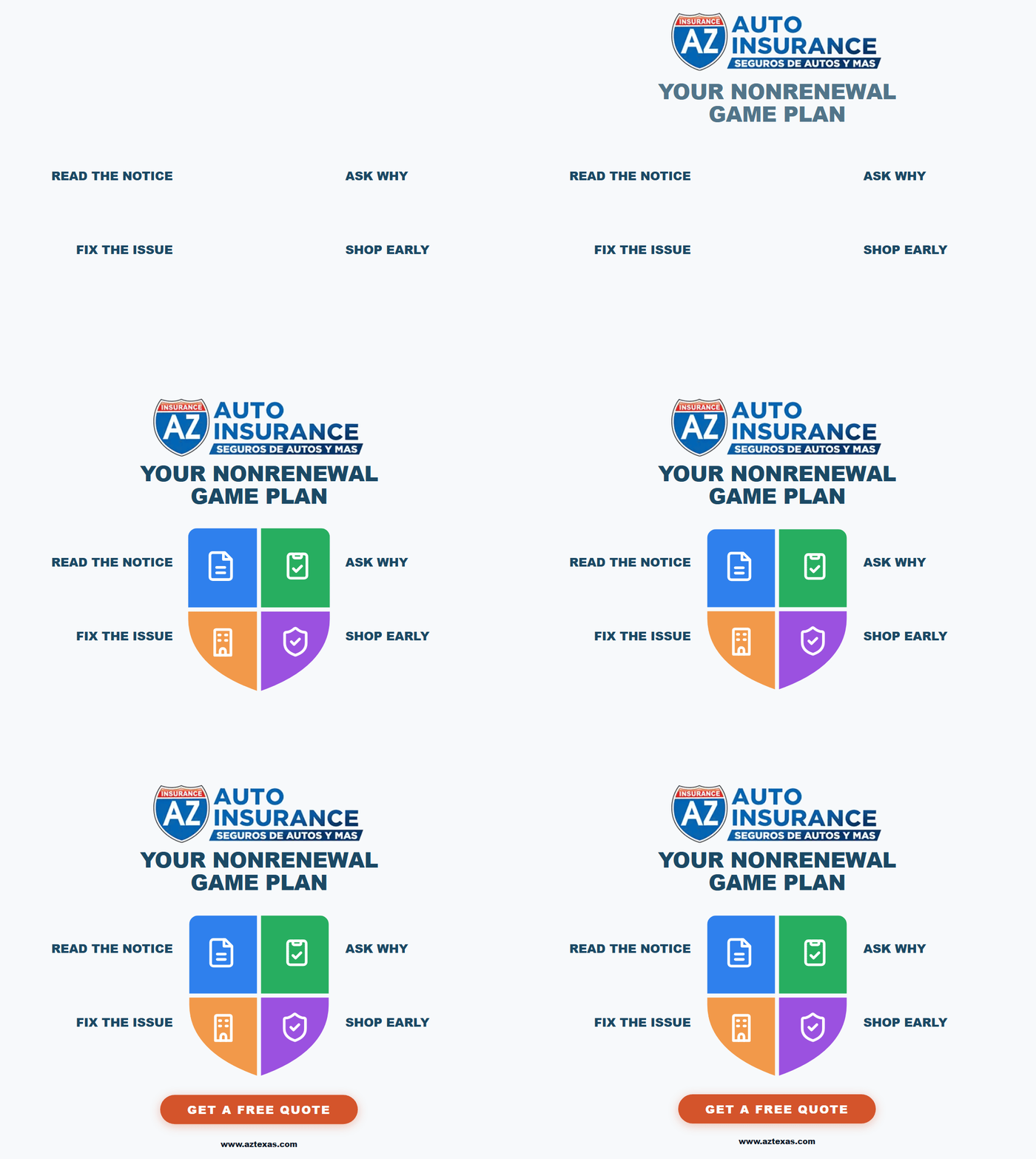
Days 1 to 7: read the letter closely. Confirm the expiration date, check that the notice was mailed at least 60 days out, and read the stated reason and its source. A late notice lets you request a renewal in writing.
Days 1 to 7: check the facts. Pull your CLUE report and compare it to any claim the letter cites. A wrong claim entry is fixable.
Days 8 to 30: fix what you can. A roof repair, a vacancy, a hazard the letter names. Keep invoices and photos, because documented fixes are what new carriers want to see.
Days 8 to 30: start quotes. A local independent agent can quote several carriers at once, which is much faster than one at a time.
Days 31 to 50: compare coverage, not just price. Check the policy form, the deductibles, and the roof terms. A cheaper policy that pays your roof at actual cash value can cost more after one hail claim.
Days 51 to 60: bind the new policy so it starts the day the old one ends. A gap in coverage on a mortgaged home can lead the lender to place its own coverage on the loan and bill you for it.
A few practical notes.
Gather your quote documents once. A new carrier will want your current declarations page, roof age and material, updates to wiring, plumbing and HVAC, and your claims history. Our list of information needed for a homeowners insurance quote saves a round of phone tag.
Do not shrink coverage just to get a yes. A nonrenewal is a bad time to guess at your dwelling limit. Check how much dwelling coverage your Houston home needs and understand the difference between HO-A, HO-B and HO-3 policies in Texas before you accept a narrower form.
Read the wind and hail deductible. Many replacement policies carry a percentage deductible. Our guide on why a 2 percent storm deductible does not mean $200 walks through the math.
Flood is still separate. No standard homeowners policy covers flood. If you are rebuilding your coverage from scratch, it is the right moment to look at whether homeowners insurance covers flood in Texas and NFIP vs private flood in Houston.
If you believe the nonrenewal was unfair, file a complaint. TDI says you may file a complaint if you think a company nonrenewed or canceled your policy unfairly. Use the TDI complaint page or call the TDI Help Line at 800-252-3439. Keep shopping while it is reviewed, because a complaint does not extend your coverage.
Your options if the standard market says no
Most Houston homeowners who get a nonrenewal find a new policy with another licensed carrier. When that does not happen, there are three other doors, and they are not equal.
Option | Who it is for | What to know |
|---|---|---|
Another Texas licensed insurer | Almost everyone, and the first place to look | Backed by the Texas guaranty association if the company fails (TDI) |
Surplus lines insurer | Homes standard companies will not write | Not a member of a guaranty association. Your agent must try licensed companies first (TDI) |
Texas FAIR Plan | Homeowners turned down by at least two licensed insurers actually writing property insurance in Texas | Sold only through an agent. Dwelling coverage up to $1,000,000 (TFPA) |
TWIA | Wind and hail only, in the 14 coastal counties and part of Harris County | Not a full homeowners policy. TDI notes TWIA will not sell a policy while a hurricane is in the Gulf |
Surplus lines. TDI's surplus lines guide says some people buy surplus lines policies when they cannot get homeowners insurance from a standard company, and that unlike Texas licensed companies, surplus lines companies are not members of a guaranty association. The notice and reason rules in this article are written for authorized insurers in Chapter 551, so read a surplus lines policy's own cancellation and nonrenewal terms before you sign.
The Texas FAIR Plan. The FAIR Plan is the state's homeowners insurer of last resort. Per its eligibility rules, you must have been denied by at least two companies licensed to write and actually writing property insurance in Texas, and you are not eligible if you have a current policy, a renewal offer, or a valid offer of comparable coverage from a Texas licensed company. It also does not sell directly to the public, so applications go through an agent. Its coverage summary lists liability limits of $100,000 or $300,000, and in the TWIA catastrophe area its policies carry a windstorm and hail exclusion, which means wind coverage there has to come from TWIA.
TWIA. The Texas Windstorm Insurance Association covers wind and hail along the coast, not your whole house. Whether your address is even in its territory is the first question, and most of Houston is not. See does your Houston home need TWIA windstorm insurance for the city by city answer.
Here is how the choice plays out in real situations.
Scenario | If you wait | If you use the 60 days |
|---|---|---|
Notice cites a 22 year old roof | You shop in week seven, every carrier wants an inspection, and the policy lapses | You schedule the inspection in week one and send new carriers the report with your application |
Notice cites a claim you never filed | The error follows you to every quote | You pull your CLUE report, dispute the entry, and send the correction with your quotes |
Carrier is leaving your ZIP code | You take the first offer, with a narrower form | You compare three offers side by side on form, roof terms and deductible |
Two licensed carriers decline | You go without coverage and the lender force places a policy | Your agent submits a FAIR Plan application with the two declinations in hand |
Key Takeaways
Texas requires 60 days written notice of nonrenewal. If the notice was late, the insurer must renew the policy at your request.
Since January 1, 2026, the written reason must name the precise incident or risk factor and the source of the information. That makes a nonrenewal something you can check and dispute.
Weather claims, unpaid claims, and customer inquiries cannot be used to nonrenew you. The three claim rule also requires a written warning after the second claim.
Your home policy cannot be tied to buying your auto policy from the same insurer. That has been the law since September 1, 2025.
Cancellation is far more restricted than nonrenewal, and it takes at least 10 days notice.
The Texas FAIR Plan is a last resort, open only after two licensed insurers decline, and it is sold only through an agent.
Frequently asked questions
Q: How much notice does a Texas home insurer have to give before it nonrenews my policy?
At least 60 days. Texas Insurance Code Section 551.105 requires written notice mailed no later than the 60th day before the policy expires. If the insurer misses that deadline, it must renew your policy if you ask.
Q: Does my insurer have to tell me why it is not renewing my home insurance?
Yes. Since January 1, 2026, Texas law requires a written statement that states the precise incident, circumstance, or risk factors behind the decision and the source of the information the insurer relied on.
Q: Can my insurance company drop me for filing a storm claim in Texas?
No. Under Section 551.107, a claim for a loss caused by natural causes does not count toward the claims that can be used to nonrenew a homeowners policy. Neither does a claim that was filed but not paid.
Q: How many claims can I file before my Texas home insurer can nonrenew me?
An insurer may refuse to renew if you file three or more qualifying claims in a three year period. But after your second qualifying claim, it must send you a written warning. If it never sent that warning, it cannot nonrenew you because of claims.
Q: Can my insurer drop my home policy because I did not buy my car insurance from them?
No. Since September 1, 2025, Texas law treats it as an unfair practice to make the issuance or renewal of a residential property policy contingent on buying a personal auto policy from the same or an affiliated insurer.
Q: What is the Texas FAIR Plan and how do I qualify?
It is the state's homeowners insurer of last resort. You must have been turned down by at least two companies licensed to write and actually writing property insurance in Texas, and you must not have a valid offer of comparable coverage from a licensed company. You apply through an agent.
Q: Can calling my insurer with a question get me nonrenewed?
No. Section 551.113 bars an insurer from using a customer inquiry, such as asking how to file a claim or whether a loss would be covered, as a basis for nonrenewal or cancellation, as long as the call does not result in an investigation or claim.
Q: My new carrier is cheaper. Is there anything I should check before I switch?
Compare the policy form, the wind and hail deductible, and how the roof is paid after a claim. A lower premium on a narrower form can cost far more after one storm. It also helps to understand how hazard insurance differs from homeowners insurance if your lender uses both terms.
Why AZ Insurance Stands Apart
A nonrenewal letter is not a verdict on your home. It is usually one carrier's appetite changing, and the fix is a second set of eyes and more than one market. AZ Insurance Agency has served Houston homeowners since 2003 from 15 offices across Houston and Dallas, and we shop your home with multiple carriers at once, read the fine print on roof terms and deductibles with you, and make sure your new policy starts the day the old one ends. If you are still sorting out what your current policy covers, start with what homeowners insurance covers and does not cover, then bring us your declarations page and the letter.
Request a free homeowners quote or call our homeowners line at (281) 833-5060, and we will start comparing options for your home.
Related Articles
This article is general information, not legal advice or a promise of coverage. What your policy covers is governed by that policy. We are happy to read it with you.
Quick Answer: In Texas, a home insurer that will not renew your policy must mail written notice at least 60 days before it expires, or renew it if you ask. Since January 1, 2026, it must also give a written statement naming the exact reason and where that information came from. Use the 60 days to challenge errors and shop early.
What this article covers
Nonrenewal and cancellation are not the same letter
How much notice does Texas require?
What the notice must tell you in 2026
Reasons an insurer can use, and reasons it cannot
Which claims count against you
Your 60 day plan
Your options if the standard market says no
Key Takeaways
Frequently asked questions
Nonrenewal and cancellation are not the same letter
The envelope looks the same, but the rules are very different, and knowing which one you are holding tells you how much time you have.
Nonrenewal means your company will not offer you another term when the current one ends. Your coverage stays in force until the expiration date on your declarations page. Cancellation means the company ends coverage before that date.
Texas makes cancellation hard. Under Texas Insurance Code Section 551.104, a homeowners insurer may cancel only if you do not pay the premium, you submit a fraudulent claim, the Texas Department of Insurance determines that continuing the policy would break the law, or there is an increase in the hazard that is within your control and would raise the premium. A cancellation does not take effect until the 10th day after the notice is mailed.
There is one narrow exception for brand new policies. In the first 60 days, a company can also cancel if it finds a condition that increases the risk, was not disclosed on the application, and is not the subject of a prior claim, or if it did not accept a required inspection report.
Nonrenewal | Cancellation | |
|---|---|---|
What happens | The company declines to offer a new term | The company ends coverage early |
Minimum notice | 60 days before expiration | 10 days before it takes effect |
When coverage stops | At the policy's expiration date | On the cancellation effective date |
Allowed reasons | Broader underwriting reasons, with limits on claims | Only the short list in Section 551.104 |
Source |
Most of this article is about nonrenewal, because that is the letter most Houston homeowners have been getting.
How much notice does Texas require?
Sixty days. Section 551.105 says that unless the insurer has mailed written notice of nonrenewal no later than the 60th day before the policy expires, it must renew the policy at the request of the insured.
The Texas Department of Insurance explains the transition plainly on its canceled or not renewed page: a company must give 60 days notice if you bought or renewed your policy in 2024, and 30 days if you bought or renewed it in 2023 or earlier. Any homeowners policy renewing today falls under the 60 day rule.
Three details are worth knowing:
Late notice gives you a choice. If the notice arrived inside the 60 day window, you can ask the company to renew. Put that request in writing and keep a copy.
That renewal ends when you replace it. The same section says the policy terminates on the effective date of any replacement policy with another carrier. So you can hold the renewal while you shop without paying for two policies.
Check your email, not just your mailbox. Section 551.008 lets an insurer deliver these notices electronically under the state's electronic delivery rules. If you agreed to paperless documents, the notice may be sitting in an inbox you rarely open.
Two situations look like a nonrenewal but legally are not one. Moving you to another company inside the same insurance group is not a refusal to renew under Section 551.004. And a renewal offer that cuts your coverage, such as moving your roof to an actual cash value payout, is not a nonrenewal either, as long as the company gives you a plain language notice of each material change at least 30 days before the renewal date under Section 551.1055. That second one is the quieter version of being dropped, and it is worth reading your renewal packet for it. Our guide to actual cash value vs replacement cost in Texas shows what that change means in dollars after a claim.
What the notice must tell you in 2026
This is the part most homeowners do not know yet, and it changes how you fight back.
House Bill 2067 took effect January 1, 2026. It rewrote Section 551.002 and Section 551.109 so that a homeowners insurer that declines, cancels, or refuses to renew must provide a written statement of the reason. The statement must fully explain the decision, and it must:
state the precise incident, circumstance, or risk factors that violate the company's guidelines, and
state the source of the information the company relied on.
Before 2026, a homeowner often had to ask for the reason and could get back something vague like "underwriting guidelines." A precise reason plus a named source is something you can check. If the letter says your roof is in poor condition based on an exterior inspection, you can ask for that inspection. If it cites a claim, you can compare it against your claims history report.
Most companies pull that history from the Comprehensive Loss Underwriting Exchange. The Texas Department of Insurance notes in its home insurance guide that CLUE reports cover seven years and can affect your rate or eligibility. Errors happen, and a wrong entry is one of the few nonrenewal reasons you can make disappear completely.
The same law requires insurers to report their reasons to TDI every quarter, organized by ZIP code, and TDI must post an aggregated summary that does not identify any insurer. That is new public data on why Texans are being dropped, neighborhood by neighborhood.
Reasons an insurer can use, and reasons it cannot
TDI lists the common grounds for nonrenewal on its canceled or not renewed page. The statute adds several things a company is not allowed to hold against you.
An insurer CAN nonrenew because | An insurer CANNOT nonrenew because |
|---|---|
Your house is in worse condition than when you bought the policy | You made a customer inquiry about coverage or how to file a claim (Sec. 551.113) |
You filed three or more qualifying claims in three years, after a written warning | You filed a claim for a loss caused by natural causes (Sec. 551.107) |
Your house has been vacant for 60 days or more | You filed a claim that was not paid or payable |
The company decided to limit the coverage it sells in your area | You declined to buy your auto policy from the same company (Sec. 551.254) |
The notice arrived late and you asked it to renew (Sec. 551.105) |
Two rows deserve a closer look.
Condition. This is the reason behind most roof related letters. If the stated incident is your roof, read how roof age affects Texas home insurance and whether home insurance covers roof damage or leaks before you decide between a repair and a replacement. A documented repair with a contractor's invoice and photos is the strongest thing you can send back.
Bundling. Since September 1, 2025, Texas law treats it as an unfair practice to make the renewal of your homeowners policy contingent on buying your auto policy from the same insurer or an affiliate. A company can still offer you a bundle discount. It cannot make your house coverage depend on it.
Limiting coverage in your area is the one reason you cannot argue with. When a carrier pulls back from a ZIP code, the fix is not a better argument, it is a different carrier, which is why shopping early matters so much.
Which claims count against you
Homeowners are often afraid to file after a storm because they think it will get them dropped. In Texas, weather claims do not count toward the claims rule. Section 551.107 excludes three kinds of claims entirely.
Claim type | Counts toward the three claim rule? |
|---|---|
Hail on the roof, wind damage, a storm tree through the fence | No, a loss caused by natural causes does not count |
A claim you filed that was denied or paid nothing | No, a claim not paid or payable does not count |
Certain appliance related claims the law bars insurers from using | No, excluded under Section 544.353 |
A kitchen fire, theft, a burst pipe, a dog bite liability claim | Yes, these are the claims that count |
A phone call asking whether something would be covered | Not a claim at all, and it cannot be used against you |
The warning rule is where many nonrenewals fall apart. After you file two qualifying claims in less than three years, the company may send you a notice that a third could lead to nonrenewal. If it never sent that notice, the statute says it may not refuse to renew your policy because of claims. TDI says the same thing: if you file two nonweather claims, the company must tell you that you are in danger of nonrenewal.
We cover the storm side of this in detail in will a storm claim raise my Texas home insurance rate and the timing side in what happens when a storm hits before your renewal. The everyday water claims that do count are covered in does homeowners insurance cover plumbing.
Get a free homeowners quote or call (281) 833-5060. Hablamos Español.
Your 60 day plan
Sixty days feels like plenty until a new carrier asks for a roof inspection that takes three weeks to schedule. Here is how we would spend it.
Days 1 to 7: read the letter closely. Confirm the expiration date, check that the notice was mailed at least 60 days out, and read the stated reason and its source. A late notice lets you request a renewal in writing.
Days 1 to 7: check the facts. Pull your CLUE report and compare it to any claim the letter cites. A wrong claim entry is fixable.
Days 8 to 30: fix what you can. A roof repair, a vacancy, a hazard the letter names. Keep invoices and photos, because documented fixes are what new carriers want to see.
Days 8 to 30: start quotes. A local independent agent can quote several carriers at once, which is much faster than one at a time.
Days 31 to 50: compare coverage, not just price. Check the policy form, the deductibles, and the roof terms. A cheaper policy that pays your roof at actual cash value can cost more after one hail claim.
Days 51 to 60: bind the new policy so it starts the day the old one ends. A gap in coverage on a mortgaged home can lead the lender to place its own coverage on the loan and bill you for it.
A few practical notes.
Gather your quote documents once. A new carrier will want your current declarations page, roof age and material, updates to wiring, plumbing and HVAC, and your claims history. Our list of information needed for a homeowners insurance quote saves a round of phone tag.
Do not shrink coverage just to get a yes. A nonrenewal is a bad time to guess at your dwelling limit. Check how much dwelling coverage your Houston home needs and understand the difference between HO-A, HO-B and HO-3 policies in Texas before you accept a narrower form.
Read the wind and hail deductible. Many replacement policies carry a percentage deductible. Our guide on why a 2 percent storm deductible does not mean $200 walks through the math.
Flood is still separate. No standard homeowners policy covers flood. If you are rebuilding your coverage from scratch, it is the right moment to look at whether homeowners insurance covers flood in Texas and NFIP vs private flood in Houston.
If you believe the nonrenewal was unfair, file a complaint. TDI says you may file a complaint if you think a company nonrenewed or canceled your policy unfairly. Use the TDI complaint page or call the TDI Help Line at 800-252-3439. Keep shopping while it is reviewed, because a complaint does not extend your coverage.
Your options if the standard market says no
Most Houston homeowners who get a nonrenewal find a new policy with another licensed carrier. When that does not happen, there are three other doors, and they are not equal.
Option | Who it is for | What to know |
|---|---|---|
Another Texas licensed insurer | Almost everyone, and the first place to look | Backed by the Texas guaranty association if the company fails (TDI) |
Surplus lines insurer | Homes standard companies will not write | Not a member of a guaranty association. Your agent must try licensed companies first (TDI) |
Texas FAIR Plan | Homeowners turned down by at least two licensed insurers actually writing property insurance in Texas | Sold only through an agent. Dwelling coverage up to $1,000,000 (TFPA) |
TWIA | Wind and hail only, in the 14 coastal counties and part of Harris County | Not a full homeowners policy. TDI notes TWIA will not sell a policy while a hurricane is in the Gulf |
Surplus lines. TDI's surplus lines guide says some people buy surplus lines policies when they cannot get homeowners insurance from a standard company, and that unlike Texas licensed companies, surplus lines companies are not members of a guaranty association. The notice and reason rules in this article are written for authorized insurers in Chapter 551, so read a surplus lines policy's own cancellation and nonrenewal terms before you sign.
The Texas FAIR Plan. The FAIR Plan is the state's homeowners insurer of last resort. Per its eligibility rules, you must have been denied by at least two companies licensed to write and actually writing property insurance in Texas, and you are not eligible if you have a current policy, a renewal offer, or a valid offer of comparable coverage from a Texas licensed company. It also does not sell directly to the public, so applications go through an agent. Its coverage summary lists liability limits of $100,000 or $300,000, and in the TWIA catastrophe area its policies carry a windstorm and hail exclusion, which means wind coverage there has to come from TWIA.
TWIA. The Texas Windstorm Insurance Association covers wind and hail along the coast, not your whole house. Whether your address is even in its territory is the first question, and most of Houston is not. See does your Houston home need TWIA windstorm insurance for the city by city answer.
Here is how the choice plays out in real situations.
Scenario | If you wait | If you use the 60 days |
|---|---|---|
Notice cites a 22 year old roof | You shop in week seven, every carrier wants an inspection, and the policy lapses | You schedule the inspection in week one and send new carriers the report with your application |
Notice cites a claim you never filed | The error follows you to every quote | You pull your CLUE report, dispute the entry, and send the correction with your quotes |
Carrier is leaving your ZIP code | You take the first offer, with a narrower form | You compare three offers side by side on form, roof terms and deductible |
Two licensed carriers decline | You go without coverage and the lender force places a policy | Your agent submits a FAIR Plan application with the two declinations in hand |
Key Takeaways
Texas requires 60 days written notice of nonrenewal. If the notice was late, the insurer must renew the policy at your request.
Since January 1, 2026, the written reason must name the precise incident or risk factor and the source of the information. That makes a nonrenewal something you can check and dispute.
Weather claims, unpaid claims, and customer inquiries cannot be used to nonrenew you. The three claim rule also requires a written warning after the second claim.
Your home policy cannot be tied to buying your auto policy from the same insurer. That has been the law since September 1, 2025.
Cancellation is far more restricted than nonrenewal, and it takes at least 10 days notice.
The Texas FAIR Plan is a last resort, open only after two licensed insurers decline, and it is sold only through an agent.
Frequently asked questions
Q: How much notice does a Texas home insurer have to give before it nonrenews my policy?
At least 60 days. Texas Insurance Code Section 551.105 requires written notice mailed no later than the 60th day before the policy expires. If the insurer misses that deadline, it must renew your policy if you ask.
Q: Does my insurer have to tell me why it is not renewing my home insurance?
Yes. Since January 1, 2026, Texas law requires a written statement that states the precise incident, circumstance, or risk factors behind the decision and the source of the information the insurer relied on.
Q: Can my insurance company drop me for filing a storm claim in Texas?
No. Under Section 551.107, a claim for a loss caused by natural causes does not count toward the claims that can be used to nonrenew a homeowners policy. Neither does a claim that was filed but not paid.
Q: How many claims can I file before my Texas home insurer can nonrenew me?
An insurer may refuse to renew if you file three or more qualifying claims in a three year period. But after your second qualifying claim, it must send you a written warning. If it never sent that warning, it cannot nonrenew you because of claims.
Q: Can my insurer drop my home policy because I did not buy my car insurance from them?
No. Since September 1, 2025, Texas law treats it as an unfair practice to make the issuance or renewal of a residential property policy contingent on buying a personal auto policy from the same or an affiliated insurer.
Q: What is the Texas FAIR Plan and how do I qualify?
It is the state's homeowners insurer of last resort. You must have been turned down by at least two companies licensed to write and actually writing property insurance in Texas, and you must not have a valid offer of comparable coverage from a licensed company. You apply through an agent.
Q: Can calling my insurer with a question get me nonrenewed?
No. Section 551.113 bars an insurer from using a customer inquiry, such as asking how to file a claim or whether a loss would be covered, as a basis for nonrenewal or cancellation, as long as the call does not result in an investigation or claim.
Q: My new carrier is cheaper. Is there anything I should check before I switch?
Compare the policy form, the wind and hail deductible, and how the roof is paid after a claim. A lower premium on a narrower form can cost far more after one storm. It also helps to understand how hazard insurance differs from homeowners insurance if your lender uses both terms.
Why AZ Insurance Stands Apart
A nonrenewal letter is not a verdict on your home. It is usually one carrier's appetite changing, and the fix is a second set of eyes and more than one market. AZ Insurance Agency has served Houston homeowners since 2003 from 15 offices across Houston and Dallas, and we shop your home with multiple carriers at once, read the fine print on roof terms and deductibles with you, and make sure your new policy starts the day the old one ends. If you are still sorting out what your current policy covers, start with what homeowners insurance covers and does not cover, then bring us your declarations page and the letter.
Request a free homeowners quote or call our homeowners line at (281) 833-5060, and we will start comparing options for your home.
Related Articles
This article is general information, not legal advice or a promise of coverage. What your policy covers is governed by that policy. We are happy to read it with you.
Latest Blogs

General Liability Will Not Pay for a Mistake. What Professional Liability Covers in Texas

What Does Cyber Insurance Cover (and Not Cover)? Full Guide

How Much Is ATV Insurance? Average Costs and Factors

Your Tools Were Stolen Off the Truck. Which Policy Actually Pays?

What Does an Umbrella Insurance Policy Cover? (And What It Doesn't)

How Much Does Flood Insurance Cost in Texas? (2026 Pricing Guide)
Let A-Z Auto Insurance Help You Find Affordable Coverage
Connect with our experienced team today & get reliable, affordable insurance designed around your needs.
Contact Us!
Let A-Z Auto Insurance Help
You Find Affordable Coverage
Connect with our experienced team today & get reliable, affordable insurance designed around your needs.
Contact Us!
Let A-Z Auto
Insurance Help You
Find Affordable Coverage
Connect with our experienced team today & get reliable, affordable insurance designed around your needs.
Contact Us!
Let A-Z Auto Insurance Help
You Find Affordable Coverage
Connect with our experienced team today & get reliable, affordable insurance designed around your needs.
Contact Us!
Latest New & Blogs
Latest New & Blogs
Related Blog Posts
Related Blog Posts
How Much Is ATV Insurance? Average Costs and Factors
Learn how much ATV insurance costs, from liability to full coverage, plus the factors that affect your premium and ways to save. Visit now!
How Much Is ATV Insurance? Average Costs and Factors
Learn how much ATV insurance costs, from liability to full coverage, plus the factors that affect your premium and ways to save. Visit now!
How Much Is ATV Insurance? Average Costs and Factors
Learn how much ATV insurance costs, from liability to full coverage, plus the factors that affect your premium and ways to save. Visit now!
Your Tools Were Stolen Off the Truck. Which Policy Actually Pays?
General liability covers other people's property. Commercial auto pays for the broken window, not what was inside. Here is the policy that actually replaces your tools.
Your Tools Were Stolen Off the Truck. Which Policy Actually Pays?
General liability covers other people's property. Commercial auto pays for the broken window, not what was inside. Here is the policy that actually replaces your tools.
Your Tools Were Stolen Off the Truck. Which Policy Actually Pays?
General liability covers other people's property. Commercial auto pays for the broken window, not what was inside. Here is the policy that actually replaces your tools.
What Does an Umbrella Insurance Policy Cover? (And What It Doesn't)
Wondering what does an umbrella insurance policy cover? See what's included what's excluded, and if you need extra liability protection.
What Does an Umbrella Insurance Policy Cover? (And What It Doesn't)
Wondering what does an umbrella insurance policy cover? See what's included what's excluded, and if you need extra liability protection.
What Does an Umbrella Insurance Policy Cover? (And What It Doesn't)
Wondering what does an umbrella insurance policy cover? See what's included what's excluded, and if you need extra liability protection.
How Much Is ATV Insurance? Average Costs and Factors
Learn how much ATV insurance costs, from liability to full coverage, plus the factors that affect your premium and ways to save. Visit now!
Your Tools Were Stolen Off the Truck. Which Policy Actually Pays?
General liability covers other people's property. Commercial auto pays for the broken window, not what was inside. Here is the policy that actually replaces your tools.