Quick support from trusted insurance professionals Call +1 713-777-2886 today! |
Call +1 713-777-2886
Call +1 713-777-2886
Quick support from insurance professionals Call +1 713-777-2886 today! |


Table of Content
Title
Let AZ Insurance Help You
Find Affordable Coverage
Connect with our experienced team today & get reliable, affordable insurance designed around your needs.
Contact Us!

Let A-Z Auto Insurance Help You Find Affordable Coverage
Connect with our experienced team today & get reliable, affordable insurance designed around your needs.
Contact Us!
Your Tools Were Stolen Off the Truck. Which Policy Actually Pays?
Your Tools Were Stolen Off the Truck. Which Policy Actually Pays?
Your Tools Were Stolen Off the Truck. Which Policy Actually Pays?
Your Tools Were Stolen Off the Truck. Which Policy Actually Pays?
Your Tools Were Stolen Off the Truck. Which Policy Actually Pays?
Quick Answer: General liability, commercial property and commercial auto all decline a stolen tools claim: liability only covers harm to others, property stops at your shop, and auto pays for the vehicle, not the contents. The policy that replaces stolen tools is inland marine, usually an equipment floater covering tools in transit, at job sites and in storage.
What this article covers
Why each policy says no
What inland marine actually is, despite the name
The Houston number, and an honest note about its age
The three things that decide whether your claim actually pays
Two traps specific to the Gulf Coast
Who this hits hardest
What to do this week
Frequently asked questions
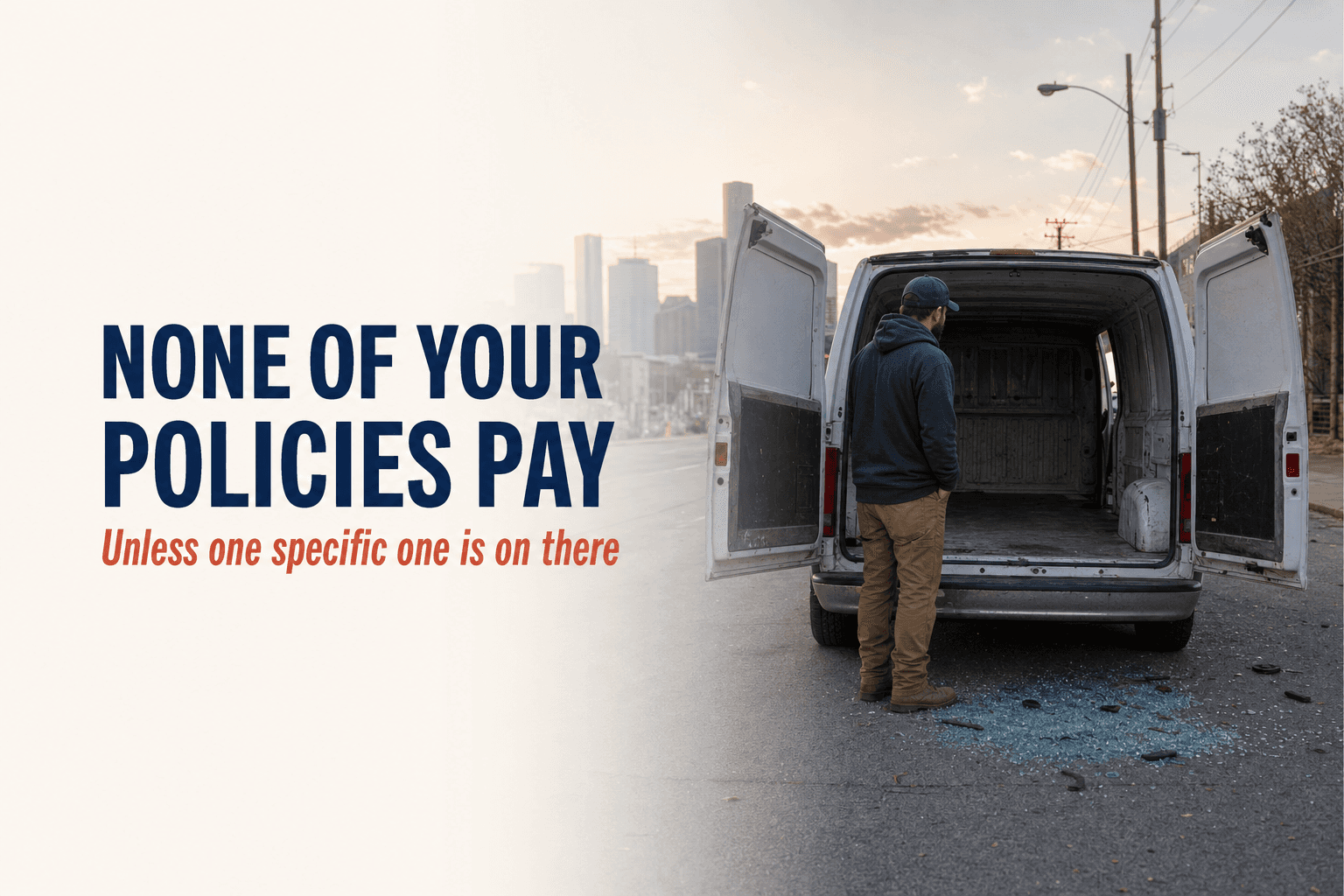
A plumbing contractor parks on a street off Washington Avenue on a Thursday night. By Friday morning the rear window of the van is on the pavement and everything behind the bulkhead is gone: two press tools, a camera, a jackhammer, and the hand tools three guys need to work that day.
He has general liability. He has commercial auto. He has a business owners policy. He files, and he is told the auto policy will pay for the window.
That is not a mistake by the carrier. It is what those three policies say.
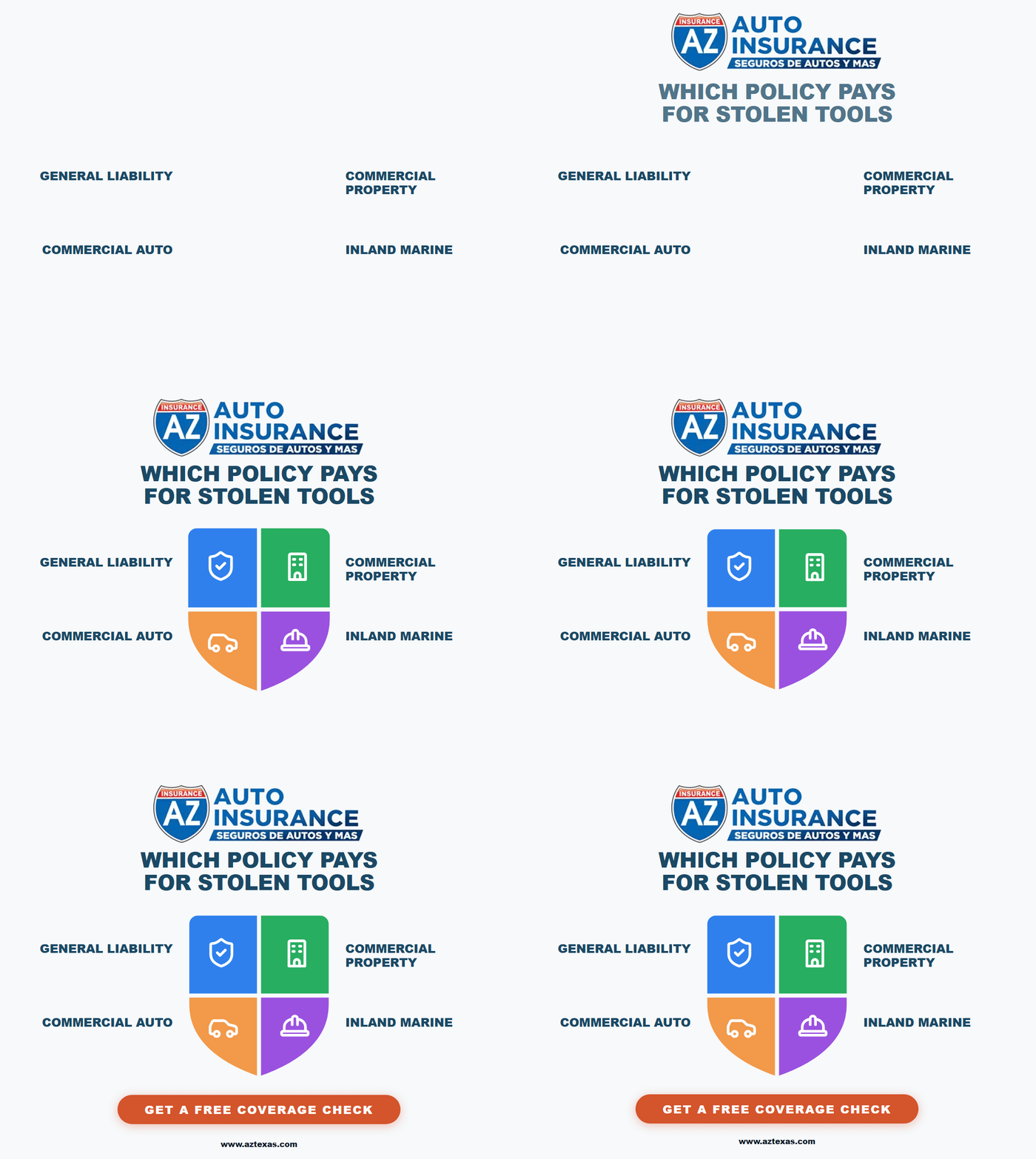
General liability covers harm you cause to other people and their property, so it never covers your own tools. Commercial property coverage is written around a fixed location, so it usually stops at your shop door. Commercial auto insures the vehicle itself, which is why it pays for the smashed window and not for what was taken through it. The policy that actually replaces stolen tools is inland marine, normally written as a contractors equipment floater or a tools and equipment policy, and on most Houston contractors it is either missing or set at a limit from years ago.
Key Takeaways
Three policies you already pay for all decline this claim, and each for a different reason. None of them is being unfair.
Inland marine is the answer, usually as an equipment floater covering tools in transit and at the job site.
Scheduled versus blanket matters more than the limit does. High value items often have to be listed by serial number to be covered at all.
Texas led the country in heavy equipment theft and Houston led every city, per the last comprehensive report in the series.
Only 23 percent of stolen heavy equipment was recovered in that same report.
Coastal Houston contractors have a second trap: named storm deductibles and flood exclusions apply to equipment policies too, not just to buildings.
Replacement cost or actual cash value is the question that decides what you actually get. A five year old rotary hammer at actual cash value is not a new rotary hammer.
Why each policy says no
Policy | What it is built for | Why the stolen tools claim fails |
|---|---|---|
General liability | Injury or damage you cause to others | Your tools are your property, not a third party's |
Commercial property | Buildings and contents at a described location | The van and the job site are not the described location |
Commercial auto | The vehicle and liability arising from it | Pays for the glass and the door, not the cargo |
Business owners policy | Liability plus property at your premises | Contains the same location limit as property above |
Inland marine | Property that moves | This is the one that pays |
The pattern is worth sitting with for a second. Insurance is organized around what a policy is for, not around what feels like it should be covered. The Texas Department of Insurance describes commercial general liability as protecting against claims for bodily injury, property damage and personal and advertising injury, all of which are claims made against you by somebody else. A theft from your own van is not a claim against you. Nobody is suing you. There is no third party. That is why the coverage does not engage, and the same logic is what we walked through in does general liability cover customer property damage, where the answer flips because the property belongs to someone else.
Commercial property is the one that surprises people most, because they do own property coverage. But that coverage is written against a described premises. Your shop is covered. The gear in the van at 6am on a Tuesday is not at your shop. Our explainer on business personal property goes through what that coverage is actually counting, and commercial property in Houston covers the building side.
Commercial auto is the cruelest of the three, because it pays something. The glass, the door skin, the ignition column if they punched it. All covered. The contents are not part of the vehicle, so they sit outside the policy entirely. If you want the wider picture on that coverage, why Houston contractors need commercial auto before starting any job and what commercial auto is and whether you need it both cover it properly.
What inland marine actually is, despite the name
The name is a historical accident. Marine insurance covered cargo at sea, then extended inland to cargo moving over land, and the label stuck to an entire category of coverage for property that moves or that sits somewhere other than a fixed address.
For a contractor it normally arrives as one of two forms:
An equipment floater, sometimes called contractors equipment coverage. This covers tools and equipment you own while they are in transit, while they are at a job site, and while they are stored. This is the one that answers the van break in.
An installation floater. This covers materials you have bought and are installing but have not yet finished installing, at which point they usually become the property owner's problem rather than yours.
Covered causes of loss generally include theft, fire, vandalism, wind and certain kinds of water damage. It can be written to cover equipment you own, and separately equipment you rent or lease, which matters because a rental agreement almost always makes you responsible for the machine from the moment it leaves the yard.
A business owners policy sometimes includes a small amount of this by endorsement, often a few thousand dollars. That is a courtesy, not a solution, and it is worth checking what yours actually says before you rely on it.
What changes when inland marine is on the policy
Scenario | Without inland marine | With an equipment floater |
|---|---|---|
Tools taken from the van overnight | Commercial auto pays for the window only | Paid up to your limit, minus the deductible |
Generator stolen from a job site | Nothing responds | Covered at the job site |
Rented skid steer stolen from the site | You owe the rental company | Covered if rented equipment is written in |
Materials stolen before you install them | Usually yours to replace | Covered under an installation floater |
Equipment flooded on a job site | Excluded | Still excluded unless flood is endorsed |
Get a free tools and equipment coverage check or call (281) 833-6755. Hablamos Español.
The Houston number, and an honest note about its age
Texas leads the country in heavy equipment theft and Houston leads every city in Texas.
In the National Insurance Crime Bureau's 2014 Heavy Equipment Theft Report, produced with the National Equipment Register, Texas ranked first among states with 1,650 reported thefts, ahead of North Carolina at 918 and Florida at 915. Among cities, Houston was first with 201, followed by Miami at 105 and San Antonio at 83. Nationally 11,625 heavy equipment thefts were reported to law enforcement that year. The prior year's report put Texas first as well, with 1,494 thefts and Houston again first among cities at 199.
Two honest caveats, because you will see these numbers quoted everywhere without them. First, this is 2014 data. The National Insurance Crime Bureau and the National Equipment Register stopped publishing detailed public annual equipment theft reports after 2016, which is why nearly every "2026 construction theft statistics" page you find is recycling this same decade old dataset without saying so. Second, this report counts heavy equipment, the machines, not the hand tools in the back of a van. Hand tool theft is not systematically tracked anywhere, which is precisely why it is easy to underestimate.
The recovery figure is the one that should change behavior: only 23 percent of the heavy equipment stolen in 2014 was ever recovered. Whatever has happened to the rate since, the shape of the problem has not changed. You are far more likely to be replacing the machine than getting it back.
The three things that decide whether your claim actually pays
Having the policy is step one. These three decide the outcome.
1. Scheduled or blanket. A blanket limit covers a category of items up to a total figure and is the right structure for a large number of moderately priced tools. Scheduled coverage lists specific items, usually by serial number and value, and is how high value equipment is normally written. The trap is assuming blanket reaches everything. On many policies, theft of a specific piece is covered only if that piece is actually scheduled. Pull your schedule and read it before a loss, not after.
2. Replacement cost or actual cash value. Replacement cost pays what it costs to buy the item today. Actual cash value subtracts depreciation first. On tools, which depreciate fast and get used hard, that gap is enormous. A five year old rotary hammer settled at actual cash value does not buy a new rotary hammer, and the difference comes out of your pocket at exactly the moment you cannot work.
3. The limit, set once and never revisited. This is the most common failure we see. A contractor sets a $15,000 limit when he starts, buys steadily for six years, and never updates it. Then $40,000 walks out of a van and the policy does exactly what it promised: it pays $15,000. That is not a denied claim, it is a covered claim that ran out, the same arithmetic that drives contractors toward a commercial umbrella on the liability side.
The five settings, side by side
Policy setting | What it means | Where it bites |
|---|---|---|
Blanket limit | One total covers a whole category of tools | A single expensive item may not be covered unless scheduled |
Scheduled items | Specific pieces listed by serial number and value | Anything bought since the last update is not on the list |
Replacement cost | Pays what the item costs to buy today | Higher premium, but the check buys a working tool |
Actual cash value | Pays today's price minus depreciation | Hard used tools settle far below the cost to replace them |
The limit itself | The most the policy pays for one loss | Set once and never revisited, it runs out on a big theft |
Two traps specific to the Gulf Coast
Equipment coverage is not exempt from the things that complicate every other Houston policy.
Flood is normally excluded. Standard inland marine forms cover wind damage but exclude flood, which in this region is not a theoretical distinction. Equipment sitting on a job site in a flood prone part of Harris County needs that addressed deliberately, either by endorsement or through a separate policy. The same divide we wrote about for buildings in commercial flood insurance in Houston applies to the machines standing next to them.
Named storm deductibles apply here too. In coastal wind exposed areas it is common for a percentage deductible to apply to a named storm loss rather than a flat dollar figure, exactly as it does on property. Percentage deductibles are the single most misunderstood item in Texas insurance and they are worth working out once, in advance, on paper.
Who this hits hardest
Solo operators and small crews, where the tools are most of the balance sheet. For a sole proprietor a van break in is not an inconvenience, it is the business stopping.
Trades with expensive portable gear: plumbing, HVAC, electrical, concrete, tree service. The same coverage gap we mapped for landscaping and lawn care sits under all of them.
Anyone renting equipment, because the rental contract makes the machine your responsibility and your general liability will not answer for it.
Contractors using 1099 help, where tool ownership gets blurry and nobody has quite established whose policy is supposed to respond.
Mobile businesses generally, including food trucks and cleaning companies, whose entire operation is equipment that moves.
What to do this week
Find out whether you have inland marine at all. It will appear on your declarations page as inland marine, contractors equipment, or tools and equipment. If none of those words appear, you do not have it.
Add up what is actually in the van and the trailer today, at what it would cost to rebuy, not what you paid.
Compare that number to your limit. Most contractors who do this exercise find they are underinsured by a factor of two or more.
Check whether it is replacement cost or actual cash value.
Schedule anything expensive, with serial numbers. Photograph it while you are at it, because a claim moves faster with a list than with a memory.
Ask specifically about rented and leased equipment, if you ever rent.
None of that requires a new policy to start. It requires knowing what the current one says, which is a fifteen minute job and is the same discipline that decides whether a certificate you hand a general contractor is actually accurate.
Frequently asked questions
Q: Does general liability cover my stolen tools?
No. General liability covers bodily injury and property damage you cause to other people. Your own tools are your property, so there is no third party claim for the policy to respond to. This is one of the most common misunderstandings we correct.
Q: My tools were stolen out of my work van. Will commercial auto pay?
It will normally pay to repair the vehicle, including the broken window or damaged door, but not to replace the contents. Property stored inside a vehicle needs inland marine or a tools and equipment policy to be covered against theft.
Q: What is inland marine insurance and why is it called that?
It is coverage for property that moves or that sits somewhere other than a fixed address. The name comes from marine cargo insurance, which extended inland to goods moving over land, and the label stuck. For contractors it is usually written as an equipment floater covering tools in transit, at a job site and in storage.
Q: Does my business owners policy already include tools coverage?
Sometimes a small amount by endorsement, often only a few thousand dollars. A BOP's property coverage is built around a described location, so gear in a van or on a job site usually sits outside it. Check the declarations page rather than assume.
Q: Do I have to list every tool by serial number?
Not every tool. Lower value items are normally covered under a blanket limit for the category. High value equipment is typically scheduled individually, and on many policies theft of a specific piece is covered only if that piece is scheduled. Pull the schedule and read it.
Q: Does it cover equipment I rent?
Only if the policy is written to include rented or leased equipment, which is a specific choice rather than a default. It matters because a rental agreement almost always makes you responsible for the machine from the moment it leaves the yard. Call our business line at (281) 833-6755 and we will check your form.
Q: How likely am I to get stolen equipment back?
Historically, not very. The National Insurance Crime Bureau's 2014 Heavy Equipment Theft Report found only 23 percent of stolen heavy equipment was recovered. That report also ranked Texas first among states and Houston first among cities. It is 2014 data, the last comprehensive public dataset in that series, and it counts machines rather than hand tools.
Q: Will a theft claim get my policy cancelled?
Not mid term, in most cases. Once a Texas liability policy is past its first 60 days or has been renewed, the permitted reasons for cancellation are narrow and a claim is not among them. It can absolutely affect whether you are renewed. We laid out how that works in what can actually cancel or void your general liability policy in Texas.
Related Articles
Why AZ Insurance Stands Apart
Most agencies quote a contractor general liability and a van, collect the premium and never ask what is in the back of the van. We ask, because the gear is usually worth more than the vehicle and it is the one thing that stops the business cold when it disappears overnight. We are independent, we have been in Houston since 2003, and we compare multiple insurance companies rather than defending a single carrier's form.
Add up what is in your truck today and bring us the number along with your declarations page. Request a free tools and equipment coverage check or call our business line at (281) 833-6755, and we will tell you exactly what your current policies would and would not have paid.
Quick Answer: General liability, commercial property and commercial auto all decline a stolen tools claim: liability only covers harm to others, property stops at your shop, and auto pays for the vehicle, not the contents. The policy that replaces stolen tools is inland marine, usually an equipment floater covering tools in transit, at job sites and in storage.
What this article covers
Why each policy says no
What inland marine actually is, despite the name
The Houston number, and an honest note about its age
The three things that decide whether your claim actually pays
Two traps specific to the Gulf Coast
Who this hits hardest
What to do this week
Frequently asked questions
A plumbing contractor parks on a street off Washington Avenue on a Thursday night. By Friday morning the rear window of the van is on the pavement and everything behind the bulkhead is gone: two press tools, a camera, a jackhammer, and the hand tools three guys need to work that day.
He has general liability. He has commercial auto. He has a business owners policy. He files, and he is told the auto policy will pay for the window.
That is not a mistake by the carrier. It is what those three policies say.
General liability covers harm you cause to other people and their property, so it never covers your own tools. Commercial property coverage is written around a fixed location, so it usually stops at your shop door. Commercial auto insures the vehicle itself, which is why it pays for the smashed window and not for what was taken through it. The policy that actually replaces stolen tools is inland marine, normally written as a contractors equipment floater or a tools and equipment policy, and on most Houston contractors it is either missing or set at a limit from years ago.
Key Takeaways
Three policies you already pay for all decline this claim, and each for a different reason. None of them is being unfair.
Inland marine is the answer, usually as an equipment floater covering tools in transit and at the job site.
Scheduled versus blanket matters more than the limit does. High value items often have to be listed by serial number to be covered at all.
Texas led the country in heavy equipment theft and Houston led every city, per the last comprehensive report in the series.
Only 23 percent of stolen heavy equipment was recovered in that same report.
Coastal Houston contractors have a second trap: named storm deductibles and flood exclusions apply to equipment policies too, not just to buildings.
Replacement cost or actual cash value is the question that decides what you actually get. A five year old rotary hammer at actual cash value is not a new rotary hammer.
Why each policy says no
Policy | What it is built for | Why the stolen tools claim fails |
|---|---|---|
General liability | Injury or damage you cause to others | Your tools are your property, not a third party's |
Commercial property | Buildings and contents at a described location | The van and the job site are not the described location |
Commercial auto | The vehicle and liability arising from it | Pays for the glass and the door, not the cargo |
Business owners policy | Liability plus property at your premises | Contains the same location limit as property above |
Inland marine | Property that moves | This is the one that pays |
The pattern is worth sitting with for a second. Insurance is organized around what a policy is for, not around what feels like it should be covered. The Texas Department of Insurance describes commercial general liability as protecting against claims for bodily injury, property damage and personal and advertising injury, all of which are claims made against you by somebody else. A theft from your own van is not a claim against you. Nobody is suing you. There is no third party. That is why the coverage does not engage, and the same logic is what we walked through in does general liability cover customer property damage, where the answer flips because the property belongs to someone else.
Commercial property is the one that surprises people most, because they do own property coverage. But that coverage is written against a described premises. Your shop is covered. The gear in the van at 6am on a Tuesday is not at your shop. Our explainer on business personal property goes through what that coverage is actually counting, and commercial property in Houston covers the building side.
Commercial auto is the cruelest of the three, because it pays something. The glass, the door skin, the ignition column if they punched it. All covered. The contents are not part of the vehicle, so they sit outside the policy entirely. If you want the wider picture on that coverage, why Houston contractors need commercial auto before starting any job and what commercial auto is and whether you need it both cover it properly.
What inland marine actually is, despite the name
The name is a historical accident. Marine insurance covered cargo at sea, then extended inland to cargo moving over land, and the label stuck to an entire category of coverage for property that moves or that sits somewhere other than a fixed address.
For a contractor it normally arrives as one of two forms:
An equipment floater, sometimes called contractors equipment coverage. This covers tools and equipment you own while they are in transit, while they are at a job site, and while they are stored. This is the one that answers the van break in.
An installation floater. This covers materials you have bought and are installing but have not yet finished installing, at which point they usually become the property owner's problem rather than yours.
Covered causes of loss generally include theft, fire, vandalism, wind and certain kinds of water damage. It can be written to cover equipment you own, and separately equipment you rent or lease, which matters because a rental agreement almost always makes you responsible for the machine from the moment it leaves the yard.
A business owners policy sometimes includes a small amount of this by endorsement, often a few thousand dollars. That is a courtesy, not a solution, and it is worth checking what yours actually says before you rely on it.
What changes when inland marine is on the policy
Scenario | Without inland marine | With an equipment floater |
|---|---|---|
Tools taken from the van overnight | Commercial auto pays for the window only | Paid up to your limit, minus the deductible |
Generator stolen from a job site | Nothing responds | Covered at the job site |
Rented skid steer stolen from the site | You owe the rental company | Covered if rented equipment is written in |
Materials stolen before you install them | Usually yours to replace | Covered under an installation floater |
Equipment flooded on a job site | Excluded | Still excluded unless flood is endorsed |
Get a free tools and equipment coverage check or call (281) 833-6755. Hablamos Español.
The Houston number, and an honest note about its age
Texas leads the country in heavy equipment theft and Houston leads every city in Texas.
In the National Insurance Crime Bureau's 2014 Heavy Equipment Theft Report, produced with the National Equipment Register, Texas ranked first among states with 1,650 reported thefts, ahead of North Carolina at 918 and Florida at 915. Among cities, Houston was first with 201, followed by Miami at 105 and San Antonio at 83. Nationally 11,625 heavy equipment thefts were reported to law enforcement that year. The prior year's report put Texas first as well, with 1,494 thefts and Houston again first among cities at 199.
Two honest caveats, because you will see these numbers quoted everywhere without them. First, this is 2014 data. The National Insurance Crime Bureau and the National Equipment Register stopped publishing detailed public annual equipment theft reports after 2016, which is why nearly every "2026 construction theft statistics" page you find is recycling this same decade old dataset without saying so. Second, this report counts heavy equipment, the machines, not the hand tools in the back of a van. Hand tool theft is not systematically tracked anywhere, which is precisely why it is easy to underestimate.
The recovery figure is the one that should change behavior: only 23 percent of the heavy equipment stolen in 2014 was ever recovered. Whatever has happened to the rate since, the shape of the problem has not changed. You are far more likely to be replacing the machine than getting it back.
The three things that decide whether your claim actually pays
Having the policy is step one. These three decide the outcome.
1. Scheduled or blanket. A blanket limit covers a category of items up to a total figure and is the right structure for a large number of moderately priced tools. Scheduled coverage lists specific items, usually by serial number and value, and is how high value equipment is normally written. The trap is assuming blanket reaches everything. On many policies, theft of a specific piece is covered only if that piece is actually scheduled. Pull your schedule and read it before a loss, not after.
2. Replacement cost or actual cash value. Replacement cost pays what it costs to buy the item today. Actual cash value subtracts depreciation first. On tools, which depreciate fast and get used hard, that gap is enormous. A five year old rotary hammer settled at actual cash value does not buy a new rotary hammer, and the difference comes out of your pocket at exactly the moment you cannot work.
3. The limit, set once and never revisited. This is the most common failure we see. A contractor sets a $15,000 limit when he starts, buys steadily for six years, and never updates it. Then $40,000 walks out of a van and the policy does exactly what it promised: it pays $15,000. That is not a denied claim, it is a covered claim that ran out, the same arithmetic that drives contractors toward a commercial umbrella on the liability side.
The five settings, side by side
Policy setting | What it means | Where it bites |
|---|---|---|
Blanket limit | One total covers a whole category of tools | A single expensive item may not be covered unless scheduled |
Scheduled items | Specific pieces listed by serial number and value | Anything bought since the last update is not on the list |
Replacement cost | Pays what the item costs to buy today | Higher premium, but the check buys a working tool |
Actual cash value | Pays today's price minus depreciation | Hard used tools settle far below the cost to replace them |
The limit itself | The most the policy pays for one loss | Set once and never revisited, it runs out on a big theft |
Two traps specific to the Gulf Coast
Equipment coverage is not exempt from the things that complicate every other Houston policy.
Flood is normally excluded. Standard inland marine forms cover wind damage but exclude flood, which in this region is not a theoretical distinction. Equipment sitting on a job site in a flood prone part of Harris County needs that addressed deliberately, either by endorsement or through a separate policy. The same divide we wrote about for buildings in commercial flood insurance in Houston applies to the machines standing next to them.
Named storm deductibles apply here too. In coastal wind exposed areas it is common for a percentage deductible to apply to a named storm loss rather than a flat dollar figure, exactly as it does on property. Percentage deductibles are the single most misunderstood item in Texas insurance and they are worth working out once, in advance, on paper.
Who this hits hardest
Solo operators and small crews, where the tools are most of the balance sheet. For a sole proprietor a van break in is not an inconvenience, it is the business stopping.
Trades with expensive portable gear: plumbing, HVAC, electrical, concrete, tree service. The same coverage gap we mapped for landscaping and lawn care sits under all of them.
Anyone renting equipment, because the rental contract makes the machine your responsibility and your general liability will not answer for it.
Contractors using 1099 help, where tool ownership gets blurry and nobody has quite established whose policy is supposed to respond.
Mobile businesses generally, including food trucks and cleaning companies, whose entire operation is equipment that moves.
What to do this week
Find out whether you have inland marine at all. It will appear on your declarations page as inland marine, contractors equipment, or tools and equipment. If none of those words appear, you do not have it.
Add up what is actually in the van and the trailer today, at what it would cost to rebuy, not what you paid.
Compare that number to your limit. Most contractors who do this exercise find they are underinsured by a factor of two or more.
Check whether it is replacement cost or actual cash value.
Schedule anything expensive, with serial numbers. Photograph it while you are at it, because a claim moves faster with a list than with a memory.
Ask specifically about rented and leased equipment, if you ever rent.
None of that requires a new policy to start. It requires knowing what the current one says, which is a fifteen minute job and is the same discipline that decides whether a certificate you hand a general contractor is actually accurate.
Frequently asked questions
Q: Does general liability cover my stolen tools?
No. General liability covers bodily injury and property damage you cause to other people. Your own tools are your property, so there is no third party claim for the policy to respond to. This is one of the most common misunderstandings we correct.
Q: My tools were stolen out of my work van. Will commercial auto pay?
It will normally pay to repair the vehicle, including the broken window or damaged door, but not to replace the contents. Property stored inside a vehicle needs inland marine or a tools and equipment policy to be covered against theft.
Q: What is inland marine insurance and why is it called that?
It is coverage for property that moves or that sits somewhere other than a fixed address. The name comes from marine cargo insurance, which extended inland to goods moving over land, and the label stuck. For contractors it is usually written as an equipment floater covering tools in transit, at a job site and in storage.
Q: Does my business owners policy already include tools coverage?
Sometimes a small amount by endorsement, often only a few thousand dollars. A BOP's property coverage is built around a described location, so gear in a van or on a job site usually sits outside it. Check the declarations page rather than assume.
Q: Do I have to list every tool by serial number?
Not every tool. Lower value items are normally covered under a blanket limit for the category. High value equipment is typically scheduled individually, and on many policies theft of a specific piece is covered only if that piece is scheduled. Pull the schedule and read it.
Q: Does it cover equipment I rent?
Only if the policy is written to include rented or leased equipment, which is a specific choice rather than a default. It matters because a rental agreement almost always makes you responsible for the machine from the moment it leaves the yard. Call our business line at (281) 833-6755 and we will check your form.
Q: How likely am I to get stolen equipment back?
Historically, not very. The National Insurance Crime Bureau's 2014 Heavy Equipment Theft Report found only 23 percent of stolen heavy equipment was recovered. That report also ranked Texas first among states and Houston first among cities. It is 2014 data, the last comprehensive public dataset in that series, and it counts machines rather than hand tools.
Q: Will a theft claim get my policy cancelled?
Not mid term, in most cases. Once a Texas liability policy is past its first 60 days or has been renewed, the permitted reasons for cancellation are narrow and a claim is not among them. It can absolutely affect whether you are renewed. We laid out how that works in what can actually cancel or void your general liability policy in Texas.
Related Articles
Why AZ Insurance Stands Apart
Most agencies quote a contractor general liability and a van, collect the premium and never ask what is in the back of the van. We ask, because the gear is usually worth more than the vehicle and it is the one thing that stops the business cold when it disappears overnight. We are independent, we have been in Houston since 2003, and we compare multiple insurance companies rather than defending a single carrier's form.
Add up what is in your truck today and bring us the number along with your declarations page. Request a free tools and equipment coverage check or call our business line at (281) 833-6755, and we will tell you exactly what your current policies would and would not have paid.
Latest Blogs

How Much Is ATV Insurance? Average Costs and Factors

What Does an Umbrella Insurance Policy Cover? (And What It Doesn't)
How Much Does Flood Insurance Cost in Texas? (2026 Pricing Guide)
BOP or General Liability? And Do You Need Either With No Employees?

How Much Does a Surety Bond Cost in Texas? (Rates & Pricing Guide)

What Can Actually Cancel or Void Your General Liability Policy in Texas
Let A-Z Auto Insurance Help You Find Affordable Coverage
Connect with our experienced team today & get reliable, affordable insurance designed around your needs.
Contact Us!
Let A-Z Auto Insurance Help
You Find Affordable Coverage
Connect with our experienced team today & get reliable, affordable insurance designed around your needs.
Contact Us!
Let A-Z Auto
Insurance Help You
Find Affordable Coverage
Connect with our experienced team today & get reliable, affordable insurance designed around your needs.
Contact Us!
Let A-Z Auto Insurance Help
You Find Affordable Coverage
Connect with our experienced team today & get reliable, affordable insurance designed around your needs.
Contact Us!
Latest New & Blogs
Latest New & Blogs
Related Blog Posts
Related Blog Posts
How Much Does Flood Insurance Cost in Texas? (2026 Pricing Guide)
Wondering how much flood insurance costs in Texas? See average NFIP and private flood rates, what affects pricing, and how to save.
How Much Does Flood Insurance Cost in Texas? (2026 Pricing Guide)
Wondering how much flood insurance costs in Texas? See average NFIP and private flood rates, what affects pricing, and how to save.
How Much Does Flood Insurance Cost in Texas? (2026 Pricing Guide)
Wondering how much flood insurance costs in Texas? See average NFIP and private flood rates, what affects pricing, and how to save.
BOP or General Liability? And Do You Need Either With No Employees?
They are not competing products. A BOP is a package that contains general liability. And having no employees removes nothing from the exposure GL exists for.
BOP or General Liability? And Do You Need Either With No Employees?
They are not competing products. A BOP is a package that contains general liability. And having no employees removes nothing from the exposure GL exists for.
BOP or General Liability? And Do You Need Either With No Employees?
They are not competing products. A BOP is a package that contains general liability. And having no employees removes nothing from the exposure GL exists for.
How Much Does a Surety Bond Cost in Texas? (Rates & Pricing Guide)
Wondering how much a surety bond costs in Texas? See average premiums, what affects your rate, and how credit score impacts pricing.
How Much Does a Surety Bond Cost in Texas? (Rates & Pricing Guide)
Wondering how much a surety bond costs in Texas? See average premiums, what affects your rate, and how credit score impacts pricing.
How Much Does a Surety Bond Cost in Texas? (Rates & Pricing Guide)
Wondering how much a surety bond costs in Texas? See average premiums, what affects your rate, and how credit score impacts pricing.
How Much Does Flood Insurance Cost in Texas? (2026 Pricing Guide)
Wondering how much flood insurance costs in Texas? See average NFIP and private flood rates, what affects pricing, and how to save.
BOP or General Liability? And Do You Need Either With No Employees?
They are not competing products. A BOP is a package that contains general liability. And having no employees removes nothing from the exposure GL exists for.