Quick support from trusted insurance professionals Call +1 713-777-2886 today! |
Call +1 713-777-2886
Call +1 713-777-2886
Quick support from insurance professionals Call +1 713-777-2886 today! |


Table of Content
Title

Let AZ Insurance Help You
Find Affordable Coverage
Connect with our experienced team today & get reliable, affordable insurance designed around your needs.
Contact Us!

Let A-Z Auto Insurance Help You Find Affordable Coverage
Connect with our experienced team today & get reliable, affordable insurance designed around your needs.
Contact Us!
Texas Non Subscriber: What Actually Happens When You Opt Out of Workers Comp
Texas Non Subscriber: What Actually Happens When You Opt Out of Workers Comp
Texas Non Subscriber: What Actually Happens When You Opt Out of Workers Comp
Texas Non Subscriber: What Actually Happens When You Opt Out of Workers Comp
Texas Non Subscriber: What Actually Happens When You Opt Out of Workers Comp

Reviewed by AZ Insurance Agency, licensed in Texas, serving Houston since 2003.
Texas is the only state that lets most private employers skip workers compensation entirely. A lot of Houston business owners hear that and stop reading, because it sounds like the state just handed them a line item they can delete. It did not. Opting out is a legal choice with paperwork attached and a specific trade you are making in court, and most owners who go bare have never been told what the second half of that trade is. Since 2003, AZ Insurance Agency has walked Texas employers through both sides of it.
Quick Answer: Texas lets most private employers decline workers compensation. Those employers are called non subscribers, and they still have three duties: file DWC Form-005 with the state every year between February 1 and April 30, post a notice of no coverage in the workplace, and report work related injuries. In exchange, they give up three legal defenses in an employee injury lawsuit.
Key Takeaways
Declining coverage does not mean opting out of the system. Non subscribers file an annual notice with the Division of Workers' Compensation, post a workplace notice, and report injuries.
DWC Form-005 is due every year between February 1 and April 30, not once at startup.
The workplace notice must be posted in English, Spanish, and any other language as needed, where employees can see it regularly.
Injury reporting applies to employers with five or more employees, for any work related injury, illness or death involving more than one day of lost time.
The Texas Department of Insurance states a non subscriber cannot argue that the employee's own negligence caused the injury, that a coworker's negligence caused it, or that the employee knew about the danger and accepted it.
An employer who carries coverage is protected from most employee lawsuits and, per TDI, generally cannot be sued unless an employee died because of the employer's negligence.
In This Guide
What a non subscriber actually is
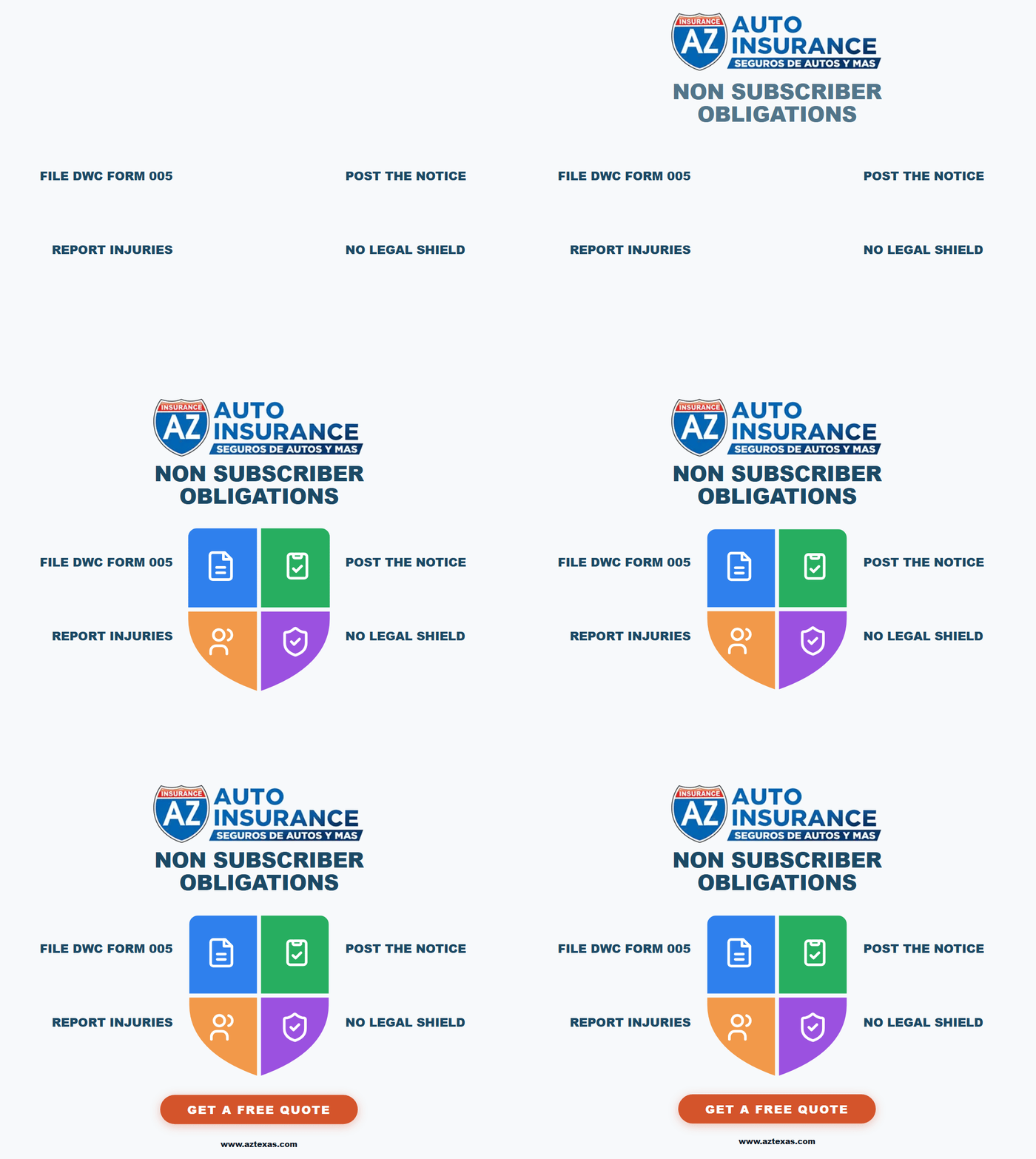
The three things the state still requires
The three defenses you give up
Subscriber versus non subscriber, side by side
What this looks like when someone gets hurt
Who does not get the choice
The contract problem nobody mentions
How AZ Insurance handles it
Frequently asked questions
What a non subscriber actually is
The Texas Department of Insurance puts the choice plainly: private employers in Texas can choose whether to provide workers compensation coverage. Employers that choose not to provide it are known as non subscribers. An employer that lets an existing policy lapse becomes a non subscriber the day the policy ends, which catches people who never made a decision at all.
That last part matters more than it sounds. A business that misses a renewal has not simply gone uninsured. It has changed its legal status, taken on filing duties it does not know about, and lost courtroom protections it was relying on, all without a single conversation.
Being a non subscriber is not the same as being uninsured generally. You can carry general liability, commercial auto and commercial property and still be a non subscriber, because none of those respond to an employee injury. General liability covers injuries to third parties, not to your own people.
The three things the state still requires
This is the part that surprises owners. Declining coverage adds obligations rather than removing them.
Obligation | What it is | When |
|---|---|---|
DWC Form-005 | Employer Notice of No Coverage or Termination of Coverage, filed with the Division of Workers' Compensation | Every year, between February 1 and April 30 |
Workplace notice | A posted notice telling employees there is no coverage, in English, Spanish, and any other language as needed | Posted where employees can see it regularly |
Injury reporting | Report work related injuries, illnesses and deaths involving more than one day of lost time | Required for employers with five or more employees |
New hire notice | Tell new employees in writing that they are not covered | At hire |
DWC Form-005 is filed through the Employer E-File system and can be submitted from a phone, tablet or computer. DWC Form-205 is the addendum used to add or remove locations, subsidiaries or separate entities under the same employer.
The annual part is the trap. This is not a one time registration you complete when you open. It is a filing that comes due every February, and a business that filed once in 2023 and never again is out of compliance right now.
Get a free quote or call (281) 833-6755. Hablamos Español.
The three defenses you give up
Here is the trade. The Texas Department of Insurance's workers compensation guide lists what a non subscriber cannot argue when an injured employee sues.
Defense a normal defendant could raise | Available to a Texas non subscriber? |
|---|---|
The employee's own negligence caused the injury | No |
Another employee's negligence caused the injury | No |
The injured employee knew about the danger and accepted it | No |
Read those three again with a real job site in mind. An employee who ignored a safety rule, an employee hurt by a coworker's mistake, an employee who knew the ladder was wobbly and climbed it anyway. In an ordinary negligence case those facts are the heart of the defense. For a non subscriber they are off the table.
On the other side, TDI states that an employer who carries workers compensation is protected from most lawsuits by injured employees, and generally cannot be sued unless an employee died because of the employer's negligence. That protection is the actual product. The medical and wage benefits are what the employee gets. The lawsuit shield is what the employer buys.
Subscriber versus non subscriber, side by side
Non subscriber | Subscriber | |
|---|---|---|
Annual state filing | DWC Form-005, February 1 to April 30 | None of this kind |
Workplace notice of no coverage | Required | Not applicable |
Employee injury benefits | None through the system | Medical and income benefits |
Employee can sue for negligence | Yes | Protected from most suits |
Employee's own negligence as a defense | Not available | Not needed, suit is generally barred |
Coworker negligence as a defense | Not available | Not needed |
Employee accepted a known danger | Not available | Not needed |
Damages exposure | Decided by a jury | Set by the benefit schedule |
What this looks like when someone gets hurt
Situation | As a non subscriber | As a subscriber |
|---|---|---|
Warehouse worker hurts their back lifting | You handle the medical bills and any suit directly, without the three defenses | Policy pays medical and income benefits |
Employee ignores a posted safety rule and is injured | Their own negligence is not a defense you can raise | Suit is generally barred, benefits paid |
One employee's mistake injures another | Coworker negligence is not a defense you can raise | Suit is generally barred, benefits paid |
A serious injury with a long recovery | A jury decides the number | The benefit schedule decides the number |
A general contractor asks for a certificate | You have nothing to show for this line | Certificate issued |
The bottom row is the one that ends up costing Houston contractors the most, and it has nothing to do with a courtroom.
Who does not get the choice
The option is not universal. Government entities in Texas are generally required to carry coverage. And a Texas business with employees working in other states has to meet those states' requirements, since Texas is the exception rather than the model. If you have crews crossing state lines, non subscriber status at home does not travel with them.
The contract problem nobody mentions
Most owners weighing this treat it as a purely internal decision. In practice it is usually settled by somebody else's paperwork.
General contractors, property managers, municipalities and larger customers routinely require subcontractors to carry workers compensation, and they ask for proof before anyone starts. A business that opted out to save premium can find itself unable to bid the jobs it wanted, which is the same wall that stops uninsured trades from getting through the gate on general liability and a certificate of insurance.
If your contracts also demand higher liability limits, that is a separate structure worth understanding before you sign, because a required limit is usually satisfied by layering rather than by one large policy. We walk through that in how a commercial umbrella actually satisfies a contract requirement. Employers liability, the piece that sits alongside workers compensation, is one of the policies an umbrella attaches to, so opting out can quietly shrink what your umbrella is able to do.
There is a classification angle too. Some owners try to sidestep the question by treating workers as contractors instead of employees. That is its own exposure, and the rules on who genuinely qualifies are strict. Our guide on general liability for 1099 contractors in Texas covers where that line actually sits.
How AZ Insurance handles it
We are a bilingual independent agency with 15 offices across Houston and Dallas, and this conversation comes up constantly with contractors, cleaning companies, restaurants and warehouses.
We do not open with a scare. We ask what your contracts require, how many people you employ, what the work actually involves, and whether you are currently filing DWC Form-005 at all, because a surprising number of non subscribers are out of compliance without knowing it. Then we price coverage against the market so the decision is made against a real number instead of a guess.
If you decide to stay a non subscriber, we will tell you what you owe the state so at least the choice is a clean one. If you decide to carry it, we structure it alongside your general liability, your commercial auto and any hired and non owned auto exposure so the pieces actually line up. For smaller operations, a business owner policy often bundles the property and liability side more cheaply than buying each part separately.
Get a free commercial quote or call (281) 833-6755. Hablamos Español.
This article is general information about Texas workers compensation requirements. It is not legal advice, and your specific obligations should be confirmed with the Division of Workers' Compensation or your attorney.
Frequently Asked Questions
Q: Is workers compensation required in Texas?
Not for most private employers. The Texas Department of Insurance states that private employers can choose whether to provide coverage. Texas is the only state that allows that choice for most private employers. Government entities are generally required to carry it, and contracts frequently require it regardless of what the state says.
Q: What is a non subscriber in Texas?
A non subscriber is an employer that has chosen not to provide Texas workers compensation coverage. An employer whose policy ends also becomes a non subscriber on the date the coverage stops, which means a missed renewal changes your legal status even if you never intended to opt out.
Q: What is DWC Form-005 and when is it due?
DWC Form-005 is the Employer Notice of No Coverage or Termination of Coverage. Texas employers without workers compensation coverage file it with the Division of Workers' Compensation every year between February 1 and April 30. It is filed through the Employer E-File system, and DWC Form-205 is the addendum for adding or removing business locations.
Q: What notice do I have to post if I do not carry workers comp?
A notice of no coverage must be posted in the workplace in English, Spanish, and any other language as needed, placed where employees can see it regularly. New employees also have to be told in writing that they are not covered.
Q: Do non subscribers have to report workplace injuries?
Yes. Non subscribers report work related injuries, illnesses and deaths involving more than one day of lost time. That requirement applies to employers with five or more employees, and reports go through the same Employer E-File system used for the annual notice.
Q: What legal defenses does a non subscriber lose?
Per the Texas Department of Insurance, a non subscriber cannot argue that the employee's own negligence caused the injury, that another employee's negligence caused it, or that the injured employee knew about the danger and accepted it. Those three are the defenses that carry most ordinary negligence cases.
Q: Does general liability cover an employee injury?
No. General liability responds to injuries to third parties such as customers and members of the public, not to your own employees. An employee injury is a workers compensation exposure, and without coverage it is a direct claim against the business.
Q: How fast can I get workers compensation coverage?
Often quickly for standard classifications, and longer for higher risk trades that need underwriting review. Bring your payroll by job type, your class codes if you know them, and any contract that spells out an insurance requirement. Call (281) 833-6755 and we will tell you what the contract actually demands before we quote it.
Why AZ Insurance Stands Apart
AZ Insurance has protected Texas businesses since 2003. Real agents in 15 local offices across Houston and Dallas, not call centers reading scripts, and bilingual service in English and Spanish.
On employee exposure specifically, we start with the contracts rather than the premium, because for most Houston businesses the requirement arrives from a general contractor long before it arrives from the state. We check whether a non subscriber is actually filing what the state asks. We look at how workers compensation sits next to the rest of the program, including what your umbrella attaches to. And because we are independent, we compare the market instead of fitting you into one company's appetite.
Get a free commercial quote today and bring whatever your customer is asking you to sign.
Related Articles
Reviewed by AZ Insurance Agency, licensed in Texas, serving Houston since 2003.
Texas is the only state that lets most private employers skip workers compensation entirely. A lot of Houston business owners hear that and stop reading, because it sounds like the state just handed them a line item they can delete. It did not. Opting out is a legal choice with paperwork attached and a specific trade you are making in court, and most owners who go bare have never been told what the second half of that trade is. Since 2003, AZ Insurance Agency has walked Texas employers through both sides of it.
Quick Answer: Texas lets most private employers decline workers compensation. Those employers are called non subscribers, and they still have three duties: file DWC Form-005 with the state every year between February 1 and April 30, post a notice of no coverage in the workplace, and report work related injuries. In exchange, they give up three legal defenses in an employee injury lawsuit.
Key Takeaways
Declining coverage does not mean opting out of the system. Non subscribers file an annual notice with the Division of Workers' Compensation, post a workplace notice, and report injuries.
DWC Form-005 is due every year between February 1 and April 30, not once at startup.
The workplace notice must be posted in English, Spanish, and any other language as needed, where employees can see it regularly.
Injury reporting applies to employers with five or more employees, for any work related injury, illness or death involving more than one day of lost time.
The Texas Department of Insurance states a non subscriber cannot argue that the employee's own negligence caused the injury, that a coworker's negligence caused it, or that the employee knew about the danger and accepted it.
An employer who carries coverage is protected from most employee lawsuits and, per TDI, generally cannot be sued unless an employee died because of the employer's negligence.
In This Guide
What a non subscriber actually is
The three things the state still requires
The three defenses you give up
Subscriber versus non subscriber, side by side
What this looks like when someone gets hurt
Who does not get the choice
The contract problem nobody mentions
How AZ Insurance handles it
Frequently asked questions
What a non subscriber actually is
The Texas Department of Insurance puts the choice plainly: private employers in Texas can choose whether to provide workers compensation coverage. Employers that choose not to provide it are known as non subscribers. An employer that lets an existing policy lapse becomes a non subscriber the day the policy ends, which catches people who never made a decision at all.
That last part matters more than it sounds. A business that misses a renewal has not simply gone uninsured. It has changed its legal status, taken on filing duties it does not know about, and lost courtroom protections it was relying on, all without a single conversation.
Being a non subscriber is not the same as being uninsured generally. You can carry general liability, commercial auto and commercial property and still be a non subscriber, because none of those respond to an employee injury. General liability covers injuries to third parties, not to your own people.
The three things the state still requires
This is the part that surprises owners. Declining coverage adds obligations rather than removing them.
Obligation | What it is | When |
|---|---|---|
DWC Form-005 | Employer Notice of No Coverage or Termination of Coverage, filed with the Division of Workers' Compensation | Every year, between February 1 and April 30 |
Workplace notice | A posted notice telling employees there is no coverage, in English, Spanish, and any other language as needed | Posted where employees can see it regularly |
Injury reporting | Report work related injuries, illnesses and deaths involving more than one day of lost time | Required for employers with five or more employees |
New hire notice | Tell new employees in writing that they are not covered | At hire |
DWC Form-005 is filed through the Employer E-File system and can be submitted from a phone, tablet or computer. DWC Form-205 is the addendum used to add or remove locations, subsidiaries or separate entities under the same employer.
The annual part is the trap. This is not a one time registration you complete when you open. It is a filing that comes due every February, and a business that filed once in 2023 and never again is out of compliance right now.
Get a free quote or call (281) 833-6755. Hablamos Español.
The three defenses you give up
Here is the trade. The Texas Department of Insurance's workers compensation guide lists what a non subscriber cannot argue when an injured employee sues.
Defense a normal defendant could raise | Available to a Texas non subscriber? |
|---|---|
The employee's own negligence caused the injury | No |
Another employee's negligence caused the injury | No |
The injured employee knew about the danger and accepted it | No |
Read those three again with a real job site in mind. An employee who ignored a safety rule, an employee hurt by a coworker's mistake, an employee who knew the ladder was wobbly and climbed it anyway. In an ordinary negligence case those facts are the heart of the defense. For a non subscriber they are off the table.
On the other side, TDI states that an employer who carries workers compensation is protected from most lawsuits by injured employees, and generally cannot be sued unless an employee died because of the employer's negligence. That protection is the actual product. The medical and wage benefits are what the employee gets. The lawsuit shield is what the employer buys.
Subscriber versus non subscriber, side by side
Non subscriber | Subscriber | |
|---|---|---|
Annual state filing | DWC Form-005, February 1 to April 30 | None of this kind |
Workplace notice of no coverage | Required | Not applicable |
Employee injury benefits | None through the system | Medical and income benefits |
Employee can sue for negligence | Yes | Protected from most suits |
Employee's own negligence as a defense | Not available | Not needed, suit is generally barred |
Coworker negligence as a defense | Not available | Not needed |
Employee accepted a known danger | Not available | Not needed |
Damages exposure | Decided by a jury | Set by the benefit schedule |
What this looks like when someone gets hurt
Situation | As a non subscriber | As a subscriber |
|---|---|---|
Warehouse worker hurts their back lifting | You handle the medical bills and any suit directly, without the three defenses | Policy pays medical and income benefits |
Employee ignores a posted safety rule and is injured | Their own negligence is not a defense you can raise | Suit is generally barred, benefits paid |
One employee's mistake injures another | Coworker negligence is not a defense you can raise | Suit is generally barred, benefits paid |
A serious injury with a long recovery | A jury decides the number | The benefit schedule decides the number |
A general contractor asks for a certificate | You have nothing to show for this line | Certificate issued |
The bottom row is the one that ends up costing Houston contractors the most, and it has nothing to do with a courtroom.
Who does not get the choice
The option is not universal. Government entities in Texas are generally required to carry coverage. And a Texas business with employees working in other states has to meet those states' requirements, since Texas is the exception rather than the model. If you have crews crossing state lines, non subscriber status at home does not travel with them.
The contract problem nobody mentions
Most owners weighing this treat it as a purely internal decision. In practice it is usually settled by somebody else's paperwork.
General contractors, property managers, municipalities and larger customers routinely require subcontractors to carry workers compensation, and they ask for proof before anyone starts. A business that opted out to save premium can find itself unable to bid the jobs it wanted, which is the same wall that stops uninsured trades from getting through the gate on general liability and a certificate of insurance.
If your contracts also demand higher liability limits, that is a separate structure worth understanding before you sign, because a required limit is usually satisfied by layering rather than by one large policy. We walk through that in how a commercial umbrella actually satisfies a contract requirement. Employers liability, the piece that sits alongside workers compensation, is one of the policies an umbrella attaches to, so opting out can quietly shrink what your umbrella is able to do.
There is a classification angle too. Some owners try to sidestep the question by treating workers as contractors instead of employees. That is its own exposure, and the rules on who genuinely qualifies are strict. Our guide on general liability for 1099 contractors in Texas covers where that line actually sits.
How AZ Insurance handles it
We are a bilingual independent agency with 15 offices across Houston and Dallas, and this conversation comes up constantly with contractors, cleaning companies, restaurants and warehouses.
We do not open with a scare. We ask what your contracts require, how many people you employ, what the work actually involves, and whether you are currently filing DWC Form-005 at all, because a surprising number of non subscribers are out of compliance without knowing it. Then we price coverage against the market so the decision is made against a real number instead of a guess.
If you decide to stay a non subscriber, we will tell you what you owe the state so at least the choice is a clean one. If you decide to carry it, we structure it alongside your general liability, your commercial auto and any hired and non owned auto exposure so the pieces actually line up. For smaller operations, a business owner policy often bundles the property and liability side more cheaply than buying each part separately.
Get a free commercial quote or call (281) 833-6755. Hablamos Español.
This article is general information about Texas workers compensation requirements. It is not legal advice, and your specific obligations should be confirmed with the Division of Workers' Compensation or your attorney.
Frequently Asked Questions
Q: Is workers compensation required in Texas?
Not for most private employers. The Texas Department of Insurance states that private employers can choose whether to provide coverage. Texas is the only state that allows that choice for most private employers. Government entities are generally required to carry it, and contracts frequently require it regardless of what the state says.
Q: What is a non subscriber in Texas?
A non subscriber is an employer that has chosen not to provide Texas workers compensation coverage. An employer whose policy ends also becomes a non subscriber on the date the coverage stops, which means a missed renewal changes your legal status even if you never intended to opt out.
Q: What is DWC Form-005 and when is it due?
DWC Form-005 is the Employer Notice of No Coverage or Termination of Coverage. Texas employers without workers compensation coverage file it with the Division of Workers' Compensation every year between February 1 and April 30. It is filed through the Employer E-File system, and DWC Form-205 is the addendum for adding or removing business locations.
Q: What notice do I have to post if I do not carry workers comp?
A notice of no coverage must be posted in the workplace in English, Spanish, and any other language as needed, placed where employees can see it regularly. New employees also have to be told in writing that they are not covered.
Q: Do non subscribers have to report workplace injuries?
Yes. Non subscribers report work related injuries, illnesses and deaths involving more than one day of lost time. That requirement applies to employers with five or more employees, and reports go through the same Employer E-File system used for the annual notice.
Q: What legal defenses does a non subscriber lose?
Per the Texas Department of Insurance, a non subscriber cannot argue that the employee's own negligence caused the injury, that another employee's negligence caused it, or that the injured employee knew about the danger and accepted it. Those three are the defenses that carry most ordinary negligence cases.
Q: Does general liability cover an employee injury?
No. General liability responds to injuries to third parties such as customers and members of the public, not to your own employees. An employee injury is a workers compensation exposure, and without coverage it is a direct claim against the business.
Q: How fast can I get workers compensation coverage?
Often quickly for standard classifications, and longer for higher risk trades that need underwriting review. Bring your payroll by job type, your class codes if you know them, and any contract that spells out an insurance requirement. Call (281) 833-6755 and we will tell you what the contract actually demands before we quote it.
Why AZ Insurance Stands Apart
AZ Insurance has protected Texas businesses since 2003. Real agents in 15 local offices across Houston and Dallas, not call centers reading scripts, and bilingual service in English and Spanish.
On employee exposure specifically, we start with the contracts rather than the premium, because for most Houston businesses the requirement arrives from a general contractor long before it arrives from the state. We check whether a non subscriber is actually filing what the state asks. We look at how workers compensation sits next to the rest of the program, including what your umbrella attaches to. And because we are independent, we compare the market instead of fitting you into one company's appetite.
Get a free commercial quote today and bring whatever your customer is asking you to sign.
Related Articles
Latest Blogs

Is Texas Minimum Car Insurance Enough? What 30/60/25 Actually Pays After a Crash

Texas SR-22 After a DWI: How to Reinstate Your License

Hit by an Uninsured Driver in Texas? The Coverage You May Have Turned Down Without Knowing

How Much Does Umbrella Insurance Cost in Texas?

Does Homeowners Insurance Cover Foundation Damage in Texas? What Pays, What Does Not, and the Endorsement to Ask For

How to Read Your Texas Home Insurance Declarations Page, Line by Line
Let A-Z Auto Insurance Help You Find Affordable Coverage
Connect with our experienced team today & get reliable, affordable insurance designed around your needs.
Contact Us!
Let A-Z Auto Insurance Help
You Find Affordable Coverage
Connect with our experienced team today & get reliable, affordable insurance designed around your needs.
Contact Us!
Let A-Z Auto
Insurance Help You
Find Affordable Coverage
Connect with our experienced team today & get reliable, affordable insurance designed around your needs.
Contact Us!
Let A-Z Auto Insurance Help
You Find Affordable Coverage
Connect with our experienced team today & get reliable, affordable insurance designed around your needs.
Contact Us!
Latest New & Blogs
Latest New & Blogs
Related Blog Posts
Related Blog Posts
Hit by an Uninsured Driver in Texas? The Coverage You May Have Turned Down Without Knowing
About 1 in 8 Texas drivers is uninsured. UM/UIM and PIP are on every Texas policy unless someone rejected them in writing. Here is how to check yours.
Hit by an Uninsured Driver in Texas? The Coverage You May Have Turned Down Without Knowing
About 1 in 8 Texas drivers is uninsured. UM/UIM and PIP are on every Texas policy unless someone rejected them in writing. Here is how to check yours.
Hit by an Uninsured Driver in Texas? The Coverage You May Have Turned Down Without Knowing
About 1 in 8 Texas drivers is uninsured. UM/UIM and PIP are on every Texas policy unless someone rejected them in writing. Here is how to check yours.
How Much Does Umbrella Insurance Cost in Texas?
How much does an umbrella policy cost? See average umbrella insurance rates by limit, what drives the price, and how Texans can save. Get a quote today.
How Much Does Umbrella Insurance Cost in Texas?
How much does an umbrella policy cost? See average umbrella insurance rates by limit, what drives the price, and how Texans can save. Get a quote today.
How Much Does Umbrella Insurance Cost in Texas?
How much does an umbrella policy cost? See average umbrella insurance rates by limit, what drives the price, and how Texans can save. Get a quote today.
Does Homeowners Insurance Cover Foundation Damage in Texas? What Pays, What Does Not, and the Endorsement to Ask For
Settling from dry clay soil is usually excluded. A plumbing leak under the slab can be covered, often only with a foundation endorsement. Here is how to check.
Does Homeowners Insurance Cover Foundation Damage in Texas? What Pays, What Does Not, and the Endorsement to Ask For
Settling from dry clay soil is usually excluded. A plumbing leak under the slab can be covered, often only with a foundation endorsement. Here is how to check.
Does Homeowners Insurance Cover Foundation Damage in Texas? What Pays, What Does Not, and the Endorsement to Ask For
Settling from dry clay soil is usually excluded. A plumbing leak under the slab can be covered, often only with a foundation endorsement. Here is how to check.
Hit by an Uninsured Driver in Texas? The Coverage You May Have Turned Down Without Knowing
About 1 in 8 Texas drivers is uninsured. UM/UIM and PIP are on every Texas policy unless someone rejected them in writing. Here is how to check yours.
How Much Does Umbrella Insurance Cost in Texas?
How much does an umbrella policy cost? See average umbrella insurance rates by limit, what drives the price, and how Texans can save. Get a quote today.