Quick support from trusted insurance professionals Call +1 713-777-2886 today! |
Call +1 713-777-2886
Call +1 713-777-2886
Quick support from insurance professionals Call +1 713-777-2886 today! |


Table of Content
Title
Let AZ Insurance Help You
Find Affordable Coverage
Connect with our experienced team today & get reliable, affordable insurance designed around your needs.
Contact Us!
Let A-Z Auto Insurance Help You Find Affordable Coverage
Connect with our experienced team today & get reliable, affordable insurance designed around your needs.
Contact Us!
Your Employee Drove Their Own Car for Work and Caused a Wreck. Whose Insurance Pays?
Your Employee Drove Their Own Car for Work and Caused a Wreck. Whose Insurance Pays?
Your Employee Drove Their Own Car for Work and Caused a Wreck. Whose Insurance Pays?
Your Employee Drove Their Own Car for Work and Caused a Wreck. Whose Insurance Pays?
Your Employee Drove Their Own Car for Work and Caused a Wreck. Whose Insurance Pays?

Reviewed by AZ Insurance Agency, licensed in Texas, serving Houston since 2003.
A Houston restaurant sends a server to drop off a catering order in her own Corolla. A cleaning company has three staff who drive their own cars between houses. A contractor's foreman takes his own pickup to pick up materials. In every one of those cases the business is exposed to a liability claim arising from a vehicle it does not own, does not insure, and in most cases has never even written down. Since 2003, AZ Insurance Agency has been closing this gap for Houston and Dallas businesses, and it is the single most common commercial auto hole we find. Not because owners are careless, but because nothing about the way policies are sold makes it obvious.
Quick Answer: Your commercial auto policy covers the vehicles listed on it. Liability for a car your employee owns falls under non owned auto coverage, and a car you rent, lease or borrow falls under hired auto coverage. Neither is automatic unless your policy uses covered auto symbol 1. Non owned coverage protects the business, not the employee, and it normally sits excess over the employee's own policy. The trap is that a personal auto policy excludes business use, so if it denies the claim there may be no primary layer underneath you at all.
Key Takeaways
Commercial auto policies assign coverage by numbered symbols. Symbol 1 means any auto and picks up hired and non owned automatically. Narrower symbols do not.
Symbol 8 covers autos you lease, hire, rent or borrow. It specifically excludes vehicles owned by your employees.
Symbol 9 covers non owned autos, which is where an employee's personal car actually lands.
Non owned auto coverage protects the business against its own vicarious liability. It does not make your employee an insured, and it does not repair their car.
Hired and non owned coverage is normally excess. The employee's personal policy is expected to pay first.
Texas minimum liability is 30/60/25, so even when the personal policy does respond, the underlying layer is thin.
Your general liability policy will not backfill this. The standard commercial general liability form excludes bodily injury arising from the use of an auto.
If you carry a commercial umbrella, the hired and non owned coverage has to be scheduled as underlying insurance or the umbrella may not respond to an auto claim.
In This Guide
The three kinds of vehicle your business touches
What the symbols on your policy actually mean
Non owned coverage protects the business, not the driver
The order of payment, and the trap when there is no primary
Texas minimums make the underlying layer thin
Physical damage is never covered
Your general liability policy will not fill this gap
Delivery, and why app coverage does not close it
If you carry an umbrella, read this part
Frequently asked questions
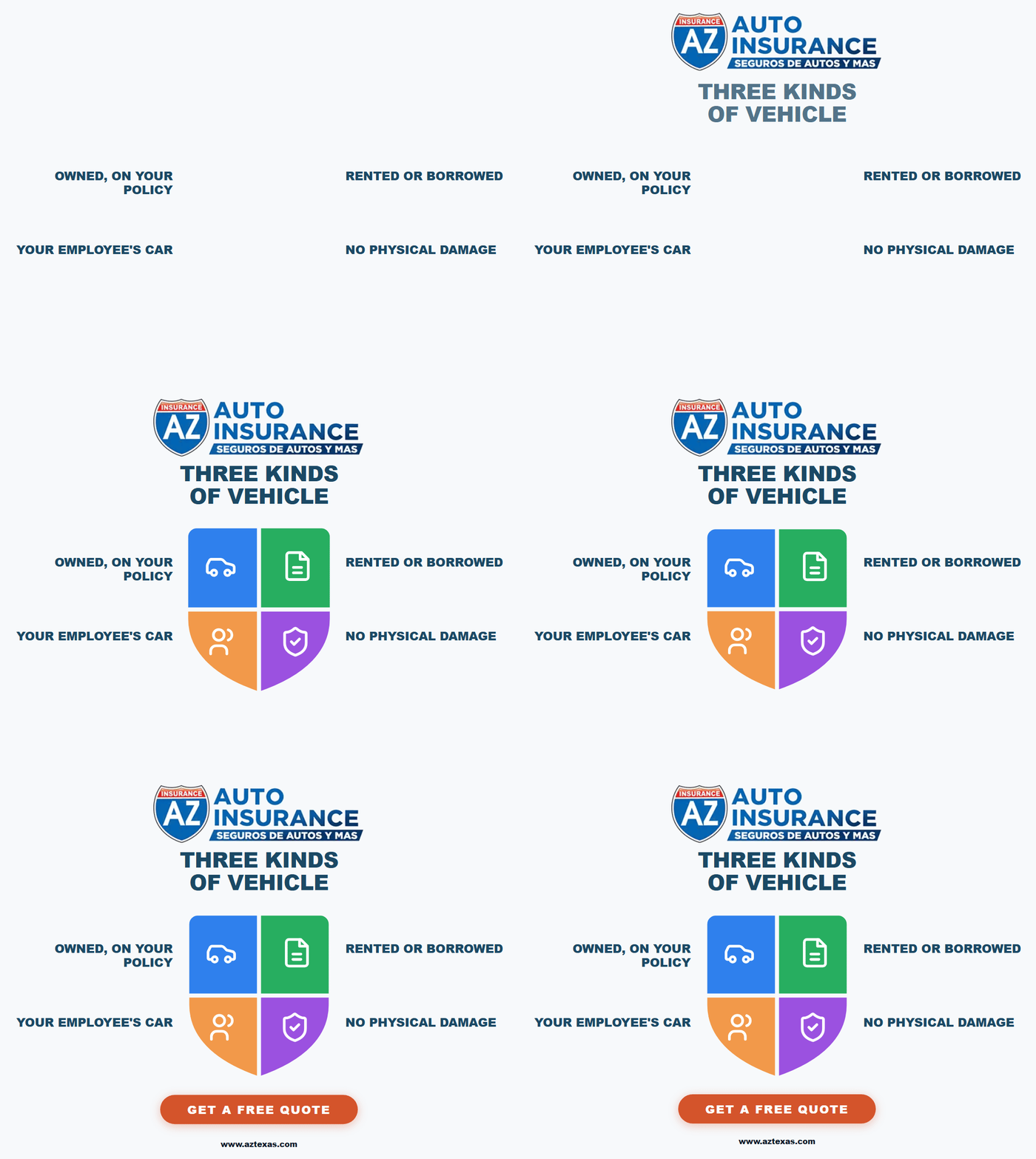
The Three Kinds of Vehicle Your Business Touches
Almost every business runs on more than one category of vehicle without ever categorizing them. Insurance does categorize them, and the categories decide who pays.
Category | Example | Where coverage comes from |
|---|---|---|
Owned | The van with your logo, titled to the business | Listed on your commercial auto policy |
Hired | A rented box truck for a busy week, a borrowed trailer | Hired auto coverage, symbol 8 |
Non owned | Your employee's own car, driven on a work errand | Non owned auto coverage, symbol 9 |
The first category is the one every owner knows about. The second and third are the ones that produce surprised phone calls.
What the Symbols on Your Policy Actually Mean
Commercial auto coverage is granted by numbered symbols printed next to each coverage on your declarations page. They are easy to miss and they decide everything.
Symbol | What it covers | Catch |
|---|---|---|
1 | Any auto | The broadest. Picks up hired and non owned automatically. |
8 | Hired autos only | Autos you lease, hire, rent or borrow. Excludes autos owned by your employees, partners or their household members. |
9 | Non owned autos only | Autos you do not own, lease, hire, rent or borrow, used in your business. This is where an employee's car lands. |
Two things follow, and they are the whole point of this article.
First, if your liability coverage is written on symbol 1, hired and non owned are already included and you do not need 8 and 9 shown separately. If your policy uses a narrower symbol, they are not included, and you need them added.
Second, and this is where owners get caught: symbol 8 does not cover your employee's car. People assume "hired and non owned" is one thing. It is two, and the employee vehicle exposure lives entirely on the symbol 9 side. Having 8 without 9 leaves exactly the gap most small businesses actually have.
If you do not have a commercial auto policy at all, these can usually be added as standalone endorsements onto a general liability policy instead.
Non Owned Coverage Protects the Business, Not the Driver
This is the most misunderstood part, and it changes what you should tell your staff.
Non owned auto coverage responds to the business's liability when an employee causes harm while driving their own car for work. It exists because you can be held responsible for what your employee does in the course of their job, even in a vehicle you have never seen.
It does not make your employee an insured. Their own liability still runs through their own policy. And it will not repair their car, ever, no matter how the claim arose.
So if an employee asks whether they are covered by the company when they run an errand in their own vehicle, the honest answer is no, not personally, and not for their car. That is a conversation worth having before it comes up the hard way.
The Order of Payment, and the Trap When There Is No Primary
Here is the sequence a claim actually follows.
Step | What is supposed to happen | What can go wrong |
|---|---|---|
1 | The employee's personal auto policy responds first as primary | It denies the claim because the vehicle was being used for business |
2 | Your non owned auto coverage responds excess, above the personal limits | If step 1 paid nothing, there is nothing for it to sit above |
3 | Your umbrella responds above that | It may not trigger if the non owned coverage was never scheduled under it |
Step 2 is the trap, and it deserves plain language. Hired and non owned coverage is generally written as excess insurance. It is designed to pay above whatever the driver's own policy pays. But a personal auto policy excludes business use, and that exclusion is categorical rather than proportional. If the carrier discovers the crash happened during a delivery or a work errand, it can deny the whole claim rather than pay a share.
Now your excess coverage is sitting above nothing. Depending on how the form is written, the business can find itself funding the defense from the first dollar, which is the opposite of what the owner believed they bought.
The fix is a question, and it is worth asking your agent in writing: does my hired and non owned form drop down to primary if the underlying personal policy denies for business use? Some forms do. Many do not. The answer belongs in your file before a claim, not after.
Texas Minimums Make the Underlying Layer Thin
Even when the employee's policy does respond, look at what it is likely to be carrying.
Texas minimum liability (30/60/25) | Amount |
|---|---|
Bodily injury per person | $30,000 |
Bodily injury per accident | $60,000 |
Property damage per accident | $25,000 |
Those are the state minimums under Texas law, and the Texas Department of Insurance itself cautions that they may be too low if you cause a multi vehicle accident or total someone's car. Many drivers carry exactly the minimum.
A serious bodily injury claim exhausts $30,000 almost immediately. If your business is named alongside the employee, the difference between $30,000 and the actual claim is the number your non owned coverage and your umbrella have to handle. That is why the limit you choose on this coverage matters more than the premium difference between limits.
Physical Damage Is Never Covered
Worth its own heading because it comes up in every conversation.
Neither hired nor non owned auto liability coverage pays to repair the vehicle. Not your employee's car, and not, under liability alone, the truck you rented. Physical damage on a rented vehicle needs to be arranged separately, either through your policy or through the rental company.
If an employee's car is damaged on a work errand, the repair runs through their own collision coverage, subject to their own deductible, and subject to their carrier's view of whether business use voided it. Employees are frequently shocked by this. Tell them first.
Your General Liability Policy Will Not Fill This Gap
A reasonable assumption is that a business with general liability coverage is broadly protected against being sued. For vehicles, that assumption fails.
The standard commercial general liability form excludes bodily injury and property damage arising out of the use of an auto. That exclusion exists specifically because auto exposure is meant to be handled on an auto policy. So a business with general liability, no commercial auto, and employees driving their own cars has no auto liability coverage at all. The general liability policy will decline it and point at the exclusion.
This is the combination we see most often in small Houston service businesses: a general liability policy bought for a contract requirement, no commercial auto because the business owns no vehicles, and staff driving personal cars every day.
Delivery, and Why App Coverage Does Not Close It
Delivery is the highest risk version of this, because the exclusion is most likely to be enforced and most likely to be discovered.
If your restaurant or shop sends staff out in their own cars, their personal policies very likely exclude it by name. Many carriers list delivery of food or goods explicitly.
Owners who use app platforms sometimes assume the platform's coverage handles it. It generally does not close the gap, for three reasons. Platform coverage is usually contingent, meaning it sits excess over the driver's own policy. It typically applies only while a delivery is actively in progress, which leaves the stretch between orders uncovered. And it protects the platform's interests, not your business's.
The practical answer for delivery is either a driver side rideshare or delivery endorsement on the employee's personal policy, or non owned coverage sized properly on the business policy. Usually both.
If You Carry an Umbrella, Read This Part
A commercial umbrella only pays above the underlying policies listed on its schedule. If you add hired and non owned coverage in the middle of a policy term and nobody updates the umbrella, the umbrella may not respond to an auto claim at all, because the coverage it is supposed to sit above was never scheduled underneath it.
This is a paperwork failure that produces a coverage failure, and it is silent until a claim. Commercial umbrella pricing rose 4.8 percent in Q1 2026, the second highest of any line, precisely because what sits underneath it keeps getting more expensive to settle. If you are paying for that layer, it is worth confirming it is actually attached to everything you think it is.
Frequently Asked Questions
Q: What is hired and non owned auto insurance?
It is two coverages usually sold together. Hired auto covers liability for vehicles your business leases, hires, rents or borrows. Non owned auto covers liability for vehicles your business does not own but that are used for business, most commonly your employees' personal cars. On a commercial auto policy they appear as covered auto symbols 8 and 9, and symbol 1 includes both automatically.
Q: Does my commercial auto policy already cover my employee's car?
Only if your liability coverage is written on symbol 1, any auto. If your declarations page shows a narrower symbol, an employee owned vehicle is not covered unless symbol 9 is added. Symbol 8 alone will not do it, because hired auto specifically excludes autos owned by employees, partners and their household members.
Q: If my employee causes a wreck in their own car on a work errand, whose insurance pays?
The employee's personal auto policy is expected to pay first. Your non owned auto coverage responds above it for the business's own liability. The problem is that personal auto policies exclude business use, so the personal carrier may deny the claim entirely, which can leave your excess coverage sitting above nothing.
Q: Does non owned auto coverage protect my employee too?
No. It protects the business against its own liability. Your employee is not made an insured by it, and it will not pay to repair their vehicle. Their own policy handles their liability and their own collision damage, subject to whether their carrier accepts the business use.
Q: Will my general liability policy cover an auto accident?
No. The standard commercial general liability form excludes bodily injury and property damage arising out of the use of an auto. Auto exposure has to be covered on an auto policy or through hired and non owned endorsements. A business with general liability and no auto coverage has no auto liability protection.
Q: Do I need this if my business does not own any vehicles?
Very likely yes, and this is the most common case we see. If any employee ever drives their own car for a business purpose, delivering, picking up supplies, visiting a customer, moving between job sites, the exposure exists. Owning no vehicles removes the owned auto exposure, not the non owned one.
Q: Does the delivery app's insurance cover my restaurant?
Not reliably. Platform coverage is typically contingent and sits excess over the driver's own policy, usually applies only while a delivery is actively in progress, and is designed to protect the platform rather than your business. Treat it as a partial layer, not a solution.
Q: How much does hired and non owned coverage cost in Texas?
It is usually one of the least expensive things you can add, because it is excess coverage over the driver's own policy rather than primary coverage on a scheduled vehicle. The exact number depends on your payroll, your industry, how many drivers you have and the limit you select. Bring your current declarations page and we will price it against 8 carriers. Call 713-777-2886. Hablamos Español.
Why AZ Insurance Stands Apart
AZ Insurance has protected Texas businesses since 2003. Real agents in 15 local offices across Houston and Dallas, not call centers reading scripts. Bilingual support, which matters here because the people driving are often the people who most need the coverage explained clearly.
When we review a commercial account, we look at the covered auto symbols on the declarations page rather than the premium, because the symbols are what decide whether a claim is paid. We ask how many people drive their own cars for the business, which almost nobody has counted. We check whether the hired and non owned form drops down to primary when a personal policy denies for business use. And we confirm the coverage is scheduled under your umbrella, so the layer you are already paying for actually attaches.
Get a free commercial quote today and we will tell you which symbols you have before we tell you what it costs.
Related Articles
Reviewed by AZ Insurance Agency, licensed in Texas, serving Houston since 2003.
A Houston restaurant sends a server to drop off a catering order in her own Corolla. A cleaning company has three staff who drive their own cars between houses. A contractor's foreman takes his own pickup to pick up materials. In every one of those cases the business is exposed to a liability claim arising from a vehicle it does not own, does not insure, and in most cases has never even written down. Since 2003, AZ Insurance Agency has been closing this gap for Houston and Dallas businesses, and it is the single most common commercial auto hole we find. Not because owners are careless, but because nothing about the way policies are sold makes it obvious.
Quick Answer: Your commercial auto policy covers the vehicles listed on it. Liability for a car your employee owns falls under non owned auto coverage, and a car you rent, lease or borrow falls under hired auto coverage. Neither is automatic unless your policy uses covered auto symbol 1. Non owned coverage protects the business, not the employee, and it normally sits excess over the employee's own policy. The trap is that a personal auto policy excludes business use, so if it denies the claim there may be no primary layer underneath you at all.
Key Takeaways
Commercial auto policies assign coverage by numbered symbols. Symbol 1 means any auto and picks up hired and non owned automatically. Narrower symbols do not.
Symbol 8 covers autos you lease, hire, rent or borrow. It specifically excludes vehicles owned by your employees.
Symbol 9 covers non owned autos, which is where an employee's personal car actually lands.
Non owned auto coverage protects the business against its own vicarious liability. It does not make your employee an insured, and it does not repair their car.
Hired and non owned coverage is normally excess. The employee's personal policy is expected to pay first.
Texas minimum liability is 30/60/25, so even when the personal policy does respond, the underlying layer is thin.
Your general liability policy will not backfill this. The standard commercial general liability form excludes bodily injury arising from the use of an auto.
If you carry a commercial umbrella, the hired and non owned coverage has to be scheduled as underlying insurance or the umbrella may not respond to an auto claim.
In This Guide
The three kinds of vehicle your business touches
What the symbols on your policy actually mean
Non owned coverage protects the business, not the driver
The order of payment, and the trap when there is no primary
Texas minimums make the underlying layer thin
Physical damage is never covered
Your general liability policy will not fill this gap
Delivery, and why app coverage does not close it
If you carry an umbrella, read this part
Frequently asked questions
The Three Kinds of Vehicle Your Business Touches
Almost every business runs on more than one category of vehicle without ever categorizing them. Insurance does categorize them, and the categories decide who pays.
Category | Example | Where coverage comes from |
|---|---|---|
Owned | The van with your logo, titled to the business | Listed on your commercial auto policy |
Hired | A rented box truck for a busy week, a borrowed trailer | Hired auto coverage, symbol 8 |
Non owned | Your employee's own car, driven on a work errand | Non owned auto coverage, symbol 9 |
The first category is the one every owner knows about. The second and third are the ones that produce surprised phone calls.
What the Symbols on Your Policy Actually Mean
Commercial auto coverage is granted by numbered symbols printed next to each coverage on your declarations page. They are easy to miss and they decide everything.
Symbol | What it covers | Catch |
|---|---|---|
1 | Any auto | The broadest. Picks up hired and non owned automatically. |
8 | Hired autos only | Autos you lease, hire, rent or borrow. Excludes autos owned by your employees, partners or their household members. |
9 | Non owned autos only | Autos you do not own, lease, hire, rent or borrow, used in your business. This is where an employee's car lands. |
Two things follow, and they are the whole point of this article.
First, if your liability coverage is written on symbol 1, hired and non owned are already included and you do not need 8 and 9 shown separately. If your policy uses a narrower symbol, they are not included, and you need them added.
Second, and this is where owners get caught: symbol 8 does not cover your employee's car. People assume "hired and non owned" is one thing. It is two, and the employee vehicle exposure lives entirely on the symbol 9 side. Having 8 without 9 leaves exactly the gap most small businesses actually have.
If you do not have a commercial auto policy at all, these can usually be added as standalone endorsements onto a general liability policy instead.
Non Owned Coverage Protects the Business, Not the Driver
This is the most misunderstood part, and it changes what you should tell your staff.
Non owned auto coverage responds to the business's liability when an employee causes harm while driving their own car for work. It exists because you can be held responsible for what your employee does in the course of their job, even in a vehicle you have never seen.
It does not make your employee an insured. Their own liability still runs through their own policy. And it will not repair their car, ever, no matter how the claim arose.
So if an employee asks whether they are covered by the company when they run an errand in their own vehicle, the honest answer is no, not personally, and not for their car. That is a conversation worth having before it comes up the hard way.
The Order of Payment, and the Trap When There Is No Primary
Here is the sequence a claim actually follows.
Step | What is supposed to happen | What can go wrong |
|---|---|---|
1 | The employee's personal auto policy responds first as primary | It denies the claim because the vehicle was being used for business |
2 | Your non owned auto coverage responds excess, above the personal limits | If step 1 paid nothing, there is nothing for it to sit above |
3 | Your umbrella responds above that | It may not trigger if the non owned coverage was never scheduled under it |
Step 2 is the trap, and it deserves plain language. Hired and non owned coverage is generally written as excess insurance. It is designed to pay above whatever the driver's own policy pays. But a personal auto policy excludes business use, and that exclusion is categorical rather than proportional. If the carrier discovers the crash happened during a delivery or a work errand, it can deny the whole claim rather than pay a share.
Now your excess coverage is sitting above nothing. Depending on how the form is written, the business can find itself funding the defense from the first dollar, which is the opposite of what the owner believed they bought.
The fix is a question, and it is worth asking your agent in writing: does my hired and non owned form drop down to primary if the underlying personal policy denies for business use? Some forms do. Many do not. The answer belongs in your file before a claim, not after.
Texas Minimums Make the Underlying Layer Thin
Even when the employee's policy does respond, look at what it is likely to be carrying.
Texas minimum liability (30/60/25) | Amount |
|---|---|
Bodily injury per person | $30,000 |
Bodily injury per accident | $60,000 |
Property damage per accident | $25,000 |
Those are the state minimums under Texas law, and the Texas Department of Insurance itself cautions that they may be too low if you cause a multi vehicle accident or total someone's car. Many drivers carry exactly the minimum.
A serious bodily injury claim exhausts $30,000 almost immediately. If your business is named alongside the employee, the difference between $30,000 and the actual claim is the number your non owned coverage and your umbrella have to handle. That is why the limit you choose on this coverage matters more than the premium difference between limits.
Physical Damage Is Never Covered
Worth its own heading because it comes up in every conversation.
Neither hired nor non owned auto liability coverage pays to repair the vehicle. Not your employee's car, and not, under liability alone, the truck you rented. Physical damage on a rented vehicle needs to be arranged separately, either through your policy or through the rental company.
If an employee's car is damaged on a work errand, the repair runs through their own collision coverage, subject to their own deductible, and subject to their carrier's view of whether business use voided it. Employees are frequently shocked by this. Tell them first.
Your General Liability Policy Will Not Fill This Gap
A reasonable assumption is that a business with general liability coverage is broadly protected against being sued. For vehicles, that assumption fails.
The standard commercial general liability form excludes bodily injury and property damage arising out of the use of an auto. That exclusion exists specifically because auto exposure is meant to be handled on an auto policy. So a business with general liability, no commercial auto, and employees driving their own cars has no auto liability coverage at all. The general liability policy will decline it and point at the exclusion.
This is the combination we see most often in small Houston service businesses: a general liability policy bought for a contract requirement, no commercial auto because the business owns no vehicles, and staff driving personal cars every day.
Delivery, and Why App Coverage Does Not Close It
Delivery is the highest risk version of this, because the exclusion is most likely to be enforced and most likely to be discovered.
If your restaurant or shop sends staff out in their own cars, their personal policies very likely exclude it by name. Many carriers list delivery of food or goods explicitly.
Owners who use app platforms sometimes assume the platform's coverage handles it. It generally does not close the gap, for three reasons. Platform coverage is usually contingent, meaning it sits excess over the driver's own policy. It typically applies only while a delivery is actively in progress, which leaves the stretch between orders uncovered. And it protects the platform's interests, not your business's.
The practical answer for delivery is either a driver side rideshare or delivery endorsement on the employee's personal policy, or non owned coverage sized properly on the business policy. Usually both.
If You Carry an Umbrella, Read This Part
A commercial umbrella only pays above the underlying policies listed on its schedule. If you add hired and non owned coverage in the middle of a policy term and nobody updates the umbrella, the umbrella may not respond to an auto claim at all, because the coverage it is supposed to sit above was never scheduled underneath it.
This is a paperwork failure that produces a coverage failure, and it is silent until a claim. Commercial umbrella pricing rose 4.8 percent in Q1 2026, the second highest of any line, precisely because what sits underneath it keeps getting more expensive to settle. If you are paying for that layer, it is worth confirming it is actually attached to everything you think it is.
Frequently Asked Questions
Q: What is hired and non owned auto insurance?
It is two coverages usually sold together. Hired auto covers liability for vehicles your business leases, hires, rents or borrows. Non owned auto covers liability for vehicles your business does not own but that are used for business, most commonly your employees' personal cars. On a commercial auto policy they appear as covered auto symbols 8 and 9, and symbol 1 includes both automatically.
Q: Does my commercial auto policy already cover my employee's car?
Only if your liability coverage is written on symbol 1, any auto. If your declarations page shows a narrower symbol, an employee owned vehicle is not covered unless symbol 9 is added. Symbol 8 alone will not do it, because hired auto specifically excludes autos owned by employees, partners and their household members.
Q: If my employee causes a wreck in their own car on a work errand, whose insurance pays?
The employee's personal auto policy is expected to pay first. Your non owned auto coverage responds above it for the business's own liability. The problem is that personal auto policies exclude business use, so the personal carrier may deny the claim entirely, which can leave your excess coverage sitting above nothing.
Q: Does non owned auto coverage protect my employee too?
No. It protects the business against its own liability. Your employee is not made an insured by it, and it will not pay to repair their vehicle. Their own policy handles their liability and their own collision damage, subject to whether their carrier accepts the business use.
Q: Will my general liability policy cover an auto accident?
No. The standard commercial general liability form excludes bodily injury and property damage arising out of the use of an auto. Auto exposure has to be covered on an auto policy or through hired and non owned endorsements. A business with general liability and no auto coverage has no auto liability protection.
Q: Do I need this if my business does not own any vehicles?
Very likely yes, and this is the most common case we see. If any employee ever drives their own car for a business purpose, delivering, picking up supplies, visiting a customer, moving between job sites, the exposure exists. Owning no vehicles removes the owned auto exposure, not the non owned one.
Q: Does the delivery app's insurance cover my restaurant?
Not reliably. Platform coverage is typically contingent and sits excess over the driver's own policy, usually applies only while a delivery is actively in progress, and is designed to protect the platform rather than your business. Treat it as a partial layer, not a solution.
Q: How much does hired and non owned coverage cost in Texas?
It is usually one of the least expensive things you can add, because it is excess coverage over the driver's own policy rather than primary coverage on a scheduled vehicle. The exact number depends on your payroll, your industry, how many drivers you have and the limit you select. Bring your current declarations page and we will price it against 8 carriers. Call 713-777-2886. Hablamos Español.
Why AZ Insurance Stands Apart
AZ Insurance has protected Texas businesses since 2003. Real agents in 15 local offices across Houston and Dallas, not call centers reading scripts. Bilingual support, which matters here because the people driving are often the people who most need the coverage explained clearly.
When we review a commercial account, we look at the covered auto symbols on the declarations page rather than the premium, because the symbols are what decide whether a claim is paid. We ask how many people drive their own cars for the business, which almost nobody has counted. We check whether the hired and non owned form drops down to primary when a personal policy denies for business use. And we confirm the coverage is scheduled under your umbrella, so the layer you are already paying for actually attaches.
Get a free commercial quote today and we will tell you which symbols you have before we tell you what it costs.
Related Articles
Latest Blogs

How Much Does Umbrella Insurance Cost in Texas?

Does Homeowners Insurance Cover Foundation Damage in Texas? What Pays, What Does Not, and the Endorsement to Ask For

How to Read Your Texas Home Insurance Declarations Page, Line by Line

How to Lower Car Insurance: 10 Practical Ways to Pay Less

What Is Gap Insurance and What Does It Cover? Do You Need It?

What Is a Deductible in Car Insurance? A Simple Guide
Let A-Z Auto Insurance Help You Find Affordable Coverage
Connect with our experienced team today & get reliable, affordable insurance designed around your needs.
Contact Us!
Let A-Z Auto Insurance Help
You Find Affordable Coverage
Connect with our experienced team today & get reliable, affordable insurance designed around your needs.
Contact Us!
Let A-Z Auto
Insurance Help You
Find Affordable Coverage
Connect with our experienced team today & get reliable, affordable insurance designed around your needs.
Contact Us!
Let A-Z Auto Insurance Help
You Find Affordable Coverage
Connect with our experienced team today & get reliable, affordable insurance designed around your needs.
Contact Us!
Latest New & Blogs
Latest New & Blogs
Related Blog Posts
Related Blog Posts
How to Read Your Texas Home Insurance Declarations Page, Line by Line
Your declarations page decides what a claim pays. What every line means in Texas, why Coverage C means two things, and what to check at renewal.
How to Read Your Texas Home Insurance Declarations Page, Line by Line
Your declarations page decides what a claim pays. What every line means in Texas, why Coverage C means two things, and what to check at renewal.
How to Read Your Texas Home Insurance Declarations Page, Line by Line
Your declarations page decides what a claim pays. What every line means in Texas, why Coverage C means two things, and what to check at renewal.
How to Lower Car Insurance: 10 Practical Ways to Pay Less
Learn how to lower car insurance in Texas with 10 proven ways to cut your premium, from discounts and deductibles to shopping smarter at every renewal.
How to Lower Car Insurance: 10 Practical Ways to Pay Less
Learn how to lower car insurance in Texas with 10 proven ways to cut your premium, from discounts and deductibles to shopping smarter at every renewal.
How to Lower Car Insurance: 10 Practical Ways to Pay Less
Learn how to lower car insurance in Texas with 10 proven ways to cut your premium, from discounts and deductibles to shopping smarter at every renewal.
What Is Gap Insurance and What Does It Cover? Do You Need It?
What is gap insurance and what does it cover? Learn how gap coverage pays off your car loan after a total loss, what it costs, and if you need it.
What Is Gap Insurance and What Does It Cover? Do You Need It?
What is gap insurance and what does it cover? Learn how gap coverage pays off your car loan after a total loss, what it costs, and if you need it.
What Is Gap Insurance and What Does It Cover? Do You Need It?
What is gap insurance and what does it cover? Learn how gap coverage pays off your car loan after a total loss, what it costs, and if you need it.
How to Read Your Texas Home Insurance Declarations Page, Line by Line
Your declarations page decides what a claim pays. What every line means in Texas, why Coverage C means two things, and what to check at renewal.
How to Lower Car Insurance: 10 Practical Ways to Pay Less
Learn how to lower car insurance in Texas with 10 proven ways to cut your premium, from discounts and deductibles to shopping smarter at every renewal.