Quick support from trusted insurance professionals Call +1 713-777-2886 today! |
Call +1 713-777-2886
Call +1 713-777-2886
Quick support from insurance professionals Call +1 713-777-2886 today! |


Table of Content
Title

Let AZ Insurance Help You
Find Affordable Coverage
Connect with our experienced team today & get reliable, affordable insurance designed around your needs.
Contact Us!

Let A-Z Auto Insurance Help You Find Affordable Coverage
Connect with our experienced team today & get reliable, affordable insurance designed around your needs.
Contact Us!
A Storm Hits Before Your Renewal: The Texas Claim Timeline, and the New Right You Have in 2026
A Storm Hits Before Your Renewal: The Texas Claim Timeline, and the New Right You Have in 2026
A Storm Hits Before Your Renewal: The Texas Claim Timeline, and the New Right You Have in 2026
A Storm Hits Before Your Renewal: The Texas Claim Timeline, and the New Right You Have in 2026
A Storm Hits Before Your Renewal: The Texas Claim Timeline, and the New Right You Have in 2026

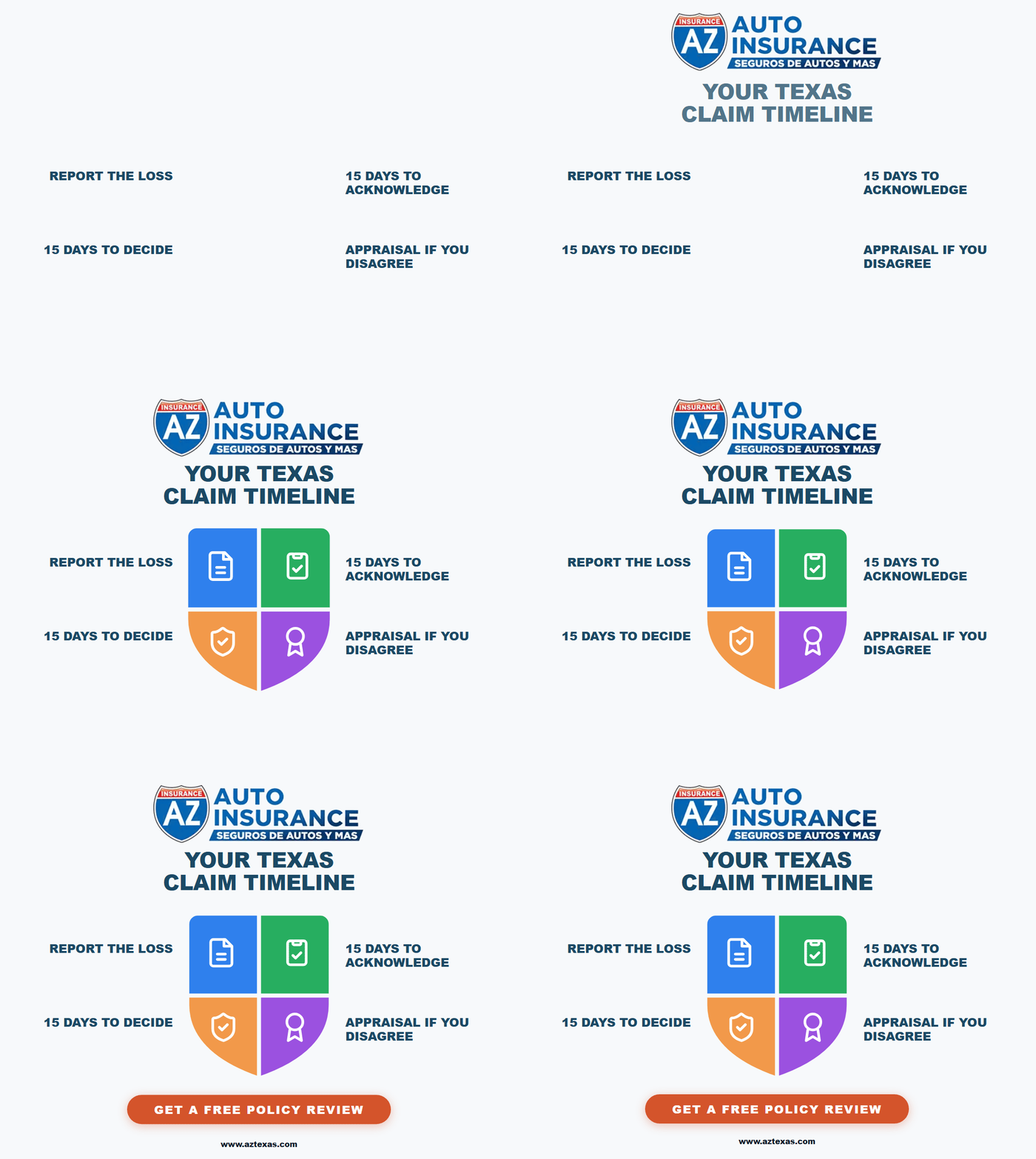
Quick Answer: A storm before your renewal does not cancel your coverage. The policy in force on the day of the damage is the one that pays, even if it renews or lapses afterward. Your insurer then has 15 business days to acknowledge the claim and 15 business days to accept or reject it, and if you disagree on the amount, Texas policies renewed after January 1, 2026 now carry an appraisal provision by law.
Table of Contents
The policy that pays is the one in force on the day of the loss
The deadlines your insurer has to meet
New for 2026: appraisal is now in your policy by law
How appraisal actually works
What a claim does to your renewal
Sugar Land, Richmond and Rosenberg specifics
The three things to do in the first 48 hours
Key Takeaways
Frequently asked questions
The policy that pays is the one in force on the day of the loss
This is the question behind the question, and the answer is reassuring.
Storm damage on September 3 is covered by the policy that was in force on September 3. If your renewal falls on September 15, the renewal does not reach backward and change how that claim is handled. If you switch carriers in October, the old carrier still owns the claim. If the policy is later nonrenewed, that does not undo a covered loss that happened while it was active.
What the timing does affect is everything that comes after: your premium, whether the carrier offers a renewal at all, and the terms you are offered next. Those are real consequences and we will get to them. But the claim itself belongs to the policy that was live when the damage happened.
The one thing that genuinely matters about timing is reporting. Policies require prompt notice of a loss. Waiting weeks while a wet roof does more damage is the fastest way to turn a clean claim into a contested one, because at that point part of the damage stops looking like storm damage and starts looking like a maintenance failure.
The deadlines your insurer has to meet
Most Texas homeowners do not know these exist, which is why a slow claim feels like something you simply have to absorb. You do not.
The Texas Department of Insurance publishes the deadlines directly.
Stage | Deadline | TDI's words |
|---|---|---|
Acknowledge the claim | 15 business days | "State law gives your company 15 business days to tell you it's received your claim." |
Accept or reject | 15 business days | "Your company has 15 business days after getting what it needs from you to decide if it will pay." |
Extension | up to 45 more days | "The company can extend this deadline by 45 days if they tell you why they need more time." |
A rejection | in writing, with a reason | "If the company rejects your claim, it must say why in writing." |
Three things worth noticing.
The second clock starts when they have what they need from you. That phrase does real work. If the carrier is waiting on your documentation, the clock has not started. This is the single best argument for sending everything at once rather than in pieces, and for keeping a record of what you sent and when.
An extension is allowed, but it is not silent. A carrier taking longer has to tell you why. If a claim goes quiet past the deadline with no explanation, that is not normal and it is worth a call.
A denial has to be explained in writing. A verbal "it is not covered" is not the end of anything. Ask for it in writing with the reason, because the reason is what tells you whether you are looking at an exclusion, a deductible issue, or a disagreement about the amount. Those three things have completely different remedies.
If a deadline passes with nothing, TDI operates a consumer help line and takes complaints about claim handling.
New for 2026: appraisal is now in your policy by law
This is the part almost nobody in Houston knows yet, and it changed this year.
TDI's Commissioner's Bulletin B-0006-26 states it plainly: "Insurance Code Chapter 1813, as added by SB 458, 89th Legislature (2025), ensures that personal automobile and residential property policies issued or renewed after January 1, 2026, will include an appraisal provision."
Read that again with your renewal date in mind. If your Texas homeowners policy was issued or renewed at any point after January 1, 2026, it contains an appraisal provision. Not "might". The statute ensures it.
Appraisal is the mechanism for resolving a disagreement about how much a loss is worth. It is not for arguing about whether something is covered. That distinction is the whole key to using it correctly, and we come back to it below.
Before 2026, whether you had this right depended on your policy form and your carrier. Now, for policies renewed on or after that date, it is there. For a homeowner staring at an adjuster's number that does not match a roofer's estimate, that is a materially different situation than it was eighteen months ago.
Get a free policy review or call (281) 833-5060. Hablamos Español.
How appraisal actually works
TDI describes the process, and it is simpler than it sounds.
Before you invoke it, try the ordinary route first. TDI's guidance is to tell the company why you disagree and "send any supporting documentation, such as a contractor's estimate." Adjusters miss things. A detailed contractor estimate resolves a meaningful share of these disagreements without any process at all.
If that does not work, the process is: "you and the company each hiring an appraiser. The two appraisers then choose a third appraiser as the umpire." Then, "the umpire makes the final decision, which is binding on both you and the company."
It binds the amount, not the coverage. In TDI's words on the auto side, which describes the same mechanism: "The appraisal decision is binding on the amount of the damage. If there is a dispute about what is covered, you can pursue a settlement of the coverage issue after the appraisal." So invoking appraisal does not give up your position on a coverage question. Those stay separate.
It is not free. TDI: "You are responsible for the expenses of the appraiser you hire and for half of the umpire's expenses." On a disagreement of a few hundred dollars that math does not work. On a roof, it often does.
There may be a deadline. TDI's instruction is direct: "Check your policy for any deadlines to demand appraisal." Do that early rather than at the end of a long back and forth.
What it settles | What it does not | |
|---|---|---|
Appraisal | The dollar amount of the loss | Whether the loss is covered at all |
A coverage dispute | What the policy does and does not include | The size of the number |
A TDI complaint | Claim handling conduct, missed deadlines | Neither of the above directly |
What a claim does to your renewal
Here is the honest part, because pretending otherwise does not help anybody.
Filing a legitimate claim is what the policy is for. It is also true that a claim goes on your record, and that carriers look at claim history at renewal alongside the age and condition of the roof. That is how the market works in Texas right now.
What follows from that is not "do not file". It is that the decision is worth thinking about on small losses. If the damage is close to your deductible, a claim may produce little or no payment while still appearing on your record. Knowing your deductible in actual dollars before you call is the whole difference, and if you have not worked that out, our storm deductible explainer does the math.
The bigger renewal factor is usually the roof itself rather than any single claim. Roof age drives both pricing and appetite in this market, and it can quietly move your settlement basis. We cover that fully in your roof and Texas home insurance: age, depreciation and nonrenewal, and the settlement mechanics in actual cash value versus replacement cost.
If a nonrenewal notice does arrive, it is not an emergency and it is not a judgment about you. It is an appetite decision, and there are carriers with different appetites. That is the entire reason to work with an agency that writes with more than one.
Sugar Land, Richmond and Rosenberg specifics
Fort Bend County homeowners have a particular version of this conversation, because two things are true here at once.
You are not TWIA territory. The Texas Windstorm Insurance Association covers a defined set of first tier coastal counties plus a specific slice of Harris County east of Highway 146. Sugar Land, Richmond and Rosenberg are none of those. Your wind and hail coverage comes from your regular homeowners policy, and if anyone has told you otherwise, that is worth correcting today. We mapped the geography carefully in does your Houston home actually need TWIA.
You are absolutely flood territory. Fort Bend sits between the Brazos River and a network of creeks and detention systems, and a great deal of flooding here happens outside the highest risk mapped zones. Flood is never covered by a homeowners policy, anywhere in Texas. It is a separate purchase, and a new policy does not take effect the day you buy it.
The practical version for a Sugar Land or Richmond homeowner is that wind damage and water damage after the same storm can land on two completely different policies, or on one policy and nothing at all. We drew that line in water damage versus flood in Houston, answered the coverage question in does homeowners insurance cover flood in Texas, and compared the two ways to buy it in NFIP versus private flood for Houston. Renters in the same neighborhoods have their own version in does renters insurance cover flood in Houston.
Two more Fort Bend notes. New construction is common here, which means a lot of policies were written when the home was new and never revisited, so the dwelling limit may not reflect today's rebuild cost. How much dwelling coverage your Houston home needs walks through sizing it. And policy form matters more than people think on storm losses, which is why HO-A versus HO-B versus HO-3 is worth five minutes before you need it.
Here is the same idea as three real situations a Fort Bend homeowner actually faces.
Scenario | Without a policy review | With one already done |
|---|---|---|
Hail marks the roof two weeks before renewal | You file, discover the percentage deductible exceeds the damage, and now carry a claim on your record for no payment | You already knew the deductible in dollars and made the call deliberately |
Wind takes shingles and the adjuster's number is short | You accept it, because you did not know appraisal existed | You send the contractor estimate, and if that fails you invoke the appraisal provision your 2026 renewal now guarantees |
Water in the house after a Brazos crest | No flood policy, so nothing pays, and the homeowners claim is correctly denied | Flood was bought earlier in the year and the waiting period has long since run |
The three things to do in the first 48 hours
Prevent further damage, and keep the receipts. Tarp the roof, board the window. Policies expect you to protect the property from getting worse, and reasonable temporary repairs are generally reimbursable. Photograph everything before you cover it.
Document before you clean up. Photos and video of every affected room and every exterior elevation, timestamped. This is what you compare the adjuster's report against later, and it is what makes a contractor's estimate credible.
Report it, and send everything at once. The second deadline runs from when the carrier has what it needs, so a complete first submission starts that clock sooner. Then write down the date you reported it and the claim number.
Everything else can wait. If you want a second set of eyes on the policy before any of this happens, that is the better time to call. Bring the declarations page from any carrier and we will read it with you. A broader map of the boundaries is in what homeowners insurance covers and does not cover, the roof specific question is in does home insurance cover roof damage or roof leaks, plumbing is in does homeowners insurance cover plumbing, and if you are shopping it properly, here is what a homeowners quote actually needs.
Key Takeaways
The policy in force on the day of the damage is the one that pays, regardless of what happens at renewal afterward.
Your insurer has 15 business days to acknowledge your claim and 15 business days to accept or reject it, with a possible 45 day extension that must come with a stated reason.
A rejection must be in writing with the reason. Ask for it, because the reason determines your remedy.
Texas policies issued or renewed after January 1, 2026 include an appraisal provision by statute. This is new and most homeowners do not know it.
Appraisal settles the amount, not the coverage, and you pay your own appraiser plus half the umpire.
Sugar Land, Richmond and Rosenberg are not TWIA territory but are very much flood territory. Wind and water after one storm can sit on two different policies.
Frequently asked questions
Q: My policy renews next month. Does a storm now affect the claim?
No. The claim is handled under the policy that was in force when the damage occurred. Your renewal terms and premium can be affected, but the claim itself is not.
Q: How long does my insurance company have to pay a Texas storm claim?
TDI states the company has 15 business days to acknowledge your claim, and 15 business days after receiving everything it needs from you to decide whether it will pay. That decision deadline can be extended by up to 45 days if the company tells you why it needs the time.
Q: What can I do if I disagree with the adjuster's amount?
Start by telling the company why and sending supporting documentation such as a contractor's estimate. If that does not resolve it, your policy's appraisal provision lets each side hire an appraiser, who together select an umpire whose decision on the amount is binding.
Q: Is appraisal new in Texas?
The process is not new, but the guarantee is. Insurance Code Chapter 1813, added by SB 458 in 2025, ensures that personal auto and residential property policies issued or renewed after January 1, 2026 include an appraisal provision.
Q: Does appraisal decide whether my damage is covered?
No. It decides the amount. If there is a dispute about what is covered, that can still be pursued separately after the appraisal.
Q: Will filing a claim raise my rate or get me nonrenewed?
A claim goes on your record and carriers do consider claim history at renewal along with roof age and condition. That is a reason to know your deductible before filing on a small loss, not a reason to avoid filing on a real one.
Q: Do I need TWIA in Sugar Land or Richmond?
No. TWIA covers specific first tier coastal counties and a defined part of Harris County east of Highway 146. Fort Bend is not in that territory, so your wind and hail coverage comes from your regular homeowners policy.
Q: My neighborhood is not in a flood zone. Do I still need flood insurance?
A large share of Fort Bend flooding happens outside the highest risk mapped zones, and no homeowners policy in Texas covers flood at any address. A separate policy is the only way to cover it, and it generally does not take effect the day you buy it.
Related Articles
Texas Storm Deductible Explained: Why 2 Percent Does Not Mean $200
Does Your Houston Home Actually Need TWIA? The Five City Answer
Your Roof and Texas Home Insurance: Age, Depreciation, and Nonrenewal
This article is general information, not legal advice or a promise of coverage. What your policy covers is governed by that policy. We are happy to read it with you.
Quick Answer: A storm before your renewal does not cancel your coverage. The policy in force on the day of the damage is the one that pays, even if it renews or lapses afterward. Your insurer then has 15 business days to acknowledge the claim and 15 business days to accept or reject it, and if you disagree on the amount, Texas policies renewed after January 1, 2026 now carry an appraisal provision by law.
Table of Contents
The policy that pays is the one in force on the day of the loss
The deadlines your insurer has to meet
New for 2026: appraisal is now in your policy by law
How appraisal actually works
What a claim does to your renewal
Sugar Land, Richmond and Rosenberg specifics
The three things to do in the first 48 hours
Key Takeaways
Frequently asked questions
The policy that pays is the one in force on the day of the loss
This is the question behind the question, and the answer is reassuring.
Storm damage on September 3 is covered by the policy that was in force on September 3. If your renewal falls on September 15, the renewal does not reach backward and change how that claim is handled. If you switch carriers in October, the old carrier still owns the claim. If the policy is later nonrenewed, that does not undo a covered loss that happened while it was active.
What the timing does affect is everything that comes after: your premium, whether the carrier offers a renewal at all, and the terms you are offered next. Those are real consequences and we will get to them. But the claim itself belongs to the policy that was live when the damage happened.
The one thing that genuinely matters about timing is reporting. Policies require prompt notice of a loss. Waiting weeks while a wet roof does more damage is the fastest way to turn a clean claim into a contested one, because at that point part of the damage stops looking like storm damage and starts looking like a maintenance failure.
The deadlines your insurer has to meet
Most Texas homeowners do not know these exist, which is why a slow claim feels like something you simply have to absorb. You do not.
The Texas Department of Insurance publishes the deadlines directly.
Stage | Deadline | TDI's words |
|---|---|---|
Acknowledge the claim | 15 business days | "State law gives your company 15 business days to tell you it's received your claim." |
Accept or reject | 15 business days | "Your company has 15 business days after getting what it needs from you to decide if it will pay." |
Extension | up to 45 more days | "The company can extend this deadline by 45 days if they tell you why they need more time." |
A rejection | in writing, with a reason | "If the company rejects your claim, it must say why in writing." |
Three things worth noticing.
The second clock starts when they have what they need from you. That phrase does real work. If the carrier is waiting on your documentation, the clock has not started. This is the single best argument for sending everything at once rather than in pieces, and for keeping a record of what you sent and when.
An extension is allowed, but it is not silent. A carrier taking longer has to tell you why. If a claim goes quiet past the deadline with no explanation, that is not normal and it is worth a call.
A denial has to be explained in writing. A verbal "it is not covered" is not the end of anything. Ask for it in writing with the reason, because the reason is what tells you whether you are looking at an exclusion, a deductible issue, or a disagreement about the amount. Those three things have completely different remedies.
If a deadline passes with nothing, TDI operates a consumer help line and takes complaints about claim handling.
New for 2026: appraisal is now in your policy by law
This is the part almost nobody in Houston knows yet, and it changed this year.
TDI's Commissioner's Bulletin B-0006-26 states it plainly: "Insurance Code Chapter 1813, as added by SB 458, 89th Legislature (2025), ensures that personal automobile and residential property policies issued or renewed after January 1, 2026, will include an appraisal provision."
Read that again with your renewal date in mind. If your Texas homeowners policy was issued or renewed at any point after January 1, 2026, it contains an appraisal provision. Not "might". The statute ensures it.
Appraisal is the mechanism for resolving a disagreement about how much a loss is worth. It is not for arguing about whether something is covered. That distinction is the whole key to using it correctly, and we come back to it below.
Before 2026, whether you had this right depended on your policy form and your carrier. Now, for policies renewed on or after that date, it is there. For a homeowner staring at an adjuster's number that does not match a roofer's estimate, that is a materially different situation than it was eighteen months ago.
Get a free policy review or call (281) 833-5060. Hablamos Español.
How appraisal actually works
TDI describes the process, and it is simpler than it sounds.
Before you invoke it, try the ordinary route first. TDI's guidance is to tell the company why you disagree and "send any supporting documentation, such as a contractor's estimate." Adjusters miss things. A detailed contractor estimate resolves a meaningful share of these disagreements without any process at all.
If that does not work, the process is: "you and the company each hiring an appraiser. The two appraisers then choose a third appraiser as the umpire." Then, "the umpire makes the final decision, which is binding on both you and the company."
It binds the amount, not the coverage. In TDI's words on the auto side, which describes the same mechanism: "The appraisal decision is binding on the amount of the damage. If there is a dispute about what is covered, you can pursue a settlement of the coverage issue after the appraisal." So invoking appraisal does not give up your position on a coverage question. Those stay separate.
It is not free. TDI: "You are responsible for the expenses of the appraiser you hire and for half of the umpire's expenses." On a disagreement of a few hundred dollars that math does not work. On a roof, it often does.
There may be a deadline. TDI's instruction is direct: "Check your policy for any deadlines to demand appraisal." Do that early rather than at the end of a long back and forth.
What it settles | What it does not | |
|---|---|---|
Appraisal | The dollar amount of the loss | Whether the loss is covered at all |
A coverage dispute | What the policy does and does not include | The size of the number |
A TDI complaint | Claim handling conduct, missed deadlines | Neither of the above directly |
What a claim does to your renewal
Here is the honest part, because pretending otherwise does not help anybody.
Filing a legitimate claim is what the policy is for. It is also true that a claim goes on your record, and that carriers look at claim history at renewal alongside the age and condition of the roof. That is how the market works in Texas right now.
What follows from that is not "do not file". It is that the decision is worth thinking about on small losses. If the damage is close to your deductible, a claim may produce little or no payment while still appearing on your record. Knowing your deductible in actual dollars before you call is the whole difference, and if you have not worked that out, our storm deductible explainer does the math.
The bigger renewal factor is usually the roof itself rather than any single claim. Roof age drives both pricing and appetite in this market, and it can quietly move your settlement basis. We cover that fully in your roof and Texas home insurance: age, depreciation and nonrenewal, and the settlement mechanics in actual cash value versus replacement cost.
If a nonrenewal notice does arrive, it is not an emergency and it is not a judgment about you. It is an appetite decision, and there are carriers with different appetites. That is the entire reason to work with an agency that writes with more than one.
Sugar Land, Richmond and Rosenberg specifics
Fort Bend County homeowners have a particular version of this conversation, because two things are true here at once.
You are not TWIA territory. The Texas Windstorm Insurance Association covers a defined set of first tier coastal counties plus a specific slice of Harris County east of Highway 146. Sugar Land, Richmond and Rosenberg are none of those. Your wind and hail coverage comes from your regular homeowners policy, and if anyone has told you otherwise, that is worth correcting today. We mapped the geography carefully in does your Houston home actually need TWIA.
You are absolutely flood territory. Fort Bend sits between the Brazos River and a network of creeks and detention systems, and a great deal of flooding here happens outside the highest risk mapped zones. Flood is never covered by a homeowners policy, anywhere in Texas. It is a separate purchase, and a new policy does not take effect the day you buy it.
The practical version for a Sugar Land or Richmond homeowner is that wind damage and water damage after the same storm can land on two completely different policies, or on one policy and nothing at all. We drew that line in water damage versus flood in Houston, answered the coverage question in does homeowners insurance cover flood in Texas, and compared the two ways to buy it in NFIP versus private flood for Houston. Renters in the same neighborhoods have their own version in does renters insurance cover flood in Houston.
Two more Fort Bend notes. New construction is common here, which means a lot of policies were written when the home was new and never revisited, so the dwelling limit may not reflect today's rebuild cost. How much dwelling coverage your Houston home needs walks through sizing it. And policy form matters more than people think on storm losses, which is why HO-A versus HO-B versus HO-3 is worth five minutes before you need it.
Here is the same idea as three real situations a Fort Bend homeowner actually faces.
Scenario | Without a policy review | With one already done |
|---|---|---|
Hail marks the roof two weeks before renewal | You file, discover the percentage deductible exceeds the damage, and now carry a claim on your record for no payment | You already knew the deductible in dollars and made the call deliberately |
Wind takes shingles and the adjuster's number is short | You accept it, because you did not know appraisal existed | You send the contractor estimate, and if that fails you invoke the appraisal provision your 2026 renewal now guarantees |
Water in the house after a Brazos crest | No flood policy, so nothing pays, and the homeowners claim is correctly denied | Flood was bought earlier in the year and the waiting period has long since run |
The three things to do in the first 48 hours
Prevent further damage, and keep the receipts. Tarp the roof, board the window. Policies expect you to protect the property from getting worse, and reasonable temporary repairs are generally reimbursable. Photograph everything before you cover it.
Document before you clean up. Photos and video of every affected room and every exterior elevation, timestamped. This is what you compare the adjuster's report against later, and it is what makes a contractor's estimate credible.
Report it, and send everything at once. The second deadline runs from when the carrier has what it needs, so a complete first submission starts that clock sooner. Then write down the date you reported it and the claim number.
Everything else can wait. If you want a second set of eyes on the policy before any of this happens, that is the better time to call. Bring the declarations page from any carrier and we will read it with you. A broader map of the boundaries is in what homeowners insurance covers and does not cover, the roof specific question is in does home insurance cover roof damage or roof leaks, plumbing is in does homeowners insurance cover plumbing, and if you are shopping it properly, here is what a homeowners quote actually needs.
Key Takeaways
The policy in force on the day of the damage is the one that pays, regardless of what happens at renewal afterward.
Your insurer has 15 business days to acknowledge your claim and 15 business days to accept or reject it, with a possible 45 day extension that must come with a stated reason.
A rejection must be in writing with the reason. Ask for it, because the reason determines your remedy.
Texas policies issued or renewed after January 1, 2026 include an appraisal provision by statute. This is new and most homeowners do not know it.
Appraisal settles the amount, not the coverage, and you pay your own appraiser plus half the umpire.
Sugar Land, Richmond and Rosenberg are not TWIA territory but are very much flood territory. Wind and water after one storm can sit on two different policies.
Frequently asked questions
Q: My policy renews next month. Does a storm now affect the claim?
No. The claim is handled under the policy that was in force when the damage occurred. Your renewal terms and premium can be affected, but the claim itself is not.
Q: How long does my insurance company have to pay a Texas storm claim?
TDI states the company has 15 business days to acknowledge your claim, and 15 business days after receiving everything it needs from you to decide whether it will pay. That decision deadline can be extended by up to 45 days if the company tells you why it needs the time.
Q: What can I do if I disagree with the adjuster's amount?
Start by telling the company why and sending supporting documentation such as a contractor's estimate. If that does not resolve it, your policy's appraisal provision lets each side hire an appraiser, who together select an umpire whose decision on the amount is binding.
Q: Is appraisal new in Texas?
The process is not new, but the guarantee is. Insurance Code Chapter 1813, added by SB 458 in 2025, ensures that personal auto and residential property policies issued or renewed after January 1, 2026 include an appraisal provision.
Q: Does appraisal decide whether my damage is covered?
No. It decides the amount. If there is a dispute about what is covered, that can still be pursued separately after the appraisal.
Q: Will filing a claim raise my rate or get me nonrenewed?
A claim goes on your record and carriers do consider claim history at renewal along with roof age and condition. That is a reason to know your deductible before filing on a small loss, not a reason to avoid filing on a real one.
Q: Do I need TWIA in Sugar Land or Richmond?
No. TWIA covers specific first tier coastal counties and a defined part of Harris County east of Highway 146. Fort Bend is not in that territory, so your wind and hail coverage comes from your regular homeowners policy.
Q: My neighborhood is not in a flood zone. Do I still need flood insurance?
A large share of Fort Bend flooding happens outside the highest risk mapped zones, and no homeowners policy in Texas covers flood at any address. A separate policy is the only way to cover it, and it generally does not take effect the day you buy it.
Related Articles
Texas Storm Deductible Explained: Why 2 Percent Does Not Mean $200
Does Your Houston Home Actually Need TWIA? The Five City Answer
Your Roof and Texas Home Insurance: Age, Depreciation, and Nonrenewal
This article is general information, not legal advice or a promise of coverage. What your policy covers is governed by that policy. We are happy to read it with you.
Latest Blogs

How to Read Your Texas Home Insurance Declarations Page, Line by Line

How to Lower Car Insurance: 10 Practical Ways to Pay Less

What Is Gap Insurance and What Does It Cover? Do You Need It?

What Is a Deductible in Car Insurance? A Simple Guide

Your Texas Home Insurance Renewal: 4 Rights You Have in 2026 and What to Ask For

Dropped by Your Texas Home Insurer? What a Nonrenewal Notice Must Tell You and What to Do in the Next 60 Days
Let A-Z Auto Insurance Help You Find Affordable Coverage
Connect with our experienced team today & get reliable, affordable insurance designed around your needs.
Contact Us!
Let A-Z Auto Insurance Help
You Find Affordable Coverage
Connect with our experienced team today & get reliable, affordable insurance designed around your needs.
Contact Us!
Let A-Z Auto
Insurance Help You
Find Affordable Coverage
Connect with our experienced team today & get reliable, affordable insurance designed around your needs.
Contact Us!
Let A-Z Auto Insurance Help
You Find Affordable Coverage
Connect with our experienced team today & get reliable, affordable insurance designed around your needs.
Contact Us!
Latest New & Blogs
Latest New & Blogs
Related Blog Posts
Related Blog Posts
What Is Gap Insurance and What Does It Cover? Do You Need It?
What is gap insurance and what does it cover? Learn how gap coverage pays off your car loan after a total loss, what it costs, and if you need it.
What Is Gap Insurance and What Does It Cover? Do You Need It?
What is gap insurance and what does it cover? Learn how gap coverage pays off your car loan after a total loss, what it costs, and if you need it.
What Is Gap Insurance and What Does It Cover? Do You Need It?
What is gap insurance and what does it cover? Learn how gap coverage pays off your car loan after a total loss, what it costs, and if you need it.
What Is a Deductible in Car Insurance? A Simple Guide
What is a deductible in car insurance? Learn how deductibles work, which coverages have one, and how to pick the right amount for your budget in Texas.
What Is a Deductible in Car Insurance? A Simple Guide
What is a deductible in car insurance? Learn how deductibles work, which coverages have one, and how to pick the right amount for your budget in Texas.
What Is a Deductible in Car Insurance? A Simple Guide
What is a deductible in car insurance? Learn how deductibles work, which coverages have one, and how to pick the right amount for your budget in Texas.
Your Texas Home Insurance Renewal: 4 Rights You Have in 2026 and What to Ask For
At renewal you can ask for a credit recheck, say no to a forced bundle, and cannot be charged more for being widowed. What changed on Sept 16, and what did not.
Your Texas Home Insurance Renewal: 4 Rights You Have in 2026 and What to Ask For
At renewal you can ask for a credit recheck, say no to a forced bundle, and cannot be charged more for being widowed. What changed on Sept 16, and what did not.
Your Texas Home Insurance Renewal: 4 Rights You Have in 2026 and What to Ask For
At renewal you can ask for a credit recheck, say no to a forced bundle, and cannot be charged more for being widowed. What changed on Sept 16, and what did not.
What Is Gap Insurance and What Does It Cover? Do You Need It?
What is gap insurance and what does it cover? Learn how gap coverage pays off your car loan after a total loss, what it costs, and if you need it.
What Is a Deductible in Car Insurance? A Simple Guide
What is a deductible in car insurance? Learn how deductibles work, which coverages have one, and how to pick the right amount for your budget in Texas.