Quick support from trusted insurance professionals Call +1 713-777-2886 today! |
Call +1 713-777-2886
Call +1 713-777-2886
Quick support from insurance professionals Call +1 713-777-2886 today! |


Table of Content
Title

Let AZ Insurance Help You
Find Affordable Coverage
Connect with our experienced team today & get reliable, affordable insurance designed around your needs.
Contact Us!

Let A-Z Auto Insurance Help You Find Affordable Coverage
Connect with our experienced team today & get reliable, affordable insurance designed around your needs.
Contact Us!
Summer Driving in Texas: 7 Insurance Tips Before You Hit the Road
Summer Driving in Texas: 7 Insurance Tips Before You Hit the Road
Summer Driving in Texas: 7 Insurance Tips Before You Hit the Road
Summer Driving in Texas: 7 Insurance Tips Before You Hit the Road
Summer Driving in Texas: 7 Insurance Tips Before You Hit the Road
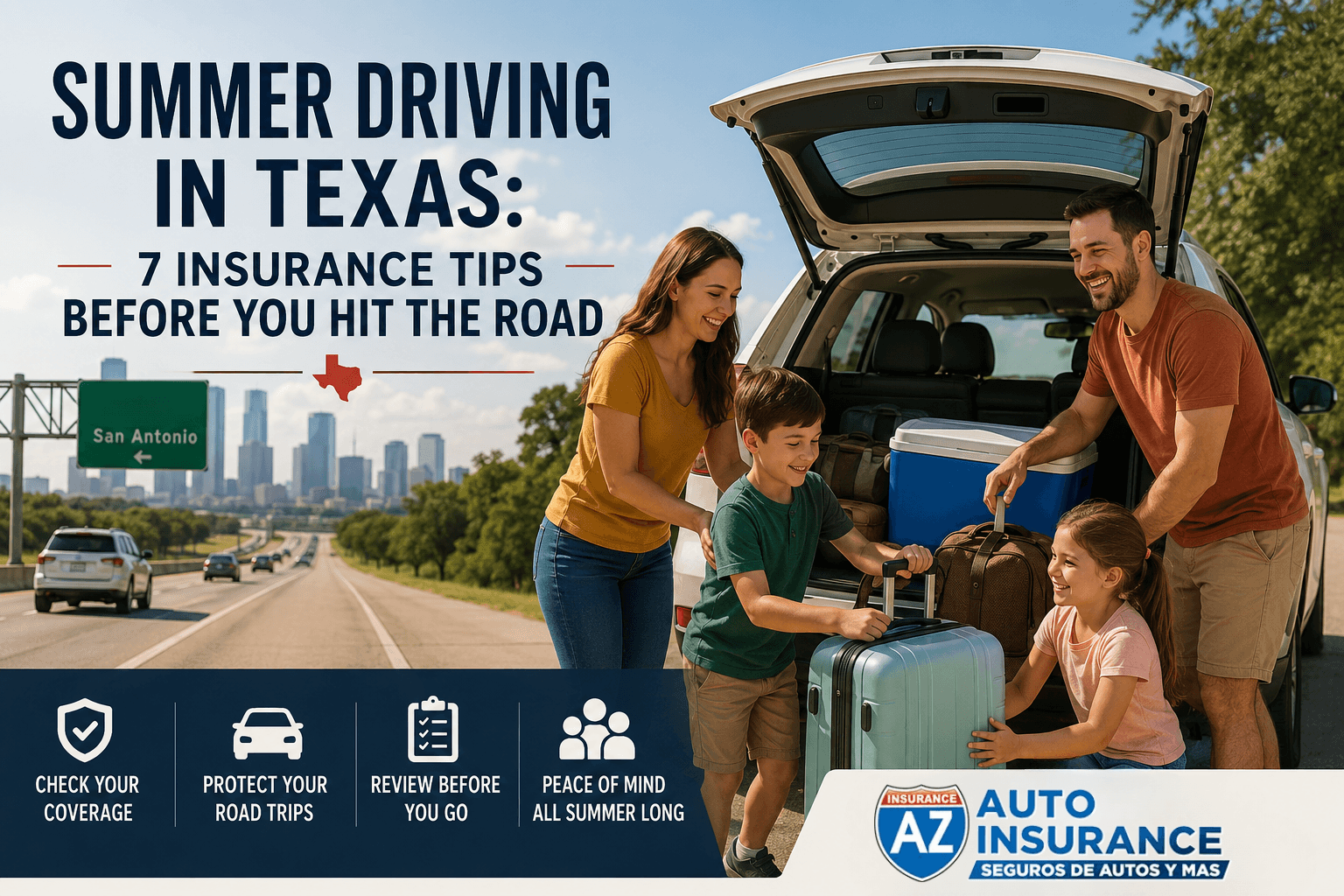
Reviewed by AZ Insurance Agency, licensed in Texas, serving Houston since 2003.
Memorial Day is the unofficial start of summer driving season. You're planning road trips to San Antonio, Austin, Corpus Christi. You're taking the family to the coast. Your teen is out of school and driving more. Your boat gets trailered from the dock. Your motorcycle comes off its stand. Before any of that happens, your insurance needs a review. At AZ Insurance Agency, we've been helping Houston families prep for summer driving since 2003. Learn more about our personalized insurance approach and how we compare eight carriers to find the right coverage for your summer plans.
Most people don't touch their auto policy from the day they buy it until they have an accident. That's the wrong time to find out your limits are too low, or that something important isn't covered. Summer is the time to check. The 7 items every Texas driver should review before June:
Liability limits (state minimums fall short of real claims)
Roadside assistance (out-of-state breakdown coverage)
Rental reimbursement (summer rates spike, daily caps matter)
Teen drivers (add before they start summer driving, not after)
Motorcycle / ATV coverage (separate policies, often lapsed)
Deductibles (cash you can actually pay out of pocket)
Uninsured / underinsured motorist coverage (Texas is 20% uninsured)
1. Check Your Liability Limits
Texas requires a minimum of 30/60/25 liability coverage — $30,000 per person, $60,000 per accident, $25,000 property damage. If you've never had an accident, it's easy to think that's enough.
It isn't. A single serious accident — someone hit by your vehicle, multiple people injured — can exceed $30,000 per person in medical costs before the ambulance even leaves the intersection. That's ER, trauma surgery, follow-up care, rehabilitation. In today's medical costs in Houston, $30,000 doesn't cover the first few days of hospitalization for a serious injury.
When you're driving more miles this summer — road trips to San Antonio, Austin, across state lines to Louisiana — your exposure goes up. A higher-speed accident on I-10 is more likely to result in serious injury than city driving.
Upgrading from 30/60/25 to 100/300/100 is often $20 to $40 per month more in premium. That's a few hundred dollars a year for coverage that can protect you from a six-figure lawsuit. The math is straightforward. According to the Texas Department of Insurance, state minimums often fall short of actual claim costs for serious accidents. At AZ Insurance, we compare eight carriers to show you exactly what that upgrade costs and which carrier gives you the best rate for higher limits.
2. Review Your Roadside Assistance Coverage
Summer breakdowns on I-10 between Houston and San Antonio in 105-degree heat are not pleasant. You're stranded. You're waiting for a tow truck. You're paying cash to the tow driver and then submitting a claim later, or you're hoping your credit card covers roadside service.
If you don't have roadside assistance on your policy, add it. It typically costs $5 to $15 per month. What roadside assistance covers:
Lockout (locksmith dispatch)
Jump-start
Fuel delivery (small amount to get you to a station)
Flat tire change
Towing to a repair facility
Some carriers also cover trip interruption (hotel + meals if you're stranded far from home)
The coverage activates when you call — you get picked up and towed to a repair facility.
The details matter. Does it cover out-of-state breakdowns. What's the towing mileage limit. Some policies limit towing to 50 miles. If you break down 100 miles from Houston, a 50-mile limit won't reach a major service center. Ask when you review your policy.
3. Understand Rental Reimbursement
If your car is in the shop for repairs after an accident during a summer road trip, rental reimbursement pays for a rental car while the repairs are happening. It keeps you mobile. It keeps your family's schedule on track.
Most standard policies cap rental reimbursement at $30 to $50 per day. In summer, rental car rates spike. Hertz and Enterprise raise rates during peak travel season. A rental that costs $40 per day in January might cost $80 per day in July.
If you're in an accident on a summer road trip and your car is in a shop for 10 days, you've got a $500 difference between what your policy covers and what the rental costs. You eat that gap.
Some carriers offer higher daily limits — $75 to $100 per day. Before summer, ask AZ to run a comparison on:
Daily reimbursement cap (most are $30–$50, premium carriers offer $75–$100)
Total claim cap (typically 30 days or $900 total, whichever comes first)
Rental class (economy / mid-size / SUV — matters if you've got a family of 5)
Out-of-state availability (some policies restrict to in-state rental locations)
The premium difference between standard and upgraded rental coverage is typically $5 to $10 per month. If you're a road-trip family, it's worth the few dollars.
4. Add Your Teen Driver Before Summer Break, Not After
Teens out of school means teens driving more. If you're adding a teen to your policy this summer, add them before they start driving, not after an accident.
Most carriers require notification when a household member gets their learner's permit, not just when they get their full license. If you don't add the teen and they're in an accident, the carrier can deny the claim based on material misrepresentation. The policyholder knew a new driver was operating the vehicle and didn't notify the carrier. That's a coverage dispute you don't want.
The other reason to add the teen early: shopping rates. Teen drivers are the highest-rated category. Rates for adding a 16-year-old vary enormously between carriers — sometimes 30 to 50 percent between the cheapest and most expensive. You want to compare eight carriers before you add the teen, not call one agent and take whatever rate they quote.
At AZ, we run eight carriers at once. You see the cheapest option immediately. You walk out with the teen added and covered the same day.
5. Don't Forget Motorcycle and ATV Coverage
Summer is motorcycle season. Personal auto insurance does not cover motorcycles or ATVs. These require separate policies.
If you already have motorcycle insurance, confirm it hasn't lapsed since last summer. Many riders put policies on hold during winter months — November through March — when they're not riding. If you've done that and you're pulling your motorcycle out in May, you need coverage back in force before the first ride, not after the first accident.
The same principle applies if you own an ATV that you only ride in summer. ATVs are not covered under auto policies. You need separate ATV liability coverage through a specialty carrier.
If you're a motorcycle rider, understand what Texas actually requires for coverage:
Liability: 30/60/25 minimum (same as auto)
PIP: not mandatory for motorcycles (different from auto — gap to plan for)
Medical payments coverage: optional but strongly recommended given typical motorcycle injury severity
Uninsured motorist: optional, recommended given 20%+ uninsured rate in Texas
Gear coverage: separate endorsement, covers helmet + protective gear, often overlooked
Motorcycle riders face exposure auto drivers don't — no metal cage, no airbags. Helmet and gear are your protection. Medical costs from a motorcycle accident are typically much higher than car accidents. Without medical payments coverage, there's no automatic coverage for your medical bills regardless of fault.

6. Review Your Deductibles
Higher deductibles mean lower premiums. A $2,000 deductible will save you money every month compared to a $500 deductible. But summer road trip season means more risk. More miles, unfamiliar roads, more chances for an accident.
Is your $2,000 deductible right for where you are financially? If your car gets damaged in an accident, can you pay $2,000 out of pocket while waiting for the insurance payout? Some people can. Some people can't. If you can't, a $2,000 deductible is a false economy.
Before summer, ask AZ to run the math on lower-deductible options. The premium difference for dropping from $2,000 to $1,000 is sometimes smaller than people expect. It might be $30 to $50 per six months. That's a tradeoff worth considering.
7. Uninsured / Underinsured Motorist Coverage
Texas has one of the highest uninsured driver rates in the country. Houston sits around 20 percent uninsured. When you're driving outside Houston on a summer road trip — heading to San Antonio, Austin, across state lines to Louisiana — you're more likely to encounter an out-of-state driver who has no insurance or minimal coverage.
Uninsured motorist coverage covers you when the at-fault driver has no insurance. Underinsured motorist coverage covers you when the at-fault driver's insurance is insufficient. Together, UM/UIM coverage protects you from the financial fallout of hitting an uninsured or underinsured driver.
Texas does not mandate UM/UIM. It's optional. But the math is simple: it's inexpensive to add, and it protects you against a costly scenario. The Texas Department of Insurance's guide on UM/UIM coverage explains how these coverages work and why they're recommended even though they're optional. If you don't have it or your limits are at the state minimum, a summer trip is the time to review it.
Bonus: Catastrophic Protection with Umbrella Coverage
For families heading out on long summer road trips, Umbrella Insurance is worth a serious look. It adds $1 million or more of liability coverage on top of your auto and home policies for a relatively small additional premium — often $200 to $400 per year for the first $1 million.
The math is simple: if you're in a serious accident on I-10 with three people in another vehicle injured, your standard auto policy's $100,000 or $300,000 limit can be exhausted in days. Umbrella picks up the rest. Without it, you're personally liable for the gap — and your savings, your home equity, and your future earnings can be at risk in a lawsuit.
Houston families with teen drivers, boats, or motorcycles have higher exposure than average. Summer is the right time to add umbrella before something happens — not after.
Frequently Asked Questions
Q: Does Texas require uninsured motorist coverage?
No. Uninsured motorist (UM) and underinsured motorist (UIM) coverage are optional in Texas. However, given that roughly 20 percent of drivers in Texas are uninsured, carrying UM/UIM is strongly recommended. It protects you when the at-fault driver has no insurance or inadequate coverage.
Q: Does my Texas auto insurance cover me on out-of-state road trips?
Yes, in most cases. Your liability, collision, comprehensive, and other coverages typically extend to other states. However, confirm with your carrier before traveling. Some carriers have restrictions on where coverage applies, and a few require notification for extended out-of-state travel. Call AZ before a long road trip to confirm your specific policy.
Q: What should I do if I'm in an accident during a road trip far from Houston?
Call 911 first if anyone is injured. Get the other driver's information (name, phone, address, insurance details, license plate). Take photos of damage and the scene. Call your insurance carrier or your agent (AZ Insurance) as soon as possible. Do not admit fault. If you're more than a few hours from Houston, ask your carrier about the claims process and whether a local shop is preferred. Many carriers have preferred repair networks in major cities.
Q: When should I add my teen driver to my policy?
Add the teen as soon as they have their learner's permit and are operating a vehicle, not just when they get their full license. Most carriers require notification at the learner's permit stage. Waiting until after they get their license or after an accident can result in a coverage denial based on misrepresentation. Shopping eight carriers before you add the teen ensures you get the best rate.
Q: How much does roadside assistance cost to add in Texas?
Roadside assistance typically costs $5 to $15 per month depending on the carrier and coverage level. Some carriers include it free for a limited period or as a loyalty reward. Confirm what your current policy includes and what it would cost to upgrade.
Q: Should I increase coverage just for the summer or all year?
Increase it for the year. Coverage changes mid-policy can create gaps and complications. The premium difference between minimum and recommended limits is small enough that running higher coverage year-round is the right move. Summer is just the right trigger to do the review — but the new limits stay in place after.
Q: How quickly can I make changes to my policy before a road trip?
Same day for most changes. Walk into any of our 15 locations or call 713-777-2886 and most adjustments (raising limits, adding roadside, increasing rental reimbursement) can be bound and active within minutes. Adding a new driver or vehicle may take longer depending on underwriting.
Why AZ Insurance Stands Apart
We've been protecting Texas drivers since 2003. Real agents in 15 local offices across Houston and DFW — not call centers reading scripts. Bilingual support so language never gets in the way of getting your policy right before you hit the road. Over 100,000 customers trust us with their family's protection.
Summer driving season is when most accidents happen. The carrier you choose, the limits you set, and the coverages you bundle really matter when you're 200 miles from home with the kids in the back seat.
Get a summer policy review today from an agent who understands your family's plans and your budget. We'll walk through every coverage and make sure you're ready before you leave the driveway.
Reviewed by AZ Insurance Agency, licensed in Texas, serving Houston since 2003.
Memorial Day is the unofficial start of summer driving season. You're planning road trips to San Antonio, Austin, Corpus Christi. You're taking the family to the coast. Your teen is out of school and driving more. Your boat gets trailered from the dock. Your motorcycle comes off its stand. Before any of that happens, your insurance needs a review. At AZ Insurance Agency, we've been helping Houston families prep for summer driving since 2003. Learn more about our personalized insurance approach and how we compare eight carriers to find the right coverage for your summer plans.
Most people don't touch their auto policy from the day they buy it until they have an accident. That's the wrong time to find out your limits are too low, or that something important isn't covered. Summer is the time to check. The 7 items every Texas driver should review before June:
Liability limits (state minimums fall short of real claims)
Roadside assistance (out-of-state breakdown coverage)
Rental reimbursement (summer rates spike, daily caps matter)
Teen drivers (add before they start summer driving, not after)
Motorcycle / ATV coverage (separate policies, often lapsed)
Deductibles (cash you can actually pay out of pocket)
Uninsured / underinsured motorist coverage (Texas is 20% uninsured)
1. Check Your Liability Limits
Texas requires a minimum of 30/60/25 liability coverage — $30,000 per person, $60,000 per accident, $25,000 property damage. If you've never had an accident, it's easy to think that's enough.
It isn't. A single serious accident — someone hit by your vehicle, multiple people injured — can exceed $30,000 per person in medical costs before the ambulance even leaves the intersection. That's ER, trauma surgery, follow-up care, rehabilitation. In today's medical costs in Houston, $30,000 doesn't cover the first few days of hospitalization for a serious injury.
When you're driving more miles this summer — road trips to San Antonio, Austin, across state lines to Louisiana — your exposure goes up. A higher-speed accident on I-10 is more likely to result in serious injury than city driving.
Upgrading from 30/60/25 to 100/300/100 is often $20 to $40 per month more in premium. That's a few hundred dollars a year for coverage that can protect you from a six-figure lawsuit. The math is straightforward. According to the Texas Department of Insurance, state minimums often fall short of actual claim costs for serious accidents. At AZ Insurance, we compare eight carriers to show you exactly what that upgrade costs and which carrier gives you the best rate for higher limits.
2. Review Your Roadside Assistance Coverage
Summer breakdowns on I-10 between Houston and San Antonio in 105-degree heat are not pleasant. You're stranded. You're waiting for a tow truck. You're paying cash to the tow driver and then submitting a claim later, or you're hoping your credit card covers roadside service.
If you don't have roadside assistance on your policy, add it. It typically costs $5 to $15 per month. What roadside assistance covers:
Lockout (locksmith dispatch)
Jump-start
Fuel delivery (small amount to get you to a station)
Flat tire change
Towing to a repair facility
Some carriers also cover trip interruption (hotel + meals if you're stranded far from home)
The coverage activates when you call — you get picked up and towed to a repair facility.
The details matter. Does it cover out-of-state breakdowns. What's the towing mileage limit. Some policies limit towing to 50 miles. If you break down 100 miles from Houston, a 50-mile limit won't reach a major service center. Ask when you review your policy.
3. Understand Rental Reimbursement
If your car is in the shop for repairs after an accident during a summer road trip, rental reimbursement pays for a rental car while the repairs are happening. It keeps you mobile. It keeps your family's schedule on track.
Most standard policies cap rental reimbursement at $30 to $50 per day. In summer, rental car rates spike. Hertz and Enterprise raise rates during peak travel season. A rental that costs $40 per day in January might cost $80 per day in July.
If you're in an accident on a summer road trip and your car is in a shop for 10 days, you've got a $500 difference between what your policy covers and what the rental costs. You eat that gap.
Some carriers offer higher daily limits — $75 to $100 per day. Before summer, ask AZ to run a comparison on:
Daily reimbursement cap (most are $30–$50, premium carriers offer $75–$100)
Total claim cap (typically 30 days or $900 total, whichever comes first)
Rental class (economy / mid-size / SUV — matters if you've got a family of 5)
Out-of-state availability (some policies restrict to in-state rental locations)
The premium difference between standard and upgraded rental coverage is typically $5 to $10 per month. If you're a road-trip family, it's worth the few dollars.
4. Add Your Teen Driver Before Summer Break, Not After
Teens out of school means teens driving more. If you're adding a teen to your policy this summer, add them before they start driving, not after an accident.
Most carriers require notification when a household member gets their learner's permit, not just when they get their full license. If you don't add the teen and they're in an accident, the carrier can deny the claim based on material misrepresentation. The policyholder knew a new driver was operating the vehicle and didn't notify the carrier. That's a coverage dispute you don't want.
The other reason to add the teen early: shopping rates. Teen drivers are the highest-rated category. Rates for adding a 16-year-old vary enormously between carriers — sometimes 30 to 50 percent between the cheapest and most expensive. You want to compare eight carriers before you add the teen, not call one agent and take whatever rate they quote.
At AZ, we run eight carriers at once. You see the cheapest option immediately. You walk out with the teen added and covered the same day.
5. Don't Forget Motorcycle and ATV Coverage
Summer is motorcycle season. Personal auto insurance does not cover motorcycles or ATVs. These require separate policies.
If you already have motorcycle insurance, confirm it hasn't lapsed since last summer. Many riders put policies on hold during winter months — November through March — when they're not riding. If you've done that and you're pulling your motorcycle out in May, you need coverage back in force before the first ride, not after the first accident.
The same principle applies if you own an ATV that you only ride in summer. ATVs are not covered under auto policies. You need separate ATV liability coverage through a specialty carrier.
If you're a motorcycle rider, understand what Texas actually requires for coverage:
Liability: 30/60/25 minimum (same as auto)
PIP: not mandatory for motorcycles (different from auto — gap to plan for)
Medical payments coverage: optional but strongly recommended given typical motorcycle injury severity
Uninsured motorist: optional, recommended given 20%+ uninsured rate in Texas
Gear coverage: separate endorsement, covers helmet + protective gear, often overlooked
Motorcycle riders face exposure auto drivers don't — no metal cage, no airbags. Helmet and gear are your protection. Medical costs from a motorcycle accident are typically much higher than car accidents. Without medical payments coverage, there's no automatic coverage for your medical bills regardless of fault.
6. Review Your Deductibles
Higher deductibles mean lower premiums. A $2,000 deductible will save you money every month compared to a $500 deductible. But summer road trip season means more risk. More miles, unfamiliar roads, more chances for an accident.
Is your $2,000 deductible right for where you are financially? If your car gets damaged in an accident, can you pay $2,000 out of pocket while waiting for the insurance payout? Some people can. Some people can't. If you can't, a $2,000 deductible is a false economy.
Before summer, ask AZ to run the math on lower-deductible options. The premium difference for dropping from $2,000 to $1,000 is sometimes smaller than people expect. It might be $30 to $50 per six months. That's a tradeoff worth considering.
7. Uninsured / Underinsured Motorist Coverage
Texas has one of the highest uninsured driver rates in the country. Houston sits around 20 percent uninsured. When you're driving outside Houston on a summer road trip — heading to San Antonio, Austin, across state lines to Louisiana — you're more likely to encounter an out-of-state driver who has no insurance or minimal coverage.
Uninsured motorist coverage covers you when the at-fault driver has no insurance. Underinsured motorist coverage covers you when the at-fault driver's insurance is insufficient. Together, UM/UIM coverage protects you from the financial fallout of hitting an uninsured or underinsured driver.
Texas does not mandate UM/UIM. It's optional. But the math is simple: it's inexpensive to add, and it protects you against a costly scenario. The Texas Department of Insurance's guide on UM/UIM coverage explains how these coverages work and why they're recommended even though they're optional. If you don't have it or your limits are at the state minimum, a summer trip is the time to review it.
Bonus: Catastrophic Protection with Umbrella Coverage
For families heading out on long summer road trips, Umbrella Insurance is worth a serious look. It adds $1 million or more of liability coverage on top of your auto and home policies for a relatively small additional premium — often $200 to $400 per year for the first $1 million.
The math is simple: if you're in a serious accident on I-10 with three people in another vehicle injured, your standard auto policy's $100,000 or $300,000 limit can be exhausted in days. Umbrella picks up the rest. Without it, you're personally liable for the gap — and your savings, your home equity, and your future earnings can be at risk in a lawsuit.
Houston families with teen drivers, boats, or motorcycles have higher exposure than average. Summer is the right time to add umbrella before something happens — not after.
Frequently Asked Questions
Q: Does Texas require uninsured motorist coverage?
No. Uninsured motorist (UM) and underinsured motorist (UIM) coverage are optional in Texas. However, given that roughly 20 percent of drivers in Texas are uninsured, carrying UM/UIM is strongly recommended. It protects you when the at-fault driver has no insurance or inadequate coverage.
Q: Does my Texas auto insurance cover me on out-of-state road trips?
Yes, in most cases. Your liability, collision, comprehensive, and other coverages typically extend to other states. However, confirm with your carrier before traveling. Some carriers have restrictions on where coverage applies, and a few require notification for extended out-of-state travel. Call AZ before a long road trip to confirm your specific policy.
Q: What should I do if I'm in an accident during a road trip far from Houston?
Call 911 first if anyone is injured. Get the other driver's information (name, phone, address, insurance details, license plate). Take photos of damage and the scene. Call your insurance carrier or your agent (AZ Insurance) as soon as possible. Do not admit fault. If you're more than a few hours from Houston, ask your carrier about the claims process and whether a local shop is preferred. Many carriers have preferred repair networks in major cities.
Q: When should I add my teen driver to my policy?
Add the teen as soon as they have their learner's permit and are operating a vehicle, not just when they get their full license. Most carriers require notification at the learner's permit stage. Waiting until after they get their license or after an accident can result in a coverage denial based on misrepresentation. Shopping eight carriers before you add the teen ensures you get the best rate.
Q: How much does roadside assistance cost to add in Texas?
Roadside assistance typically costs $5 to $15 per month depending on the carrier and coverage level. Some carriers include it free for a limited period or as a loyalty reward. Confirm what your current policy includes and what it would cost to upgrade.
Q: Should I increase coverage just for the summer or all year?
Increase it for the year. Coverage changes mid-policy can create gaps and complications. The premium difference between minimum and recommended limits is small enough that running higher coverage year-round is the right move. Summer is just the right trigger to do the review — but the new limits stay in place after.
Q: How quickly can I make changes to my policy before a road trip?
Same day for most changes. Walk into any of our 15 locations or call 713-777-2886 and most adjustments (raising limits, adding roadside, increasing rental reimbursement) can be bound and active within minutes. Adding a new driver or vehicle may take longer depending on underwriting.
Why AZ Insurance Stands Apart
We've been protecting Texas drivers since 2003. Real agents in 15 local offices across Houston and DFW — not call centers reading scripts. Bilingual support so language never gets in the way of getting your policy right before you hit the road. Over 100,000 customers trust us with their family's protection.
Summer driving season is when most accidents happen. The carrier you choose, the limits you set, and the coverages you bundle really matter when you're 200 miles from home with the kids in the back seat.
Get a summer policy review today from an agent who understands your family's plans and your budget. We'll walk through every coverage and make sure you're ready before you leave the driveway.
Latest Blogs

Is Texas Minimum Car Insurance Enough? What 30/60/25 Actually Pays After a Crash

Texas SR-22 After a DWI: How to Reinstate Your License

Hit by an Uninsured Driver in Texas? The Coverage You May Have Turned Down Without Knowing

How Much Does Umbrella Insurance Cost in Texas?

Does Homeowners Insurance Cover Foundation Damage in Texas? What Pays, What Does Not, and the Endorsement to Ask For

How to Read Your Texas Home Insurance Declarations Page, Line by Line
Let A-Z Auto Insurance Help You Find Affordable Coverage
Connect with our experienced team today & get reliable, affordable insurance designed around your needs.
Contact Us!
Let A-Z Auto Insurance Help
You Find Affordable Coverage
Connect with our experienced team today & get reliable, affordable insurance designed around your needs.
Contact Us!
Let A-Z Auto
Insurance Help You
Find Affordable Coverage
Connect with our experienced team today & get reliable, affordable insurance designed around your needs.
Contact Us!
Let A-Z Auto Insurance Help
You Find Affordable Coverage
Connect with our experienced team today & get reliable, affordable insurance designed around your needs.
Contact Us!
Latest New & Blogs
Latest New & Blogs
Related Blog Posts
Related Blog Posts
Hit by an Uninsured Driver in Texas? The Coverage You May Have Turned Down Without Knowing
About 1 in 8 Texas drivers is uninsured. UM/UIM and PIP are on every Texas policy unless someone rejected them in writing. Here is how to check yours.
Hit by an Uninsured Driver in Texas? The Coverage You May Have Turned Down Without Knowing
About 1 in 8 Texas drivers is uninsured. UM/UIM and PIP are on every Texas policy unless someone rejected them in writing. Here is how to check yours.
Hit by an Uninsured Driver in Texas? The Coverage You May Have Turned Down Without Knowing
About 1 in 8 Texas drivers is uninsured. UM/UIM and PIP are on every Texas policy unless someone rejected them in writing. Here is how to check yours.
How Much Does Umbrella Insurance Cost in Texas?
How much does an umbrella policy cost? See average umbrella insurance rates by limit, what drives the price, and how Texans can save. Get a quote today.
How Much Does Umbrella Insurance Cost in Texas?
How much does an umbrella policy cost? See average umbrella insurance rates by limit, what drives the price, and how Texans can save. Get a quote today.
How Much Does Umbrella Insurance Cost in Texas?
How much does an umbrella policy cost? See average umbrella insurance rates by limit, what drives the price, and how Texans can save. Get a quote today.
Does Homeowners Insurance Cover Foundation Damage in Texas? What Pays, What Does Not, and the Endorsement to Ask For
Settling from dry clay soil is usually excluded. A plumbing leak under the slab can be covered, often only with a foundation endorsement. Here is how to check.
Does Homeowners Insurance Cover Foundation Damage in Texas? What Pays, What Does Not, and the Endorsement to Ask For
Settling from dry clay soil is usually excluded. A plumbing leak under the slab can be covered, often only with a foundation endorsement. Here is how to check.
Does Homeowners Insurance Cover Foundation Damage in Texas? What Pays, What Does Not, and the Endorsement to Ask For
Settling from dry clay soil is usually excluded. A plumbing leak under the slab can be covered, often only with a foundation endorsement. Here is how to check.
Hit by an Uninsured Driver in Texas? The Coverage You May Have Turned Down Without Knowing
About 1 in 8 Texas drivers is uninsured. UM/UIM and PIP are on every Texas policy unless someone rejected them in writing. Here is how to check yours.
How Much Does Umbrella Insurance Cost in Texas?
How much does an umbrella policy cost? See average umbrella insurance rates by limit, what drives the price, and how Texans can save. Get a quote today.