Quick support from trusted insurance professionals Call +1 713-777-2886 today! |
Call +1 713-777-2886
Call +1 713-777-2886
Quick support from insurance professionals Call +1 713-777-2886 today! |


Table of Content
Title

Let AZ Insurance Help You
Find Affordable Coverage
Connect with our experienced team today & get reliable, affordable insurance designed around your needs.
Contact Us!
Let A-Z Auto Insurance Help You Find Affordable Coverage
Connect with our experienced team today & get reliable, affordable insurance designed around your needs.
Contact Us!
What Does Homeowners Insurance Cover and Not Cover?
What Does Homeowners Insurance Cover and Not Cover?
What Does Homeowners Insurance Cover and Not Cover?
What Does Homeowners Insurance Cover and Not Cover?
What Does Homeowners Insurance Cover and Not Cover?
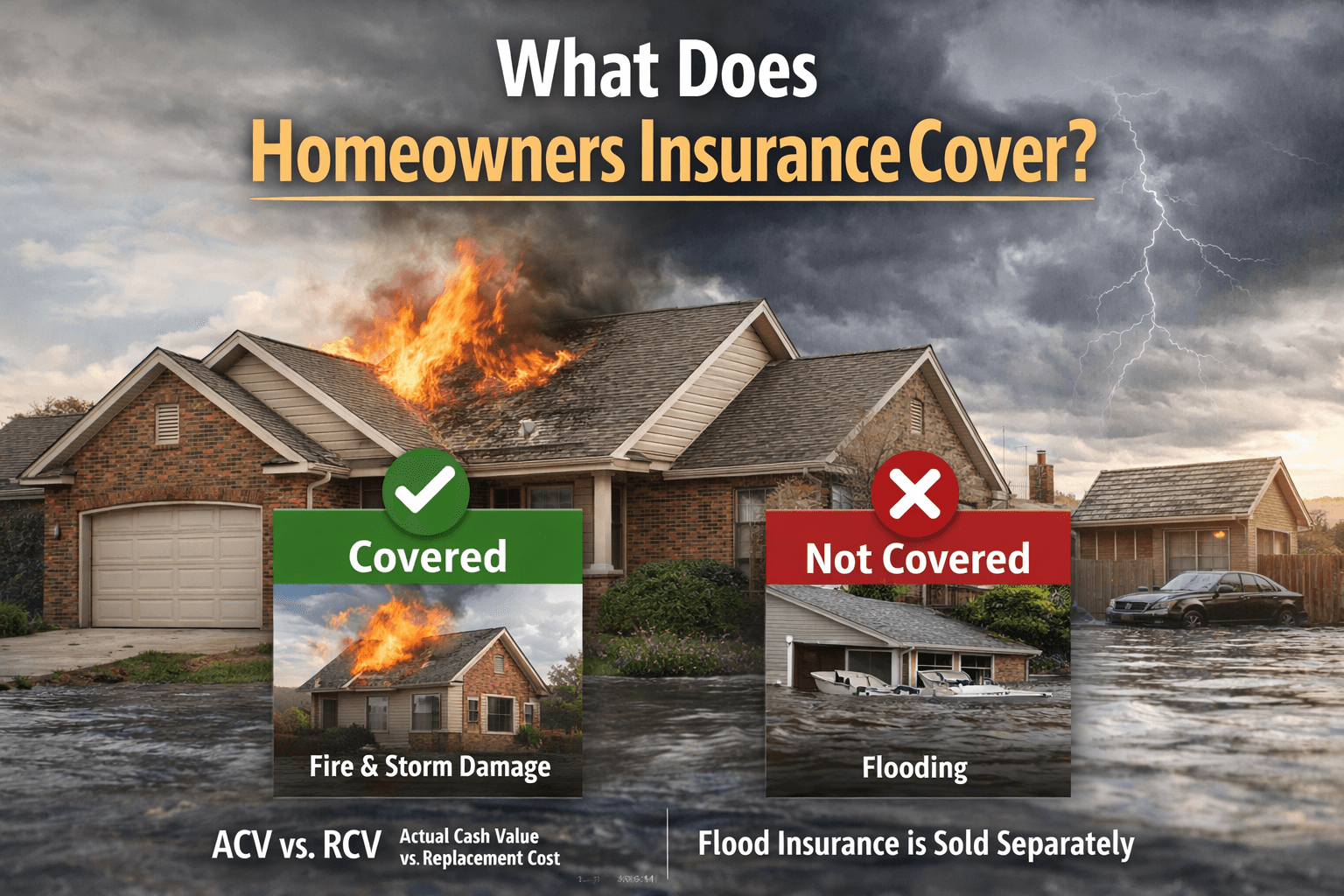
If you own a home in Texas, homeowners' insurance is one of the most important financial protections you can have. But many homeowners are surprised to discover - often at the worst possible time - that their policy doesn't cover what they assumed it did. So, what does homeowners' insurance cover and not cover, exactly?
In this guide, we break it all down: what's typically included in a standard homeowner policy, what's commonly excluded, and how to make sure you're not left with a major out-of-pocket expense after a loss.
What Does Homeowners Insurance Cover?
A standard homeowners insurance policy - also called an HO-3 policy - typically covers four main areas:
1. Dwelling Coverage (Coverage A)
This covers the physical structure of your home - walls, roofs, floors, built-in appliances, and attached structures like a garage. If a covered event damages your house, your insurer will pay to repair or rebuild it up to your policy's dwelling limit.
Covered perils typically include:
Fire and smoke damage
Lightning strikes
Windstorm and hail
Explosions
Vandalism and malicious mischief
Damage from vehicles or aircraft
Weight of ice, snow, or sleet
Sudden and accidental water damage from plumbing (not flooding)
2. Other Structures Coverage (Coverage B)
This covers detached structures on your property, such as a fence, detached garage, shed, or guest house. Coverage B is typically set at 10% of your dwelling coverage limit.
3. Personal Property Coverage (Coverage C)
Even when you're not at home, your personal belongings - such as furniture, electronics, clothing, and appliances - are covered if they are stolen or harmed by a covered peril. Remember that expensive goods, such as jewelry, artwork, or collectibles, might have sub-limits and need a different rider or scheduled endorsement.
4. Liability Protection (Coverage E)
Liability coverage assists in covering legal fees and damages if someone is hurt on your property, or you unintentionally damage someone else's property. For greater protection, many homeowners decide to raise the $100,000 starting point of most standard policies. You can learn more about how liability coverage works by visiting our general liability insurance page.
5. Additional Living Expenses / Loss of Use (Coverage D)
If your home becomes uninhabitable due to a covered loss, this coverage pays for temporary housing, meals, and other additional living costs while your home is being repaired.

What Is Not Covered by Homeowners Insurance?
This is where a lot of homeowners are unprepared. The most typical exclusions from homeowner's insurance are as follows:
Flooding: Rising water, storm surges, and overflowing rivers are not covered by standard homeowners' insurance. For Texas homeowners, particularly those in the Houston region, this is one of the most important exclusions. You must obtain a separate flood insurance policy from a private insurer or the National Flood Insurance Program (NFIP) to receive flood coverage.
Earthquakes and Earth Movement: A typical policy does not cover land subsidence, sinkholes, or earthquake damage. A different earthquake endorsement or policy might be required if you live in an area with soil problems or seismic risk.
Maintenance Issues and Wear & Tear: Homeowners insurance is not a home warranty. Gradual deterioration, aging roofs, mold from long-term moisture, pest infestations (termites, rodents), and routine maintenance repairs are excluded. The damage must be sudden and accidental - not the result of neglect.
Sewer Backup: If a sewer line backs up and damages your home, standard policies typically exclude this. However, many insurers offer a sewer backup endorsement that can be added for a relatively small additional premium - and it's well worth it.
Business Activities at Home: If you run a business out of your home - whether it's a daycare, contractor operation, or home office - damage or liability related to that business is generally excluded from your homeowner's policy. You'd need a home-based business endorsement or a separate commercial policy.
High-Value Items (Above Sub-Limits): Jewelry, fine art, collectibles, guns, and electronics often have coverage of sub-limits (e.g., $1,500 for jewelry). If the item value exceeds the sub-limit, you could be significantly underinsured without a scheduled personal property endorsement.
Intentional Damage: Any damage you intentionally cause to your own property is excluded. Additionally, losses resulting from criminal acts by the insured are typically not covered.
Texas-Specific Considerations for Homeowners
Living in Texas - and especially in the Houston area - comes with unique risks that every homeowner should understand:
Hurricane and windstorm: Many Texas coastal policies have a separate wind/hail deductible, which is typically a percentage of your dwelling coverage rather than a flat dollar amount. Our blog on hurricane season preparedness covers this in more detail.
Flooding: Houston is one of the most flood-prone cities in the US. Even if you're not in a designated flood zone, flood insurance is strongly recommended.
Heat and drought: Soil movement from extreme heat can cause foundation cracking - which is usually excluded from standard policies.
Hail: Texas leads the nation to hail damage claims. Make sure your policy includes hail coverage and confirm whether you have an ACV (actual cash value) or RCV (replacement cost value) on your roof.
Actual Cash Value vs. Replacement Cost Value: What's the Difference?
This is one of the most important coverage decisions you'll make:
Actual Cash Value (ACV): Pays what your damaged property is worth at the time of loss - factoring in depreciation. An older roof or aging appliances will get you significantly less.
Replacement Cost Value (RCV): Pays what it would cost to replace your property with a new equivalent today - no depreciation deducted. This is the better option for most homeowners.
Always confirm which your policy uses, especially your roof and personal property. You can explore related terms in our insurance glossary if you need clarification on any coverage terminology.
Quick Reference: Covered vs. Not Covered
Typically Covered | Typically NOT Covered |
Fire & smoke damage | Flooding (requires separate policy) |
Lightning damage | Earthquakes & earth movement |
Windstorm & hail | Sewer backup (needs endorsement) |
Theft & vandalism | Pest damage (termites, rodents) |
Personal liability | Wear, tear & maintenance |
Temporary living expenses | High-value items above sub-limits |
Accidental water damage | Home business liability |
How to Make Sure You're Properly Covered
Here are a ew steps to protect yourself from coverage gaps:
Review your policy annually - your home's value changes, and so should your coverage.
Know your deductibles - including any separate wind/hail deductibles if you're in a Texas coastal area.
Consider flood insurance - especially in Houston where flooding is a recurring risk even outside flood zones.
Add endorsements where needed - sewer backup, scheduled personal property, and home business coverage are all relatively affordable add-ons.
Talk to a licensed agent - not all policies are created equal, and a local agent who knows Texas can help you find the right fit.
Get a Homeowners Insurance Quote in Houston
At A-Z Insurance Agency, we help Houston-area homeowners understand their coverage, fill the gaps, and find policies that truly protect what matters most. Whether you're buying your first home or reassessing your existing policy, our licensed agents are here to help - in English and Spanish.
Contact us today for a free homeowners insurance review or quote. With 15 offices across Houston, we're right in your neighborhood.
📍 aztexas.com | Visit any of our 15 Houston locations
Frequently Asked Questions
1. Does homeowners insurance cover flood damage?
No. Flood damage is not covered by standard homeowners' insurance. You need a separate flood insurance policy.
2. What is the difference between ACV and RCV?
ACV pays the depreciated value of items, while RCV pays the cost to replace them with new ones. RCV offers better coverage.
3. Are valuable items like jewelry fully covered?
Not always. High-value items often have coverage limits, so you may need an additional endorsement for full protection.
4. Is sewer backup covered?
No, it’s not included. You can add sewer backup coverage as an optional endorsement.
Frequently Asked Questions
Q: Does homeowners insurance cover flood damage in Houston?
No. Flood is excluded from every standard homeowners policy, and that surprises people every hurricane season. Flood coverage is bought separately, either through the National Flood Insurance Program or a private flood policy. This matters more in Houston than almost anywhere else, and you do not have to be in a mapped flood zone to flood. A large share of Harvey claims came from homes outside the high risk zones.
Q: Will filing a claim raise my premium?
It depends on what kind of claim it is, and Texas draws a line here that most people do not know about. Under the Texas Consumer Bill of Rights, an insurer cannot raise your premium or refuse to renew you because of a claim caused by a weather event. A claim you are at fault for, like a liability claim, is treated differently. So the fear of filing is usually pointed at the wrong claim.
Q: How long does a claim stay on my record?
Seven years, in a database called CLUE. The part people miss is that CLUE follows the house, not just the person. If you buy a home that had two water claims three years ago, those show up when you go to insure it, even though they were not yours. It is worth pulling the CLUE report on a house before you close.
Q: What is the difference between my dwelling limit and what I paid for the house?
They are not the same number and they should not be. Your dwelling limit is what it would cost to rebuild the structure, not what the property is worth on the market. Land value is a large part of a Houston purchase price and land does not burn down. Insuring to the purchase price usually means paying for coverage you cannot collect.
Q: Does my policy cover the roof at full value?
Read the roof endorsement before you assume it does. Many Texas policies have moved roofs to actual cash value, meaning depreciation comes out of the payment. On a fifteen year old roof that difference can be most of the claim. It is one of the few line items where the cheapest quote and the most expensive quote are genuinely selling different things.
Q: What is not covered that people assume is?
Flood, earth movement, ordinary wear, mold beyond a small capped amount, and damage from a maintenance problem you knew about. Sewer backup is usually an add on rather than standard. None of these are hidden, they are just in the part of the policy nobody reads until they need it.
If you own a home in Texas, homeowners' insurance is one of the most important financial protections you can have. But many homeowners are surprised to discover - often at the worst possible time - that their policy doesn't cover what they assumed it did. So, what does homeowners' insurance cover and not cover, exactly?
In this guide, we break it all down: what's typically included in a standard homeowner policy, what's commonly excluded, and how to make sure you're not left with a major out-of-pocket expense after a loss.
What Does Homeowners Insurance Cover?
A standard homeowners insurance policy - also called an HO-3 policy - typically covers four main areas:
1. Dwelling Coverage (Coverage A)
This covers the physical structure of your home - walls, roofs, floors, built-in appliances, and attached structures like a garage. If a covered event damages your house, your insurer will pay to repair or rebuild it up to your policy's dwelling limit.
Covered perils typically include:
Fire and smoke damage
Lightning strikes
Windstorm and hail
Explosions
Vandalism and malicious mischief
Damage from vehicles or aircraft
Weight of ice, snow, or sleet
Sudden and accidental water damage from plumbing (not flooding)
2. Other Structures Coverage (Coverage B)
This covers detached structures on your property, such as a fence, detached garage, shed, or guest house. Coverage B is typically set at 10% of your dwelling coverage limit.
3. Personal Property Coverage (Coverage C)
Even when you're not at home, your personal belongings - such as furniture, electronics, clothing, and appliances - are covered if they are stolen or harmed by a covered peril. Remember that expensive goods, such as jewelry, artwork, or collectibles, might have sub-limits and need a different rider or scheduled endorsement.
4. Liability Protection (Coverage E)
Liability coverage assists in covering legal fees and damages if someone is hurt on your property, or you unintentionally damage someone else's property. For greater protection, many homeowners decide to raise the $100,000 starting point of most standard policies. You can learn more about how liability coverage works by visiting our general liability insurance page.
5. Additional Living Expenses / Loss of Use (Coverage D)
If your home becomes uninhabitable due to a covered loss, this coverage pays for temporary housing, meals, and other additional living costs while your home is being repaired.
What Is Not Covered by Homeowners Insurance?
This is where a lot of homeowners are unprepared. The most typical exclusions from homeowner's insurance are as follows:
Flooding: Rising water, storm surges, and overflowing rivers are not covered by standard homeowners' insurance. For Texas homeowners, particularly those in the Houston region, this is one of the most important exclusions. You must obtain a separate flood insurance policy from a private insurer or the National Flood Insurance Program (NFIP) to receive flood coverage.
Earthquakes and Earth Movement: A typical policy does not cover land subsidence, sinkholes, or earthquake damage. A different earthquake endorsement or policy might be required if you live in an area with soil problems or seismic risk.
Maintenance Issues and Wear & Tear: Homeowners insurance is not a home warranty. Gradual deterioration, aging roofs, mold from long-term moisture, pest infestations (termites, rodents), and routine maintenance repairs are excluded. The damage must be sudden and accidental - not the result of neglect.
Sewer Backup: If a sewer line backs up and damages your home, standard policies typically exclude this. However, many insurers offer a sewer backup endorsement that can be added for a relatively small additional premium - and it's well worth it.
Business Activities at Home: If you run a business out of your home - whether it's a daycare, contractor operation, or home office - damage or liability related to that business is generally excluded from your homeowner's policy. You'd need a home-based business endorsement or a separate commercial policy.
High-Value Items (Above Sub-Limits): Jewelry, fine art, collectibles, guns, and electronics often have coverage of sub-limits (e.g., $1,500 for jewelry). If the item value exceeds the sub-limit, you could be significantly underinsured without a scheduled personal property endorsement.
Intentional Damage: Any damage you intentionally cause to your own property is excluded. Additionally, losses resulting from criminal acts by the insured are typically not covered.
Texas-Specific Considerations for Homeowners
Living in Texas - and especially in the Houston area - comes with unique risks that every homeowner should understand:
Hurricane and windstorm: Many Texas coastal policies have a separate wind/hail deductible, which is typically a percentage of your dwelling coverage rather than a flat dollar amount. Our blog on hurricane season preparedness covers this in more detail.
Flooding: Houston is one of the most flood-prone cities in the US. Even if you're not in a designated flood zone, flood insurance is strongly recommended.
Heat and drought: Soil movement from extreme heat can cause foundation cracking - which is usually excluded from standard policies.
Hail: Texas leads the nation to hail damage claims. Make sure your policy includes hail coverage and confirm whether you have an ACV (actual cash value) or RCV (replacement cost value) on your roof.
Actual Cash Value vs. Replacement Cost Value: What's the Difference?
This is one of the most important coverage decisions you'll make:
Actual Cash Value (ACV): Pays what your damaged property is worth at the time of loss - factoring in depreciation. An older roof or aging appliances will get you significantly less.
Replacement Cost Value (RCV): Pays what it would cost to replace your property with a new equivalent today - no depreciation deducted. This is the better option for most homeowners.
Always confirm which your policy uses, especially your roof and personal property. You can explore related terms in our insurance glossary if you need clarification on any coverage terminology.
Quick Reference: Covered vs. Not Covered
Typically Covered | Typically NOT Covered |
Fire & smoke damage | Flooding (requires separate policy) |
Lightning damage | Earthquakes & earth movement |
Windstorm & hail | Sewer backup (needs endorsement) |
Theft & vandalism | Pest damage (termites, rodents) |
Personal liability | Wear, tear & maintenance |
Temporary living expenses | High-value items above sub-limits |
Accidental water damage | Home business liability |
How to Make Sure You're Properly Covered
Here are a ew steps to protect yourself from coverage gaps:
Review your policy annually - your home's value changes, and so should your coverage.
Know your deductibles - including any separate wind/hail deductibles if you're in a Texas coastal area.
Consider flood insurance - especially in Houston where flooding is a recurring risk even outside flood zones.
Add endorsements where needed - sewer backup, scheduled personal property, and home business coverage are all relatively affordable add-ons.
Talk to a licensed agent - not all policies are created equal, and a local agent who knows Texas can help you find the right fit.
Get a Homeowners Insurance Quote in Houston
At A-Z Insurance Agency, we help Houston-area homeowners understand their coverage, fill the gaps, and find policies that truly protect what matters most. Whether you're buying your first home or reassessing your existing policy, our licensed agents are here to help - in English and Spanish.
Contact us today for a free homeowners insurance review or quote. With 15 offices across Houston, we're right in your neighborhood.
📍 aztexas.com | Visit any of our 15 Houston locations
Frequently Asked Questions
1. Does homeowners insurance cover flood damage?
No. Flood damage is not covered by standard homeowners' insurance. You need a separate flood insurance policy.
2. What is the difference between ACV and RCV?
ACV pays the depreciated value of items, while RCV pays the cost to replace them with new ones. RCV offers better coverage.
3. Are valuable items like jewelry fully covered?
Not always. High-value items often have coverage limits, so you may need an additional endorsement for full protection.
4. Is sewer backup covered?
No, it’s not included. You can add sewer backup coverage as an optional endorsement.
Frequently Asked Questions
Q: Does homeowners insurance cover flood damage in Houston?
No. Flood is excluded from every standard homeowners policy, and that surprises people every hurricane season. Flood coverage is bought separately, either through the National Flood Insurance Program or a private flood policy. This matters more in Houston than almost anywhere else, and you do not have to be in a mapped flood zone to flood. A large share of Harvey claims came from homes outside the high risk zones.
Q: Will filing a claim raise my premium?
It depends on what kind of claim it is, and Texas draws a line here that most people do not know about. Under the Texas Consumer Bill of Rights, an insurer cannot raise your premium or refuse to renew you because of a claim caused by a weather event. A claim you are at fault for, like a liability claim, is treated differently. So the fear of filing is usually pointed at the wrong claim.
Q: How long does a claim stay on my record?
Seven years, in a database called CLUE. The part people miss is that CLUE follows the house, not just the person. If you buy a home that had two water claims three years ago, those show up when you go to insure it, even though they were not yours. It is worth pulling the CLUE report on a house before you close.
Q: What is the difference between my dwelling limit and what I paid for the house?
They are not the same number and they should not be. Your dwelling limit is what it would cost to rebuild the structure, not what the property is worth on the market. Land value is a large part of a Houston purchase price and land does not burn down. Insuring to the purchase price usually means paying for coverage you cannot collect.
Q: Does my policy cover the roof at full value?
Read the roof endorsement before you assume it does. Many Texas policies have moved roofs to actual cash value, meaning depreciation comes out of the payment. On a fifteen year old roof that difference can be most of the claim. It is one of the few line items where the cheapest quote and the most expensive quote are genuinely selling different things.
Q: What is not covered that people assume is?
Flood, earth movement, ordinary wear, mold beyond a small capped amount, and damage from a maintenance problem you knew about. Sewer backup is usually an add on rather than standard. None of these are hidden, they are just in the part of the policy nobody reads until they need it.
Latest Blogs
General Liability Will Not Pay for a Mistake. What Professional Liability Covers in Texas
What Does Cyber Insurance Cover (and Not Cover)? Full Guide

How Much Is ATV Insurance? Average Costs and Factors

Your Tools Were Stolen Off the Truck. Which Policy Actually Pays?

What Does an Umbrella Insurance Policy Cover? (And What It Doesn't)
How Much Does Flood Insurance Cost in Texas? (2026 Pricing Guide)
Let A-Z Auto Insurance Help You Find Affordable Coverage
Connect with our experienced team today & get reliable, affordable insurance designed around your needs.
Contact Us!
Let A-Z Auto Insurance Help
You Find Affordable Coverage
Connect with our experienced team today & get reliable, affordable insurance designed around your needs.
Contact Us!
Let A-Z Auto
Insurance Help You
Find Affordable Coverage
Connect with our experienced team today & get reliable, affordable insurance designed around your needs.
Contact Us!
Let A-Z Auto Insurance Help
You Find Affordable Coverage
Connect with our experienced team today & get reliable, affordable insurance designed around your needs.
Contact Us!
Latest New & Blogs
Latest New & Blogs
Related Blog Posts
Related Blog Posts
How Much Is ATV Insurance? Average Costs and Factors
Learn how much ATV insurance costs, from liability to full coverage, plus the factors that affect your premium and ways to save. Visit now!
How Much Is ATV Insurance? Average Costs and Factors
Learn how much ATV insurance costs, from liability to full coverage, plus the factors that affect your premium and ways to save. Visit now!
How Much Is ATV Insurance? Average Costs and Factors
Learn how much ATV insurance costs, from liability to full coverage, plus the factors that affect your premium and ways to save. Visit now!
Your Tools Were Stolen Off the Truck. Which Policy Actually Pays?
General liability covers other people's property. Commercial auto pays for the broken window, not what was inside. Here is the policy that actually replaces your tools.
Your Tools Were Stolen Off the Truck. Which Policy Actually Pays?
General liability covers other people's property. Commercial auto pays for the broken window, not what was inside. Here is the policy that actually replaces your tools.
Your Tools Were Stolen Off the Truck. Which Policy Actually Pays?
General liability covers other people's property. Commercial auto pays for the broken window, not what was inside. Here is the policy that actually replaces your tools.
What Does an Umbrella Insurance Policy Cover? (And What It Doesn't)
Wondering what does an umbrella insurance policy cover? See what's included what's excluded, and if you need extra liability protection.
What Does an Umbrella Insurance Policy Cover? (And What It Doesn't)
Wondering what does an umbrella insurance policy cover? See what's included what's excluded, and if you need extra liability protection.
What Does an Umbrella Insurance Policy Cover? (And What It Doesn't)
Wondering what does an umbrella insurance policy cover? See what's included what's excluded, and if you need extra liability protection.
How Much Is ATV Insurance? Average Costs and Factors
Learn how much ATV insurance costs, from liability to full coverage, plus the factors that affect your premium and ways to save. Visit now!
Your Tools Were Stolen Off the Truck. Which Policy Actually Pays?
General liability covers other people's property. Commercial auto pays for the broken window, not what was inside. Here is the policy that actually replaces your tools.