Quick support from trusted insurance professionals Call +1 713-777-2886 today! |
Call +1 713-777-2886
Call +1 713-777-2886
Quick support from insurance professionals Call +1 713-777-2886 today! |


Table of Content
Title

Let AZ Insurance Help You
Find Affordable Coverage
Connect with our experienced team today & get reliable, affordable insurance designed around your needs.
Contact Us!

Let A-Z Auto Insurance Help You Find Affordable Coverage
Connect with our experienced team today & get reliable, affordable insurance designed around your needs.
Contact Us!
How to Switch Car Insurance: A Step-by-Step Guide to Changing Companies or Moving States
How to Switch Car Insurance: A Step-by-Step Guide to Changing Companies or Moving States
How to Switch Car Insurance: A Step-by-Step Guide to Changing Companies or Moving States
How to Switch Car Insurance: A Step-by-Step Guide to Changing Companies or Moving States
How to Switch Car Insurance: A Step-by-Step Guide to Changing Companies or Moving States
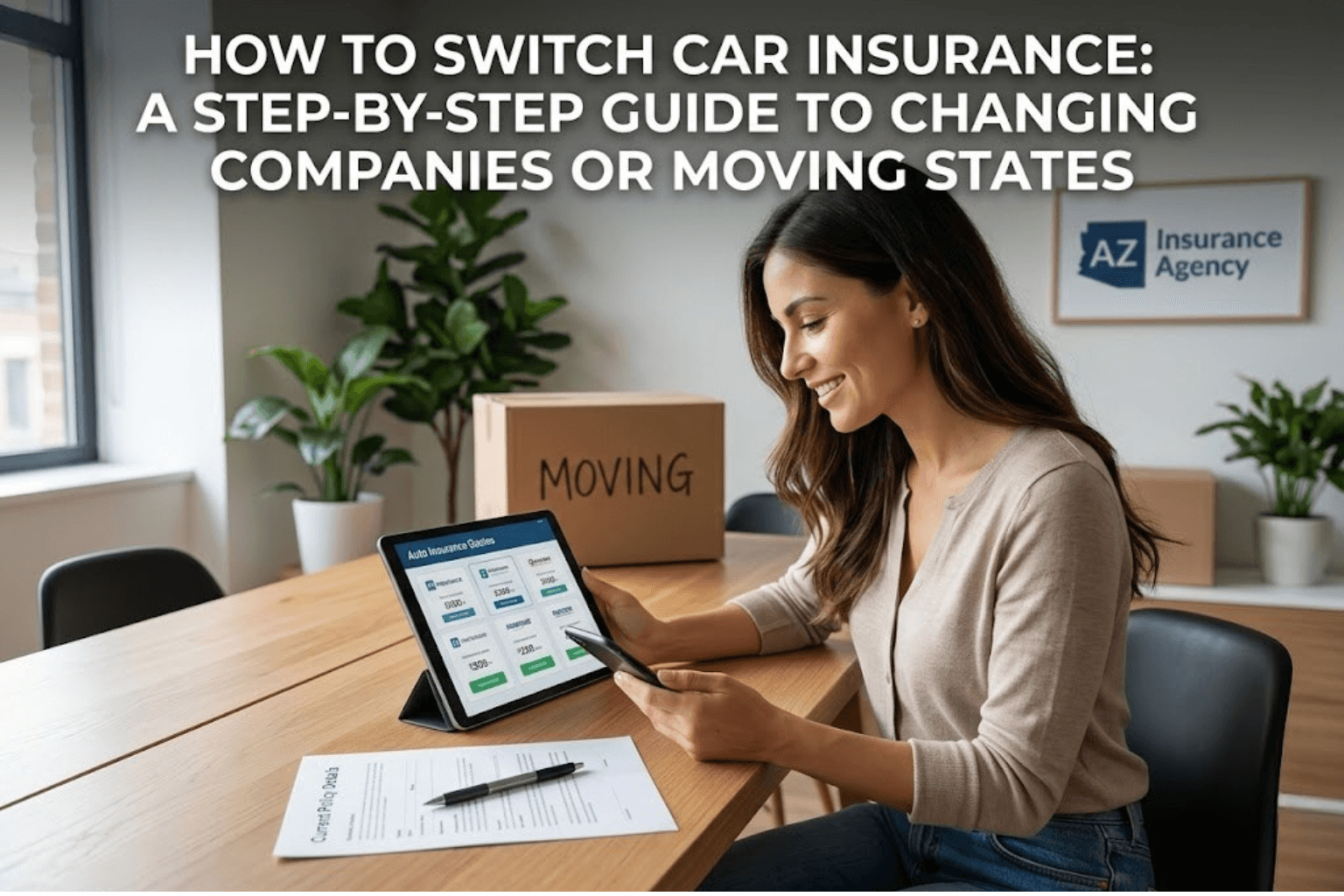
Quick Answer: Switching car insurance is straightforward: shop for a new policy, secure coverage before canceling your current one, then cancel your old policy and request any unused premium refund. You can switch at any time — you don't have to wait for your renewal date. If you're moving to another state, you typically have 30–90 days to register your vehicle and update your insurance to meet the new state requirements.
Whether your premium went up at renewal, you found a better rate, or you're relocating to Texas from another state, switching car insurance is easier than most drivers think. The key is doing it in the right order — so you're never caught without coverage, even for a single day.
In this step-by-step guide, we walk you through exactly how to switch car insurance companies easily, what to watch out for, and what to do if you're moving states and need to update your policy.
When Should You Switch Car Insurance?
You can switch car insurance at any time — mid-policy or at renewal. But some moments are better than others:
Good Time to Switch | Why It Makes Sense |
At renewal | No cancellation fees; seamless transition with no coverage gap |
After a premium increase | Rate hikes at renewal are the most common trigger for switching |
After a life change | Marriage, new vehicle, new home, or added driver can change your ideal carrier |
When moving to Texas from another state | New state = new requirements; you must update your policy regardless |
After improving your credit score | Better credit = lower premiums; a new carrier reflects your improved profile |
After comparing quotes and saving | If you find the same coverage for significantly less — switch |
Important: Switching mid-policy is completely fine. Most insurers will refund the unused portion of your premium on a pro-rated basis after you cancel. There is typically no penalty for canceling early, though some carriers charge a small flat fee.
How to Switch Car Insurance Companies Easily: Step by Step
Step | Action | Key Tips |
1 | Gather your current policy details | Have your declarations page ready — coverage types, limits, deductibles, and current premiums. This is your benchmark. |
2 | Shop and compare at least 3 quotes | Use the same coverage limits when comparing, so quotes are apples-to-apples. Don't just compare price — check the carrier's claims reputation too. |
3 | Check for discounts with the new carrier | Ask about bundling, safe driver, paid-in-full, paperless, and loyalty discounts. These can significantly lower your new premium. |
4 | Purchase your new policy FIRST | Never cancel your current policy until your new one is active. Even a one-day lapse in coverage can raise your rates with future insurers. |
5 | Set your new policy start date | Schedule the new policy to begin the same day or the day before you cancel the old one. Confirm the effective date of writing. |
6 | Cancel your old policy | Contact your current insurer by phone or in writing to cancel. Request written confirmation and ask about any pro-rated refund. |
7 | Update your lender or leasing company | If your car is financed or leased, your lender must be listed as a lienholder on the new policy. Notify them promptly. |
8 | Update your proof of insurance | Remove your old insurance card from your vehicle and replace it with the new one. Update your state registration if required. |
What to Compare When Switching Car Insurance
Price matters — but it shouldn't be your only consideration. When evaluating a new carrier, compare these factors side by side:
What to Compare | Why It Matters |
Coverage types and limits | Make sure the new policy matches or improves on your current coverage |
Deductible amounts | A lower premium with a much higher deductible may not be a real saving |
Claims satisfaction ratings | J.D. Power and AM Best ratings show how well an insurer handles claims |
Financial strength rating | AM Best A- or better means the insurer can pay claims reliably |
Available discounts | A new carrier may offer discounts your current one doesn't |
Cancellation policy | Check if the new carrier charges fees for mid-term cancellation |
Digital tools and app | Online claims filing, ID cards, and account management matter for convenience |
How to Switch Car Insurance to Another State
If you're moving to Texas from another state — or leaving Texas for a new state — your car insurance needs to be updated to reflect your new location. Here's what you need to know:
Step | Action | Timeframe |
1 | Notify your current insurer of your move | As soon as you have a new address |
2 | Get quotes for your new state's requirements | Before or immediately after moving |
3 | Purchase a policy that meets the new state's minimum requirements | Before your grace period expires |
4 | Register your vehicle in the new state | Within 30–90 days — varies by state |
5 | Update your driver's license to the new state | Within 30–90 days — varies by state |
6 | Cancel your old state policy once new coverage is active | Same day new policy starts |
Moving to Texas: What You Need to Know
If you're relocating to the Houston area, here are the Texas-specific steps to complete your insurance switch:
Texas requires minimum liability coverage of 30/60/25 — confirm your new policy meets this
You have 30 days from establishing Texas residency to obtain a Texas driver's license
Vehicle registration must be updated within 30 days of moving to Texas
Houston's urban density, hail exposure, and flood risk make comprehensive and collision coverage especially important — review your coverage levels when switching
If you're moving from a no-fault state to Texas (an at-fault state), your liability coverage becomes more critical — consider higher limits than your previous state required

Moving From Texas to Another State
Each state has a different minimum requirement. Before canceling your Texas policy, confirm:
The new state's minimum liability limits — some states require higher minimums than Texas
Whether your new state requires Personal Injury Protection (PIP) or no-fault coverage — Texas does not, but many states do
Whether your current carrier operates in your new state — if so, a simple transfer may be possible without shopping
Common Mistakes to Avoid When Switching Car Insurance
Mistake | Why It's a Problem |
Canceling your old policy before the new one starts | Even a one-day lapse counts as uninsured — raises future rates and leaves you exposed |
Only comparing price, not coverage | A cheaper policy with lower limits or higher deductibles may cost you more at claim time |
Forgetting to notify your lender | Lenders require proof of insurance — failure to update can trigger force-placed coverage |
Not asking for a refund on unused premium | You are entitled to a pro-rated refund for any unused coverage period after cancellation |
Switching too often | Some carriers penalize frequent switchers or exclude loyalty discounts — compare carefully |
Ignoring the carrier's claims reputation | A low premium with a poor claims process can be far more costly than a slightly higher premium elsewhere |
How Much Can You Save With Switching Car Insurance?
Savings vary widely depending on your profile, current carrier, and new carrier. However, research consistently shows that drivers who shop and switch can save significantly — especially if they haven't compared rates in 2+ years. Here are typical savings scenarios for Texas drivers:
Driver Profile | Potential Annual Savings by Switching |
Driver who hasn't shopped in 3+ years | $200 – $600/yr |
Driver whose rate increased after a ticket | $150 – $400/yr after ticket falls off record |
Driver who improved credit score significantly | $300 – $800/yr |
Driver who bundled auto + home with new carrier | $200 – $500/yr in bundle discounts |
Young driver added to parents' policy at wrong carrier | $500 – $1,500/yr by finding a youth-friendly carrier |
The only way to know your actual savings is to get quotes. At AZ Insurance Agency, we compare rates across multiple carriers — so you get the best available rate without spending hours on hold.
Frequently Asked Questions
Q1: How do I switch car insurance companies easily?
The easiest way to switch car insurance is to: (1) gather your current policy details, (2) get at least 3 quotes with identical coverage levels, (3) purchase your new policy first, (4) set the new policy start date, and (5) cancel your old policy on the same day. Never cancel before your new coverage is active and always request a pro-rated refund for unused premium.
Q2: Can I switch car insurance at any time or only at renewal?
You can switch car insurance at any time — you do not have to wait for your renewal date. Mid-policy switches are common and completely allowed. Most insurers will refund the unused portion of your premium on a pro-rated basis. Some carriers charge a small flat cancellation fee, but this is typically far less than the savings from switching.
Q3: How do I switch car insurance to another state?
When moving states, contact your current insurer to update your address, then get quotes that meet the new state's minimum requirements. Purchase the new policy before canceling the old one. In Texas, you have 30 days from establishing residency to update your driver's license and vehicle registration. Make sure your new policy reflects Texas's 30/60/25 minimum liability requirements.
Q4: Will switching car insurance affect my credit score?
Shopping car insurance quotes does not affect your credit score. Insurers use a 'soft pull' when quoting — not a hard inquiry like a loan application. You can get as many quotes as you want without any impact on your credit.
Q5: What happens to my old car insurance when I switch?
When you cancel your old policy, coverage stops on the cancellation date. If you've paid in advance, your insurer will issue a pro-rated refund for the unused period. Make sure to get written confirmation of the cancellation date and keep a copy of your records.
Q6: Is there a penalty for switching car insurance mid-policy?
Most car insurance companies do not charge a penalty for canceling mid-policy. Some may charge a small flat cancellation fee — typically $25 or less. Always check your policy terms before canceling. If your carrier does charge a fee, compare it against the savings your new policy offers — in most cases, switching still makes financial sense.
Ready to Switch? Get a Free Quote from AZ Insurance Agency
Switching car insurance is one of the easiest ways to save money without giving up coverage — and it takes less time than most drivers think. Whether you're switching companies in Houston or moving to Texas from another state, AZ Insurance Agency makes the process simple.
Our licensed agents compare rates across multiple carriers, explain your coverage options in plain language, and handle the details — in English and Spanish. With 15 locations, switching is as easy as stopping by or calling us today.
Quick Answer: Switching car insurance is straightforward: shop for a new policy, secure coverage before canceling your current one, then cancel your old policy and request any unused premium refund. You can switch at any time — you don't have to wait for your renewal date. If you're moving to another state, you typically have 30–90 days to register your vehicle and update your insurance to meet the new state requirements.
Whether your premium went up at renewal, you found a better rate, or you're relocating to Texas from another state, switching car insurance is easier than most drivers think. The key is doing it in the right order — so you're never caught without coverage, even for a single day.
In this step-by-step guide, we walk you through exactly how to switch car insurance companies easily, what to watch out for, and what to do if you're moving states and need to update your policy.
When Should You Switch Car Insurance?
You can switch car insurance at any time — mid-policy or at renewal. But some moments are better than others:
Good Time to Switch | Why It Makes Sense |
At renewal | No cancellation fees; seamless transition with no coverage gap |
After a premium increase | Rate hikes at renewal are the most common trigger for switching |
After a life change | Marriage, new vehicle, new home, or added driver can change your ideal carrier |
When moving to Texas from another state | New state = new requirements; you must update your policy regardless |
After improving your credit score | Better credit = lower premiums; a new carrier reflects your improved profile |
After comparing quotes and saving | If you find the same coverage for significantly less — switch |
Important: Switching mid-policy is completely fine. Most insurers will refund the unused portion of your premium on a pro-rated basis after you cancel. There is typically no penalty for canceling early, though some carriers charge a small flat fee.
How to Switch Car Insurance Companies Easily: Step by Step
Step | Action | Key Tips |
1 | Gather your current policy details | Have your declarations page ready — coverage types, limits, deductibles, and current premiums. This is your benchmark. |
2 | Shop and compare at least 3 quotes | Use the same coverage limits when comparing, so quotes are apples-to-apples. Don't just compare price — check the carrier's claims reputation too. |
3 | Check for discounts with the new carrier | Ask about bundling, safe driver, paid-in-full, paperless, and loyalty discounts. These can significantly lower your new premium. |
4 | Purchase your new policy FIRST | Never cancel your current policy until your new one is active. Even a one-day lapse in coverage can raise your rates with future insurers. |
5 | Set your new policy start date | Schedule the new policy to begin the same day or the day before you cancel the old one. Confirm the effective date of writing. |
6 | Cancel your old policy | Contact your current insurer by phone or in writing to cancel. Request written confirmation and ask about any pro-rated refund. |
7 | Update your lender or leasing company | If your car is financed or leased, your lender must be listed as a lienholder on the new policy. Notify them promptly. |
8 | Update your proof of insurance | Remove your old insurance card from your vehicle and replace it with the new one. Update your state registration if required. |
What to Compare When Switching Car Insurance
Price matters — but it shouldn't be your only consideration. When evaluating a new carrier, compare these factors side by side:
What to Compare | Why It Matters |
Coverage types and limits | Make sure the new policy matches or improves on your current coverage |
Deductible amounts | A lower premium with a much higher deductible may not be a real saving |
Claims satisfaction ratings | J.D. Power and AM Best ratings show how well an insurer handles claims |
Financial strength rating | AM Best A- or better means the insurer can pay claims reliably |
Available discounts | A new carrier may offer discounts your current one doesn't |
Cancellation policy | Check if the new carrier charges fees for mid-term cancellation |
Digital tools and app | Online claims filing, ID cards, and account management matter for convenience |
How to Switch Car Insurance to Another State
If you're moving to Texas from another state — or leaving Texas for a new state — your car insurance needs to be updated to reflect your new location. Here's what you need to know:
Step | Action | Timeframe |
1 | Notify your current insurer of your move | As soon as you have a new address |
2 | Get quotes for your new state's requirements | Before or immediately after moving |
3 | Purchase a policy that meets the new state's minimum requirements | Before your grace period expires |
4 | Register your vehicle in the new state | Within 30–90 days — varies by state |
5 | Update your driver's license to the new state | Within 30–90 days — varies by state |
6 | Cancel your old state policy once new coverage is active | Same day new policy starts |
Moving to Texas: What You Need to Know
If you're relocating to the Houston area, here are the Texas-specific steps to complete your insurance switch:
Texas requires minimum liability coverage of 30/60/25 — confirm your new policy meets this
You have 30 days from establishing Texas residency to obtain a Texas driver's license
Vehicle registration must be updated within 30 days of moving to Texas
Houston's urban density, hail exposure, and flood risk make comprehensive and collision coverage especially important — review your coverage levels when switching
If you're moving from a no-fault state to Texas (an at-fault state), your liability coverage becomes more critical — consider higher limits than your previous state required
Moving From Texas to Another State
Each state has a different minimum requirement. Before canceling your Texas policy, confirm:
The new state's minimum liability limits — some states require higher minimums than Texas
Whether your new state requires Personal Injury Protection (PIP) or no-fault coverage — Texas does not, but many states do
Whether your current carrier operates in your new state — if so, a simple transfer may be possible without shopping
Common Mistakes to Avoid When Switching Car Insurance
Mistake | Why It's a Problem |
Canceling your old policy before the new one starts | Even a one-day lapse counts as uninsured — raises future rates and leaves you exposed |
Only comparing price, not coverage | A cheaper policy with lower limits or higher deductibles may cost you more at claim time |
Forgetting to notify your lender | Lenders require proof of insurance — failure to update can trigger force-placed coverage |
Not asking for a refund on unused premium | You are entitled to a pro-rated refund for any unused coverage period after cancellation |
Switching too often | Some carriers penalize frequent switchers or exclude loyalty discounts — compare carefully |
Ignoring the carrier's claims reputation | A low premium with a poor claims process can be far more costly than a slightly higher premium elsewhere |
How Much Can You Save With Switching Car Insurance?
Savings vary widely depending on your profile, current carrier, and new carrier. However, research consistently shows that drivers who shop and switch can save significantly — especially if they haven't compared rates in 2+ years. Here are typical savings scenarios for Texas drivers:
Driver Profile | Potential Annual Savings by Switching |
Driver who hasn't shopped in 3+ years | $200 – $600/yr |
Driver whose rate increased after a ticket | $150 – $400/yr after ticket falls off record |
Driver who improved credit score significantly | $300 – $800/yr |
Driver who bundled auto + home with new carrier | $200 – $500/yr in bundle discounts |
Young driver added to parents' policy at wrong carrier | $500 – $1,500/yr by finding a youth-friendly carrier |
The only way to know your actual savings is to get quotes. At AZ Insurance Agency, we compare rates across multiple carriers — so you get the best available rate without spending hours on hold.
Frequently Asked Questions
Q1: How do I switch car insurance companies easily?
The easiest way to switch car insurance is to: (1) gather your current policy details, (2) get at least 3 quotes with identical coverage levels, (3) purchase your new policy first, (4) set the new policy start date, and (5) cancel your old policy on the same day. Never cancel before your new coverage is active and always request a pro-rated refund for unused premium.
Q2: Can I switch car insurance at any time or only at renewal?
You can switch car insurance at any time — you do not have to wait for your renewal date. Mid-policy switches are common and completely allowed. Most insurers will refund the unused portion of your premium on a pro-rated basis. Some carriers charge a small flat cancellation fee, but this is typically far less than the savings from switching.
Q3: How do I switch car insurance to another state?
When moving states, contact your current insurer to update your address, then get quotes that meet the new state's minimum requirements. Purchase the new policy before canceling the old one. In Texas, you have 30 days from establishing residency to update your driver's license and vehicle registration. Make sure your new policy reflects Texas's 30/60/25 minimum liability requirements.
Q4: Will switching car insurance affect my credit score?
Shopping car insurance quotes does not affect your credit score. Insurers use a 'soft pull' when quoting — not a hard inquiry like a loan application. You can get as many quotes as you want without any impact on your credit.
Q5: What happens to my old car insurance when I switch?
When you cancel your old policy, coverage stops on the cancellation date. If you've paid in advance, your insurer will issue a pro-rated refund for the unused period. Make sure to get written confirmation of the cancellation date and keep a copy of your records.
Q6: Is there a penalty for switching car insurance mid-policy?
Most car insurance companies do not charge a penalty for canceling mid-policy. Some may charge a small flat cancellation fee — typically $25 or less. Always check your policy terms before canceling. If your carrier does charge a fee, compare it against the savings your new policy offers — in most cases, switching still makes financial sense.
Ready to Switch? Get a Free Quote from AZ Insurance Agency
Switching car insurance is one of the easiest ways to save money without giving up coverage — and it takes less time than most drivers think. Whether you're switching companies in Houston or moving to Texas from another state, AZ Insurance Agency makes the process simple.
Our licensed agents compare rates across multiple carriers, explain your coverage options in plain language, and handle the details — in English and Spanish. With 15 locations, switching is as easy as stopping by or calling us today.
Latest Blogs

Hazard Insurance vs. Homeowners Insurance: What's the Difference?

Average Hazard Insurance Cost: What Homeowners Can Expect

What Is Home Hazard Insurance and What Does It Cover?

Certificate Holder or Additional Insured? The Difference That Decides Who Pays Your Defense

Does General Liability Cover Your Own Faulty Workmanship? What Texas Contractors Get Wrong

Buying a Car in Houston? What Insurance You Need Before You Drive Off the Lot
Let A-Z Auto Insurance Help You Find Affordable Coverage
Connect with our experienced team today & get reliable, affordable insurance designed around your needs.
Contact Us!
Let A-Z Auto Insurance Help
You Find Affordable Coverage
Connect with our experienced team today & get reliable, affordable insurance designed around your needs.
Contact Us!
Let A-Z Auto
Insurance Help You
Find Affordable Coverage
Connect with our experienced team today & get reliable, affordable insurance designed around your needs.
Contact Us!
Let A-Z Auto Insurance Help
You Find Affordable Coverage
Connect with our experienced team today & get reliable, affordable insurance designed around your needs.
Contact Us!
Latest New & Blogs
Latest New & Blogs
Related Blog Posts
Related Blog Posts
What Is Home Hazard Insurance and What Does It Cover?
Learn what home hazard insurance is, what it covers in TX, & what's left out. See how AZ Insurance Agency helps Houston homeowners close the gaps.
What Is Home Hazard Insurance and What Does It Cover?
Learn what home hazard insurance is, what it covers in TX, & what's left out. See how AZ Insurance Agency helps Houston homeowners close the gaps.
What Is Home Hazard Insurance and What Does It Cover?
Learn what home hazard insurance is, what it covers in TX, & what's left out. See how AZ Insurance Agency helps Houston homeowners close the gaps.
Certificate Holder or Additional Insured? The Difference That Decides Who Pays Your Defense
One is a name on a form. The other is coverage under someone else's policy. Here is how Texas contractors tell them apart before a claim decides it for them.
Certificate Holder or Additional Insured? The Difference That Decides Who Pays Your Defense
One is a name on a form. The other is coverage under someone else's policy. Here is how Texas contractors tell them apart before a claim decides it for them.
Certificate Holder or Additional Insured? The Difference That Decides Who Pays Your Defense
One is a name on a form. The other is coverage under someone else's policy. Here is how Texas contractors tell them apart before a claim decides it for them.
Does General Liability Cover Your Own Faulty Workmanship? What Texas Contractors Get Wrong
Your policy will not pay to redo the work you got wrong. In Texas it may still pay for the damage that work caused. Here is exactly where the line sits.
Does General Liability Cover Your Own Faulty Workmanship? What Texas Contractors Get Wrong
Your policy will not pay to redo the work you got wrong. In Texas it may still pay for the damage that work caused. Here is exactly where the line sits.
Does General Liability Cover Your Own Faulty Workmanship? What Texas Contractors Get Wrong
Your policy will not pay to redo the work you got wrong. In Texas it may still pay for the damage that work caused. Here is exactly where the line sits.
What Is Home Hazard Insurance and What Does It Cover?
Learn what home hazard insurance is, what it covers in TX, & what's left out. See how AZ Insurance Agency helps Houston homeowners close the gaps.
Certificate Holder or Additional Insured? The Difference That Decides Who Pays Your Defense
One is a name on a form. The other is coverage under someone else's policy. Here is how Texas contractors tell them apart before a claim decides it for them.